A form asking for a “country code” may want two letters, while a telephone needs digits and a website uses a domain ending. These systems often refer to the same place but do different jobs. Choose the system first, then look up the identifier.
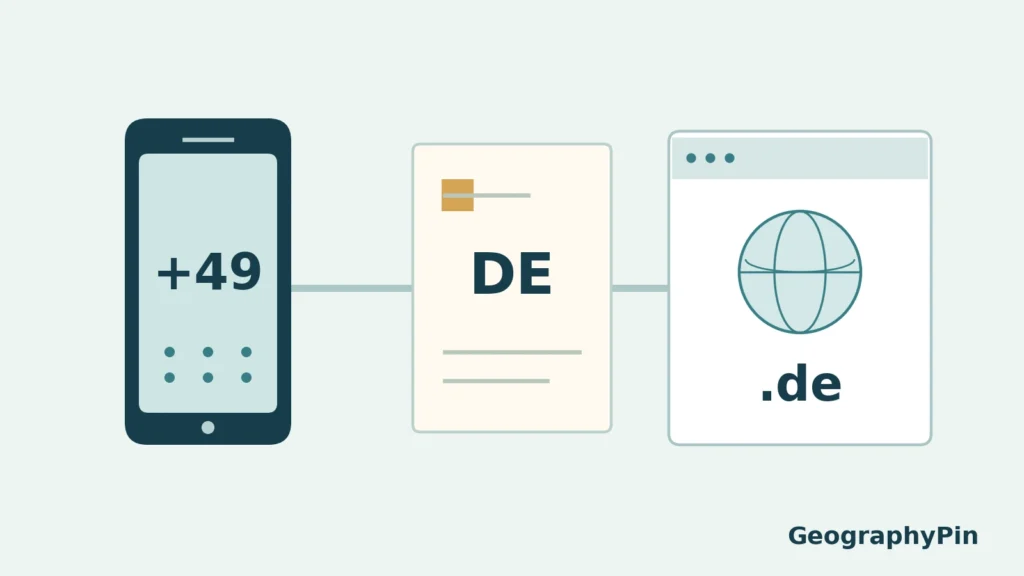
A country code can mean an international telephone prefix, an ISO identifier, an internet country-code domain, or a mobile-network identifier. Germany, for example, uses +49 for international calls, DE and DEU in ISO 3166-1, and .de online. These codes are not interchangeable, and some telephone prefixes are shared by several places.
1. Which country-code system do you need?
Check the label or instructions rather than guessing from the word “country.” A telephone field commonly expects a plus sign followed by digits. A database field may specify ISO alpha-2 or alpha-3. An internet-domain question concerns the suffix after the final dot, while a mobile-network field refers to a separate technical numbering system.
The organizations responsible are different too: the International Telecommunication Union’s E.164 framework covers international telephone numbering, ISO 3166 provides standardized country identifiers, and IANA’s Root Zone Database records top-level domains. Mobile network identification uses ITU E.212.
Identifying a place in one system does not establish that it is a sovereign state. Territories and other separately coded areas can have their own identifiers, and each system has its own coverage and exceptions.
2. Compare country and area codes
This reference covers the 193 UN member states plus the Holy See and the State of Palestine, with eight additional separately coded areas marked “area”: Bermuda, the Faroe Islands, Gibraltar, Greenland, Guam, Hong Kong, Macao, and Puerto Rico. It is not a complete list of ISO entries, telephone allocations, or internet domains.
The domain column shows one Latin-letter country-code top-level domain (ccTLD) per entry, not internationalized domain names. Telephone entries distinguish the shared +1 calling code from its area codes. Links on calling prefixes lead to the primary numbering reference; domain links open the corresponding IANA record.
Search the table by country or area name, calling prefix, ISO code, or domain. All 203 entries belong to this reference; use the table controls to explore the results.
Country and selected-area code reference
| Country or area | Calling prefix | ISO alpha-2 | ISO alpha-3 | Latin ccTLD | Notes |
|---|---|---|---|---|---|
| Afghanistan | +93 | AF | AFG | .af | — |
| Albania | +355 | AL | ALB | .al | — |
| Algeria | +213 | DZ | DZA | .dz | — |
| Andorra | +376 | AD | AND | .ad | — |
| Angola | +244 | AO | AGO | .ao | — |
| Antigua and Barbuda | +1 Area: 268 | AG | ATG | .ag | Shared +1 plan; area code(s): 268 |
| Argentina | +54 | AR | ARG | .ar | — |
| Armenia | +374 | AM | ARM | .am | — |
| Australia | +61 | AU | AUS | .au | — |
| Austria | +43 | AT | AUT | .at | — |
| Azerbaijan | +994 | AZ | AZE | .az | — |
| Bahamas | +1 Area: 242 | BS | BHS | .bs | Shared +1 plan; area code(s): 242 |
| Bahrain | +973 | BH | BHR | .bh | — |
| Bangladesh | +880 | BD | BGD | .bd | — |
| Barbados | +1 Area: 246 | BB | BRB | .bb | Shared +1 plan; area code(s): 246 |
| Belarus | +375 | BY | BLR | .by | — |
| Belgium | +32 | BE | BEL | .be | — |
| Belize | +501 | BZ | BLZ | .bz | — |
| Benin | +229 | BJ | BEN | .bj | — |
| Bermuda (area) | +1 Area: 441 | BM | BMU | .bm | Shared +1 plan; area code(s): 441 |
| Bhutan | +975 | BT | BTN | .bt | — |
| Bolivia | +591 | BO | BOL | .bo | — |
| Bosnia and Herzegovina | +387 | BA | BIH | .ba | — |
| Botswana | +267 | BW | BWA | .bw | — |
| Brazil | +55 | BR | BRA | .br | — |
| Brunei | +673 | BN | BRN | .bn | — |
| Bulgaria | +359 | BG | BGR | .bg | — |
| Burkina Faso | +226 | BF | BFA | .bf | — |
| Burundi | +257 | BI | BDI | .bi | — |
| Cabo Verde | +238 | CV | CPV | .cv | — |
| Cambodia | +855 | KH | KHM | .kh | — |
| Cameroon | +237 | CM | CMR | .cm | — |
| Canada | +1 | CA | CAN | .ca | Shared +1 numbering plan; an area code is also required. |
| Central African Republic | +236 | CF | CAF | .cf | — |
| Chad | +235 | TD | TCD | .td | — |
| Chile | +56 | CL | CHL | .cl | — |
| China | +86 | CN | CHN | .cn | — |
| Colombia | +57 | CO | COL | .co | — |
| Comoros | +269 | KM | COM | .km | — |
| Costa Rica | +506 | CR | CRI | .cr | — |
| Croatia | +385 | HR | HRV | .hr | — |
| Cuba | +53 | CU | CUB | .cu | — |
| Cyprus | +357 | CY | CYP | .cy | — |
| Czechia | +420 | CZ | CZE | .cz | — |
| Côte d’Ivoire | +225 | CI | CIV | .ci | — |
| Democratic Republic of the Congo | +243 | CD | COD | .cd | — |
| Denmark | +45 | DK | DNK | .dk | — |
| Djibouti | +253 | DJ | DJI | .dj | — |
| Dominica | +1 Area: 767 | DM | DMA | .dm | Shared +1 plan; area code(s): 767 |
| Dominican Republic | +1 Area: 809, 829, 849 | DO | DOM | .do | Shared +1 plan; area code(s): 809, 829, 849 |
| Ecuador | +593 | EC | ECU | .ec | — |
| Egypt | +20 | EG | EGY | .eg | — |
| El Salvador | +503 | SV | SLV | .sv | — |
| Equatorial Guinea | +240 | GQ | GNQ | .gq | — |
| Eritrea | +291 | ER | ERI | .er | — |
| Estonia | +372 | EE | EST | .ee | — |
| Eswatini | +268 | SZ | SWZ | .sz | — |
| Ethiopia | +251 | ET | ETH | .et | — |
| Faroe Islands (area) | +298 | FO | FRO | .fo | — |
| Fiji | +679 | FJ | FJI | .fj | — |
| Finland | +358 | FI | FIN | .fi | — |
| France | +33 | FR | FRA | .fr | — |
| Gabon | +241 | GA | GAB | .ga | — |
| Gambia | +220 | GM | GMB | .gm | — |
| Georgia | +995 | GE | GEO | .ge | — |
| Germany | +49 | DE | DEU | .de | — |
| Ghana | +233 | GH | GHA | .gh | — |
| Gibraltar (area) | +350 | GI | GIB | .gi | — |
| Greece | +30 | GR | GRC | .gr | — |
| Greenland (area) | +299 | GL | GRL | .gl | — |
| Grenada | +1 Area: 473 | GD | GRD | .gd | Shared +1 plan; area code(s): 473 |
| Guam (area) | +1 Area: 671 | GU | GUM | .gu | Shared +1 plan; area code(s): 671 |
| Guatemala | +502 | GT | GTM | .gt | — |
| Guinea | +224 | GN | GIN | .gn | — |
| Guinea-Bissau | +245 | GW | GNB | .gw | — |
| Guyana | +592 | GY | GUY | .gy | — |
| Haiti | +509 | HT | HTI | .ht | — |
| Honduras | +504 | HN | HND | .hn | — |
| Hong Kong (area) | +852 | HK | HKG | .hk | — |
| Hungary | +36 | HU | HUN | .hu | — |
| Iceland | +354 | IS | ISL | .is | — |
| India | +91 | IN | IND | .in | — |
| Indonesia | +62 | ID | IDN | .id | — |
| Iran | +98 | IR | IRN | .ir | — |
| Iraq | +964 | IQ | IRQ | .iq | — |
| Ireland | +353 | IE | IRL | .ie | — |
| Israel | +972 | IL | ISR | .il | — |
| Italy | +39 | IT | ITA | .it | — |
| Jamaica | +1 Area: 876, 658 | JM | JAM | .jm | Shared +1 plan; area code(s): 876, 658 |
| Japan | +81 | JP | JPN | .jp | — |
| Jordan | +962 | JO | JOR | .jo | — |
| Kazakhstan | +7 | KZ | KAZ | .kz | Shares country calling code +7. |
| Kenya | +254 | KE | KEN | .ke | — |
| Kiribati | +686 | KI | KIR | .ki | — |
| Kuwait | +965 | KW | KWT | .kw | — |
| Kyrgyzstan | +996 | KG | KGZ | .kg | — |
| Laos | +856 | LA | LAO | .la | — |
| Latvia | +371 | LV | LVA | .lv | — |
| Lebanon | +961 | LB | LBN | .lb | — |
| Lesotho | +266 | LS | LSO | .ls | — |
| Liberia | +231 | LR | LBR | .lr | — |
| Libya | +218 | LY | LBY | .ly | — |
| Liechtenstein | +423 | LI | LIE | .li | — |
| Lithuania | +370 | LT | LTU | .lt | — |
| Luxembourg | +352 | LU | LUX | .lu | — |
| Macao (area) | +853 | MO | MAC | .mo | — |
| Madagascar | +261 | MG | MDG | .mg | — |
| Malawi | +265 | MW | MWI | .mw | — |
| Malaysia | +60 | MY | MYS | .my | — |
| Maldives | +960 | MV | MDV | .mv | — |
| Mali | +223 | ML | MLI | .ml | — |
| Malta | +356 | MT | MLT | .mt | — |
| Marshall Islands | +692 | MH | MHL | .mh | — |
| Mauritania | +222 | MR | MRT | .mr | — |
| Mauritius | +230 | MU | MUS | .mu | — |
| Mexico | +52 | MX | MEX | .mx | — |
| Micronesia | +691 | FM | FSM | .fm | — |
| Moldova | +373 | MD | MDA | .md | — |
| Monaco | +377 | MC | MCO | .mc | — |
| Mongolia | +976 | MN | MNG | .mn | — |
| Montenegro | +382 | ME | MNE | .me | — |
| Morocco | +212 | MA | MAR | .ma | — |
| Mozambique | +258 | MZ | MOZ | .mz | — |
| Myanmar | +95 | MM | MMR | .mm | — |
| Namibia | +264 | NA | NAM | .na | — |
| Naoero (Nauru) | +674 | NR | NRU | .nr | — |
| Nepal | +977 | NP | NPL | .np | — |
| Netherlands | +31 | NL | NLD | .nl | — |
| New Zealand | +64 | NZ | NZL | .nz | — |
| Nicaragua | +505 | NI | NIC | .ni | — |
| Niger | +227 | NE | NER | .ne | — |
| Nigeria | +234 | NG | NGA | .ng | — |
| North Korea | +850 | KP | PRK | .kp | — |
| North Macedonia | +389 | MK | MKD | .mk | — |
| Norway | +47 | NO | NOR | .no | — |
| Oman | +968 | OM | OMN | .om | — |
| Pakistan | +92 | PK | PAK | .pk | — |
| Palau | +680 | PW | PLW | .pw | — |
| Palestine | +970 | PS | PSE | .ps | Assigned +970. ITU communication dated 1 October 2024 states implementation was not complete; check the intended number and provider before dialing. |
| Panama | +507 | PA | PAN | .pa | — |
| Papua New Guinea | +675 | PG | PNG | .pg | — |
| Paraguay | +595 | PY | PRY | .py | — |
| Peru | +51 | PE | PER | .pe | — |
| Philippines | +63 | PH | PHL | .ph | — |
| Poland | +48 | PL | POL | .pl | — |
| Portugal | +351 | PT | PRT | .pt | — |
| Puerto Rico (area) | +1 Area: 787, 939 | PR | PRI | .pr | Shared +1 plan; area code(s): 787, 939 |
| Qatar | +974 | QA | QAT | .qa | — |
| Republic of the Congo | +242 | CG | COG | .cg | — |
| Romania | +40 | RO | ROU | .ro | — |
| Russia | +7 | RU | RUS | .ru | Shares country calling code +7. |
| Rwanda | +250 | RW | RWA | .rw | — |
| Saint Kitts and Nevis | +1 Area: 869 | KN | KNA | .kn | Shared +1 plan; area code(s): 869 |
| Saint Lucia | +1 Area: 758 | LC | LCA | .lc | Shared +1 plan; area code(s): 758 |
| Saint Vincent and the Grenadines | +1 Area: 784 | VC | VCT | .vc | Shared +1 plan; area code(s): 784 |
| Samoa | +685 | WS | WSM | .ws | — |
| San Marino | +378 | SM | SMR | .sm | — |
| Saudi Arabia | +966 | SA | SAU | .sa | — |
| Senegal | +221 | SN | SEN | .sn | — |
| Serbia | +381 | RS | SRB | .rs | — |
| Seychelles | +248 | SC | SYC | .sc | — |
| Sierra Leone | +232 | SL | SLE | .sl | — |
| Singapore | +65 | SG | SGP | .sg | — |
| Slovakia | +421 | SK | SVK | .sk | — |
| Slovenia | +386 | SI | SVN | .si | — |
| Solomon Islands | +677 | SB | SLB | .sb | — |
| Somalia | +252 | SO | SOM | .so | — |
| South Africa | +27 | ZA | ZAF | .za | — |
| South Korea | +82 | KR | KOR | .kr | — |
| South Sudan | +211 | SS | SSD | .ss | — |
| Spain | +34 | ES | ESP | .es | — |
| Sri Lanka | +94 | LK | LKA | .lk | — |
| Sudan | +249 | SD | SDN | .sd | — |
| Suriname | +597 | SR | SUR | .sr | — |
| Sweden | +46 | SE | SWE | .se | — |
| Switzerland | +41 | CH | CHE | .ch | — |
| Syria | +963 | SY | SYR | .sy | — |
| São Tomé and Príncipe | +239 | ST | STP | .st | — |
| Tajikistan | +992 | TJ | TJK | .tj | — |
| Tanzania | +255 | TZ | TZA | .tz | — |
| Thailand | +66 | TH | THA | .th | — |
| Timor-Leste | +670 | TL | TLS | .tl | — |
| Togo | +228 | TG | TGO | .tg | — |
| Tonga | +676 | TO | TON | .to | — |
| Trinidad and Tobago | +1 Area: 868 | TT | TTO | .tt | Shared +1 plan; area code(s): 868 |
| Tunisia | +216 | TN | TUN | .tn | — |
| Turkmenistan | +993 | TM | TKM | .tm | — |
| Tuvalu | +688 | TV | TUV | .tv | — |
| Türkiye | +90 | TR | TUR | .tr | — |
| Uganda | +256 | UG | UGA | .ug | — |
| Ukraine | +380 | UA | UKR | .ua | — |
| United Arab Emirates | +971 | AE | ARE | .ae | — |
| United Kingdom | +44 | GB | GBR | .uk | ISO GB/GBR; Internet .uk, not .gb. |
| United States | +1 | US | USA | .us | Shared +1 numbering plan; an area code is also required. |
| Uruguay | +598 | UY | URY | .uy | — |
| Uzbekistan | +998 | UZ | UZB | .uz | — |
| Vanuatu | +678 | VU | VUT | .vu | — |
| Vatican City (Holy See) | +39 | VA | VAT | .va | Practical Vatican telephone access uses +39; do not substitute +379. |
| Venezuela | +58 | VE | VEN | .ve | — |
| Vietnam | +84 | VN | VNM | .vn | — |
| Yemen | +967 | YE | YEM | .ye | — |
| Zambia | +260 | ZM | ZMB | .zm | — |
| Zimbabwe | +263 | ZW | ZWE | .zw | — |
A listed calling code is not a guarantee that every number is reachable. Use the full number supplied by the recipient and check the numbering-plan notes, particularly where implementation is changing.
3. International calling codes
Country calling code versus access and area codes
The plus sign represents international dialing format; it is not itself one of the code’s digits. When entering a number on a device that accepts this format, keep the recipient’s complete international number. The international access prefix used from a particular network is a separate matter: 00 and 011 are not universal country codes.
Do not automatically remove every zero after the calling code. National numbering plans differ, and an incorrect shortcut can change the number. The ITU national numbering-plan directory links to the country-specific information.
The United States and Canada share +1 with other participants in the North American Numbering Plan. In +1 242, for example, +1 is the country calling code and 242 identifies the Bahamas within that plan. Treating +1242 as an independent four-digit country code hides this structure. The North American Numbering Plan Administrator explains the shared arrangement.
4. ISO codes and internet domains
DE, CH, and SE are not telephone prefixes
ISO alpha-2 uses two letters and alpha-3 uses three. Germany is DE/DEU, Switzerland CH/CHE, and Sweden SE/SWE. The three-letter value is not reliably formed by adding a letter to the two-letter one. Use the specified identifier exactly, particularly when importing data or completing a form.
The table’s ISO columns come from the UN Statistics Division’s country-and-area table, which publishes ISO alpha-2 and alpha-3 alongside its own statistical codes. ISO’s browsing platform is the direct reference for the standard and its changes.
A domain ending has its own registration rules
Many Latin-letter ccTLDs resemble ISO alpha-2 codes, but they should not be generated by simply placing a dot before those letters. The United Kingdom is GB/GBR in ISO but uses .uk online. IANA’s .gb record says that .gb is reserved and may not be used.
A root-database entry describes a domain’s delegation, not a promise that anyone can register under it. Registry eligibility and registration rules require separate checking. This table also does not attempt to list every internationalized domain written in other scripts.
5. Mobile country codes identify networks
MCC and MNC are not the number you dial
Under ITU E.212, a mobile country code (MCC) has three digits and a mobile network code (MNC) has two or three. Together they identify a network within the numbering system used for subscriber identification. They do not replace an international telephone calling code.
The word “country” can be misleading here: international and shared assignments also exist. A home-network identifier is not a reliable statement of where a phone is physically located while roaming. For that reason, this page explains MCC/MNC but does not present a short list of examples as a complete network-assignment register.
6. Shared codes and important exceptions
Shared calling codes: +1 serves multiple countries and areas; Russia and Kazakhstan share +7. A calling prefix alone therefore cannot always identify a unique country.
The Holy See and Vatican City: official Vatican contact numbers use +39. The table follows that practical telephone information, rather than presenting +379 as a prefix to use for those contacts.
State of Palestine: +970 is assigned, but an ITU communication dated October 1, 2024 states that implementation was not complete. That dated notice is not a live routing check; confirm the intended number and its provider before making a call.
Names and codes: a change in a country’s name need not change all of its identifiers. Naoero is also widely known as Nauru; the table includes both names for recognition. Different code systems update through their own processes rather than as one synchronized list.
What Did We Learn Today?
Start with the system, not just the country name. Calling prefixes, ISO letters, internet domains, and mobile-network identifiers answer different questions. Shared prefixes, separately coded areas, and exceptions such as GB versus .uk make source checking more reliable than guessing.
Sources & Data Notes
The table combines separately maintained numbering and identifier systems. Its scope is 195 entries under the UN-member-plus-observer convention and eight selected additional areas, not an exhaustive sovereignty or code-allocation list. Data were checked against the linked primary records in November 2026; assignments and implementation can change. Calling-prefix links retain individual source records. Domain coverage is Latin-letter ccTLDs only.
- ITU national numbering plans: telephone assignments and linked national communications.
- UNSD country and area identifiers: ISO alpha-2 and alpha-3 lookup values.
- ISO 3166: purpose, formats, and direct browsing reference.
- IANA Root Zone Database: individual domain records and exceptions.
- NANPA: shared +1 numbering structure.
- Holy See: useful information: practical +39 contact numbers.
- ITU E.212: mobile-network and subscription identification.
- UN member states and observer states: the core collection convention.