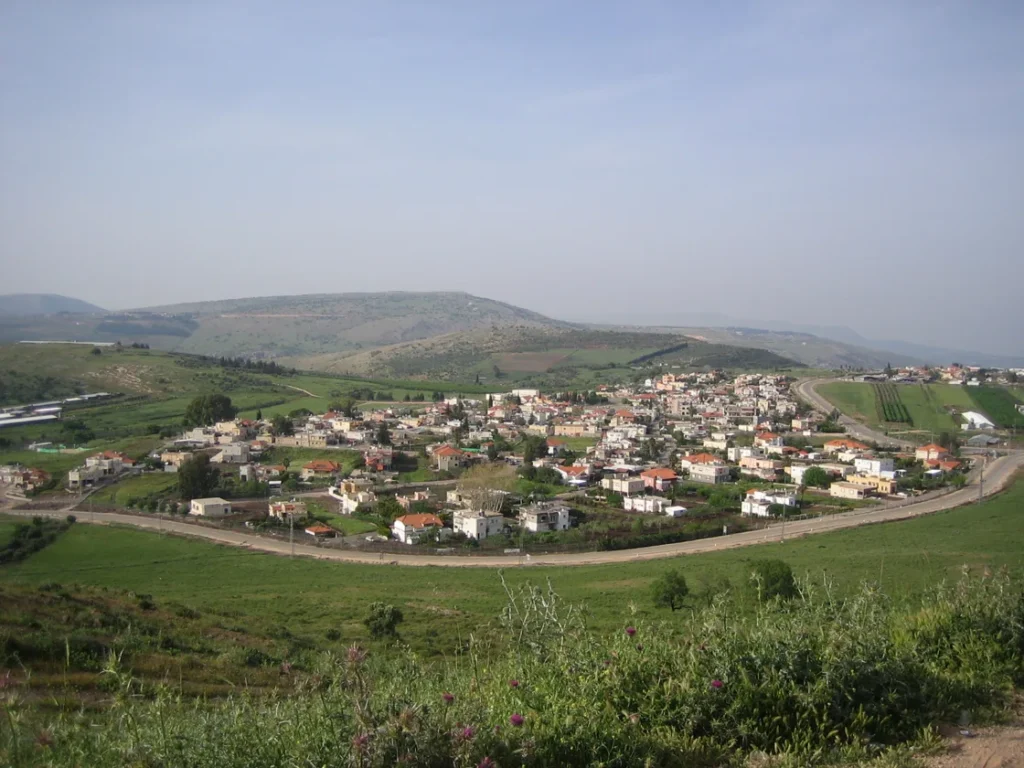
North of Safed, the village in the opening photograph is Rehaniya. Farther south, between Mount Tabor and the Sea of Galilee, is Kfar Kama. The two villages share a language whose roots lie far beyond Galilee, near the eastern shore of the Black Sea.
Circassians in Israel descend from people forced out of the northwestern Caucasus during the Russian Empire’s conquest in the nineteenth century. Some refugees resettled in Ottoman Galilee, where Kfar Kama and Rehaniya took root. Their descendants still use Circassian, also called Adyghe, though how people speak and write it varies by household and setting.
How to use this article: Read why families left the Caucasus, see how Kfar Kama uses its old mill, or learn what Rehaniya’s street names remember.
1. From the Caucasus to Ottoman Galilee
From Black Sea Communities to Exile
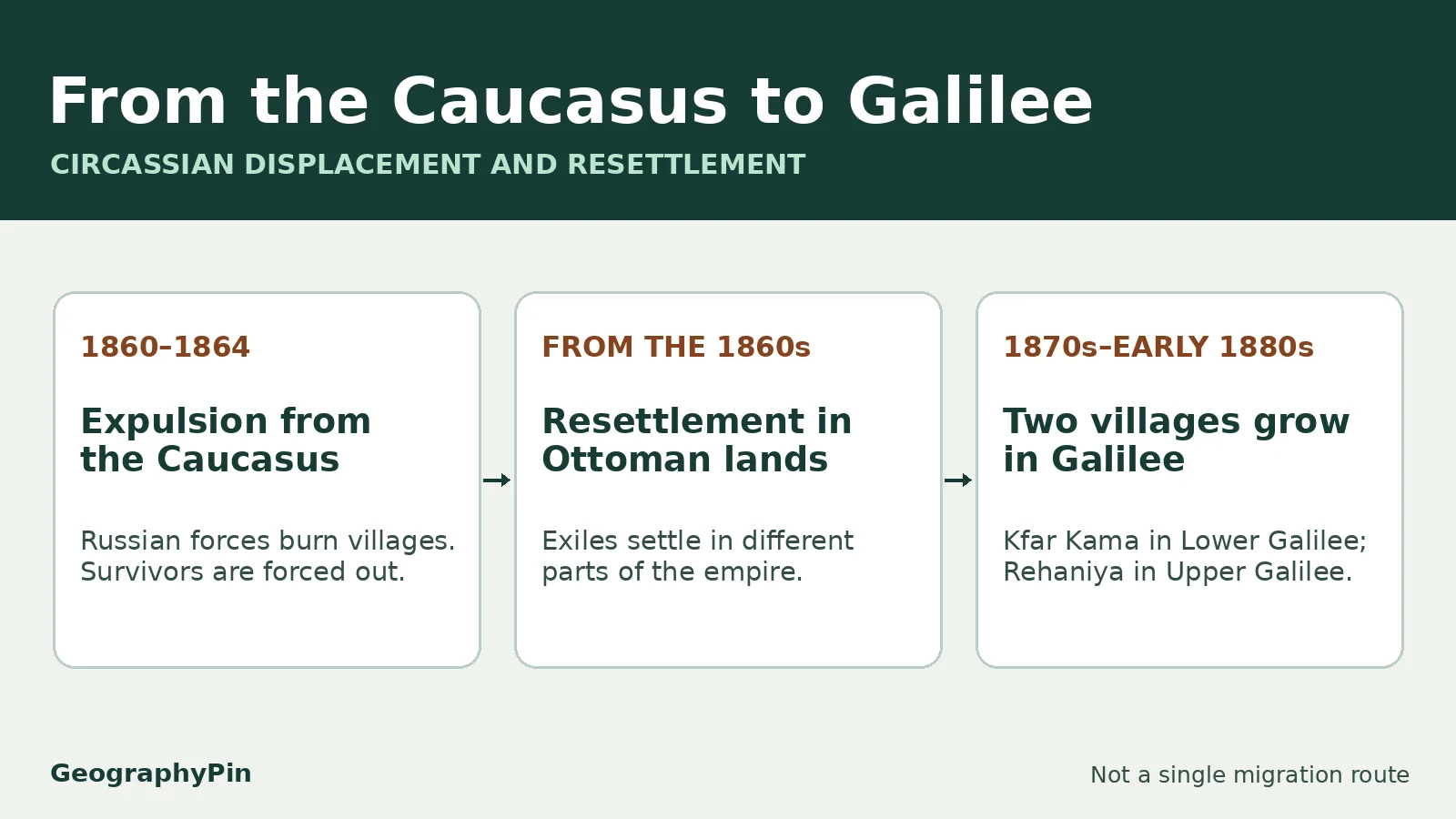
The Circassians, who also call themselves Adyghe, come from the northwestern Caucasus. In the last years of the Russian Empire’s conquest, Russian forces burned villages and expelled survivors. Many found refuge in the Ottoman Empire. The conquest ended in 1864; May 21 marks a day of mourning for the killings and exile that the Kfar Kama heritage center commemorates as the Circassian genocide.

Why Galilee Was One Destination
Most Circassian refugees did not end up in Galilee. Ottoman authorities settled families across the empire. Historians Roy Fischel and Ruth Kark connect settlement in Palestine to two concerns: where to house refugees and how to strengthen Ottoman authority in areas where local groups held power. A village in Galilee was one outcome of that policy, not the first or only stop for an entire people.
The National Library of Israel dates Kfar Kama’s old village to 1878. Fischel and Kark place the establishment of Rehaniya between 1876 and 1881; a municipal conservation study uses a broader range, 1870 to 1885. Rehaniya and Kfar Kama are now the two main Circassian villages in Israel. A third settlement near Hadera did not last, according to the National Library.
2. Two Villages, Two Ways to Keep a History
Kfar Kama: From Flour Mill to Heritage Center
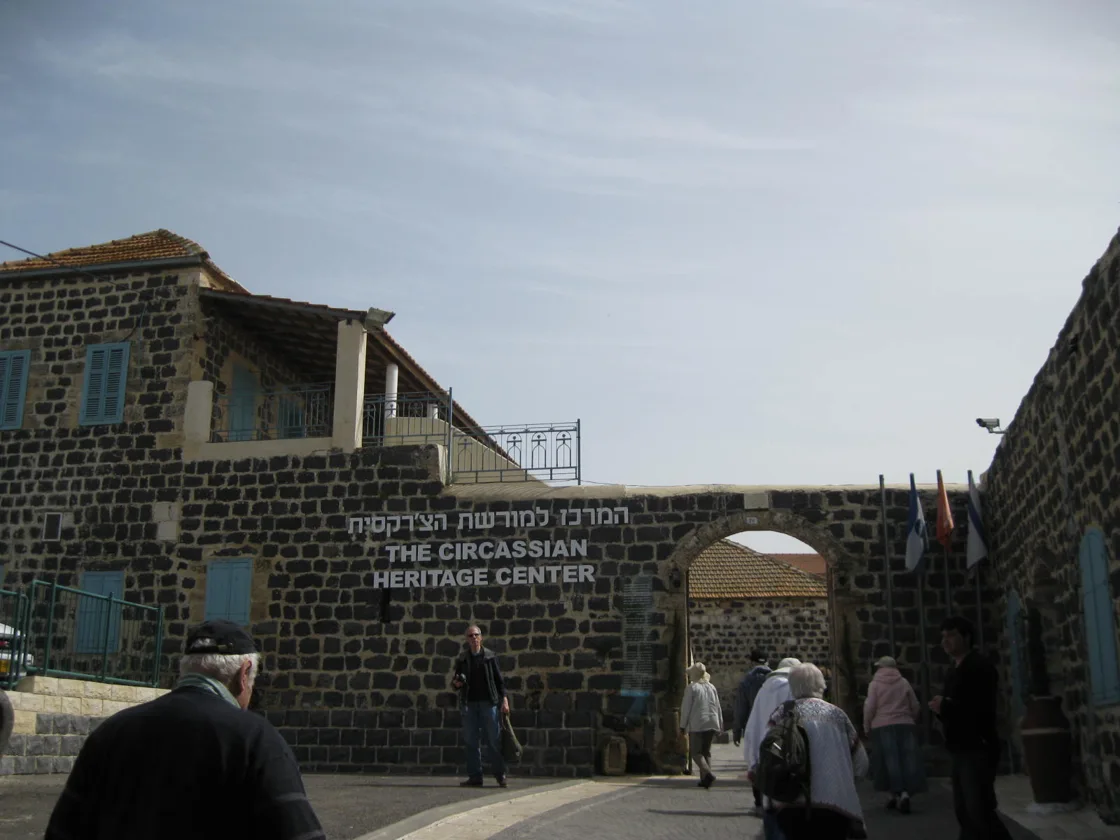
Kfar Kama is in Lower Galilee. Its heritage center occupies Shami’s House, a late Ottoman-era compound with a flour mill. The mill once drew customers outside the village. It now makes the community’s history accessible to people who do not speak Circassian: the center displays Russian archival documents alongside excerpts translated into Hebrew, English and Arabic.
Rehaniya: Remembering the Caucasus in Street Names
Rehaniya is in Upper Galilee, north of Safed. In May 2023, the Merom HaGalil Regional Council unanimously approved a set of street names for a new neighborhood there. In introducing the names, the council director pointed out a Caucasus river and a woman he described as having founded a school for Circassian children. The record shows what the council chose to remember, not when every street sign went up.
Rehaniya’s older streets tell a different part of the story. The village conservation plan describes a walled core with north and south entrances, houses built side by side and a mosque beside the central open space. The old plan organized a place to live and gather; the 2023 street decision used a new part of the village to keep ties to the past visible.
3. Where Circassian Fits in Daily Life
From a Kitchen Table to a Shop Counter
In Kfar Kama, dairy owner Sara Thakoo told journalist Diana Bletter in 2025 that she speaks Circassian with her children and with some customers. When she writes her grocery list, however, she switches to Hebrew. In Rehaniya, local guide Hani Madaji described parents speaking Circassian with their children as an ordinary part of family life in a 2022 interview. He also pointed out distinct family symbols on a sign near the old village mosque.
These are individual accounts, but they match a distinction that language researchers found in Rehaniya: speakers chose a language according to whom they were talking to and what they needed to do. Circassian was a home language among participants; Arabic, Hebrew and English served different roles. That fieldwork recorded Arabic-medium schooling there at the time. It should not be read as a statement about the language of instruction in every classroom today.
Frequently Asked Questions
How are Kfar Kama and Rehaniya spelled?
Kfar Kama can also appear as Kfar Kamma or Kafr Kama. Rehaniya also appears as Rihaniya or Reihaniya. Those are different ways of writing the same two place names in the Latin alphabet, not separate villages.
Which languages do residents use?
Accounts from the villages document spoken Circassian, Hebrew in public and written settings, Arabic in religious and other contexts, and English in school or some social settings. There is no rule that each person speaks all four or uses them for the same things.
What Did We Learn Today?
Russian conquest separated Circassian families from their homeland, and Ottoman resettlement brought some to Galilee. Kfar Kama and Rehaniya keep that history visible in different ways, from a former flour mill to new street names. The language also survives in ordinary conversations, even as speakers switch to other languages for other parts of their lives.
Sources & Data Notes
View the historical sources, interviews and photo credits
The founding dates are not equally precise. The timeline uses a range rather than assigning both villages a common year. The two interviews document individual practice, not a survey of present-day language use.
- National Library of Israel, The Circassians in Israel, for expulsion and settlement; Roy Fischel and Ruth Kark, Sultan Abdülhamid II and Palestine, for Ottoman policy and the Rehaniya date range.
- Rehaniya conservation appendix, 2020, on the original village plan, and Merom HaGalil council minutes, May 28, 2023, page 5, item 4, for the vote and street names.
- Circassian Heritage Center, Kfar Kama, for Shami’s House, the flour mill, archival exhibits and commemoration.
- Diana Bletter’s interviews with Sara Thakoo in Kfar Kama (2025) and Hani Madaji in Rehaniya (2022); Elite Olshtain and Frieda Nissim-Amitai, Language choice in a multicultural society, for historical fieldwork in Rehaniya.
- Cover: Sesetsik’u, Rehaniya (2006), released into the public domain, resized and converted to WebP. Center entrance: DiggerDina, Kfar Kama (2012), resized and converted to WebP, original and web copy under CC BY-SA 3.0.

