For Reine or Å, take Torghatten’s car ferry from Bodø ferjekai to Moskenes ferjekai, even if you’re traveling on foot. The ferry lands between the two villages, not in either one. Choose a direct sailing if your priority is getting across Vestfjorden; some departures call at other islands and some never reach Moskenes.
Practical information checked: November 23, 2026
Look for route 18-782 and check that your departure lists a Moskenes arrival. In the December 1, 2026 timetable example, the direct ferry takes 3 hours 15 minutes versus 7 hours via Røst and Værøy. From Moskenes, either village is about 3.4 road miles (5.5 km) away.
How to use this article: Find the Bodø boarding point, compare the direct and island-call sailings, or plan the road or bus from Moskenes.
1. Find the Bodø car-ferry terminal
Use Bodø ferjekai, not the express-boat quay
In the national journey planner, select Bodø ferjekai as the departure and Moskenes ferjekai as the destination. Ferjekai means ferry quay. In Bodø, the car ferry leaves just northeast of the railway station. Bodø hurtigbåtkai is a different city quay for passenger services, including Reis Nordland’s NEX 2 to Svolvær. Use that passenger boat for Svolvær, not for Moskenes or to take a car across.
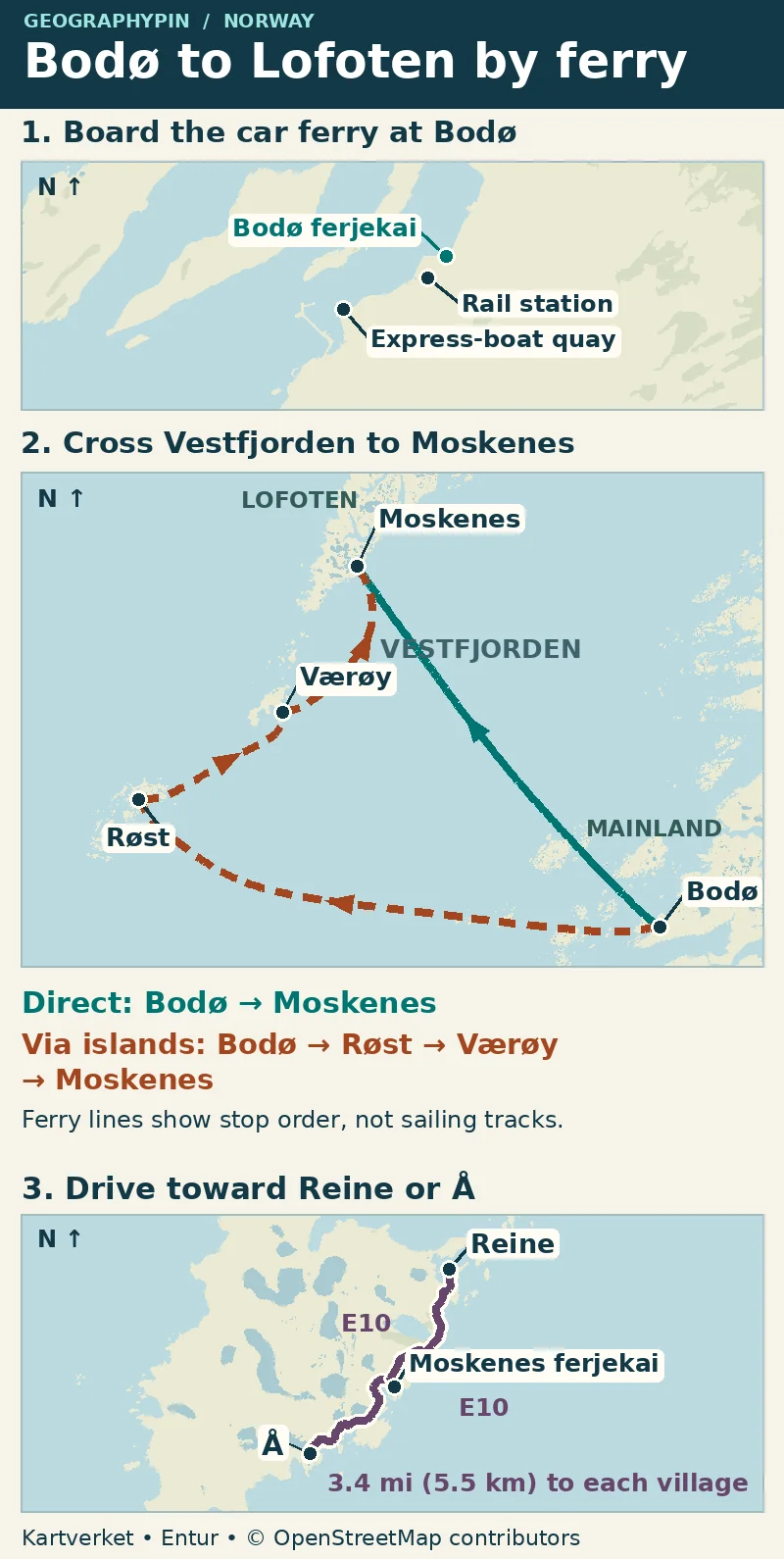
Enlarge map: Phone version · Desktop version
On foot: The crossing is free without a reservation if space is available. Torghatten lists NOK 65 to reserve an adult foot-passenger place. If you haven’t booked, scan the QR code at the quay to register and wait in the passenger queue.
With a car: The posted full fare for a conventional car up to 19.7 feet (6 m) is NOK 605, plus NOK 130 if you reserve. Other vehicle rates and discounts differ. A reserved vehicle goes in the lanes marked reservert. Be at the quay at least 45 minutes before departure with any reservation; the winter schedule also asks travelers to allow that time for passenger registration. Check the booking terms for your crossing. Torghatten lists lifts and accessible toilets on Landegode and Værøy; ask about the vessel and boarding ramp for your sailing if you need step-free access.
2. Compare direct sailings with island calls
A winter timetable example for December 1, 2026
On that Tuesday, the winter timetable lists these departures from Bodø that reach Moskenes. Both use route 18-782, but the stops and arrival times are not interchangeable.
| Sailing | Leave Bodø | Reach Moskenes | Scheduled crossing |
|---|---|---|---|
| Via Røst, then Værøy | 5:00 a.m. | Noon | 7 hours |
| Direct | 4:45 p.m. | 8:00 p.m. | 3 hours 15 minutes |
The last scheduled Moskenes-to-Bodø departure that Tuesday is 8:30 p.m., arriving in Bodø at 11:45 p.m. The 8:00 p.m. outbound arrival leaves only 30 minutes before the return, less than the reserved check-in requirement. Don’t plan a same-evening turnaround around that pair. Check both legs and Torghatten’s service messages for your date; the published timetable is not a seat check or confirmation that a ferry will run.
When demand is high, Torghatten gives passengers heading to Røst and Værøy priority and advises Bodø–Moskenes travelers to take a direct sailing. In the PDF, read all the way down the departure’s column to a Moskenes arrival; an island port in the route heading is not a promise that the ferry goes there.
3. Continue from Moskenes to Reine or Å
Choose a direction on the E10 or check for a bus
From the quay, drive north toward Reine or southwest through Sørvågen toward Å. Both are about 3.4 road miles (5.5 km) from the same mapped starting point. That is a comparison of road distances, not a recommendation to walk the road.
Without a car, check departures from Moskenes ferjekai in Entur. At the terminal, bus listings use Moskenes kai. Search for Reine or Å i Lofoten, not just for another ferry. In this example, routes 300 and 742 serve the quay in different directions. Open the Moskenes departure board for your date and check the direction: a bus toward Å does not take you to Reine.
On December 1, Entur lists bus 742 to Reine at 8:10 p.m., just 10 minutes after the direct ferry is due in. Its destination display reads Leknes sentrum via Reine. Bus 300 toward Å leaves at 11:05 p.m. The island-call ferry arrives at noon, when a bus toward Å is already due to leave; the next useful departure shown is 2:05 p.m. These are separate schedules. If your late ferry leaves only a few minutes to reach a Reine bus, arrange a pickup rather than relying on the connection.
The Norway country profile shows how islands, fjords and mountain corridors shape these routes. For another coast-to-inland connection by a different mode, use the Flåm Railway route map to see where travelers switch from the fjord branch to the Bergen Line.
Frequently Asked Questions
Why does an address in Reine say Moskenes?
Reine is the administrative center of Moskenes municipality. The municipality name on an address does not mean the place is next to the ferry quay.
What does “N” next to a ferry time mean?
On Torghatten’s winter sheet it means the time falls on the next day. If an arrival after midnight has an N, use that following date when checking your accommodation or onward transport.
What Did We Learn Today?
On this trip, the fast crossing and the easy arrival are two different decisions. A direct ferry cuts time on the water, but it can leave you with a longer wait for a bus. Pick the right Bodø quay first, then work backward from how you’ll get from Moskenes to your village.
Sources & Data Notes
The December 1 example uses Torghatten’s September 7, 2026–May 16, 2027 winter timetable and Entur’s bus schedules, checked November 23, 2026. They do not establish that a connection will run or wait. Road distances are rounded from mapped drives between one ferry access point and two named bus stops. Ferry lines show stop order, not recorded tracks.
View sources, map data and photo credit
- Torghatten route 18-782: bookings, fares, and boarding and winter operator timetable and service messages.
- Reis Nordland express boats, including NEX 2, Lofoten bus lines and Entur departure board for the Moskenes terminal.
- Visit Lofoten: Reine in Moskenes municipality; selected OpenStreetMap road data (ZIP) under the Open Database License.
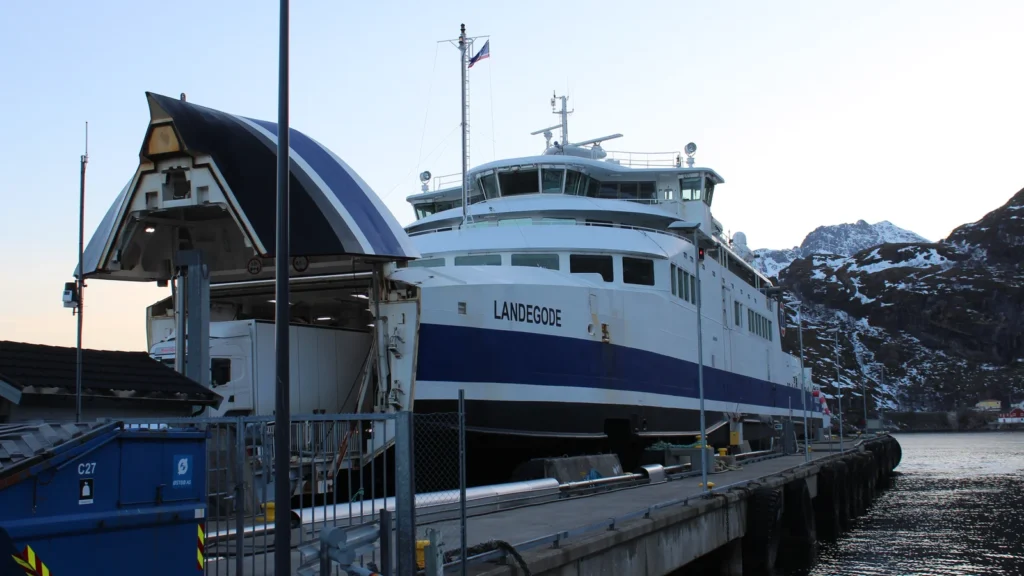
- Cover photograph: MF Landegode at Moskenes by Wolfgang Hägele (Scandi), April 13, 2023, CC BY-SA 4.0. Cropped, resized and converted to WebP under the same license.