Start with the route, not the season. The week Kyoto’s maples turn red can already feel like winter in Sapporo, while travelers in Okinawa may still be planning a beach day. The best time to visit Japan depends on which of those trips you want to take.
For a first Tokyo and Kyoto trip, choose mid-to-late May after Golden Week. For cherry blossoms in those cities, try late March to early April. Kyoto’s fall color usually favors mid-November into early December. For a ski trip in Hokkaido, start with January or February. Okinawa follows a different calendar.
How to use this article: Find your season by trip goal, compare May and November for Tokyo and Kyoto, or decide when to go to Okinawa.
Best months by trip goal
Four starting windows
- Cherry blossoms: late March to early April in Tokyo and Kyoto. A short viewing window at any one park makes flexible dates more valuable than choosing the right month on paper. Sapporo usually starts later, around late April or early May. Okinawa’s different local cherry trees flower mainly in late January and February.
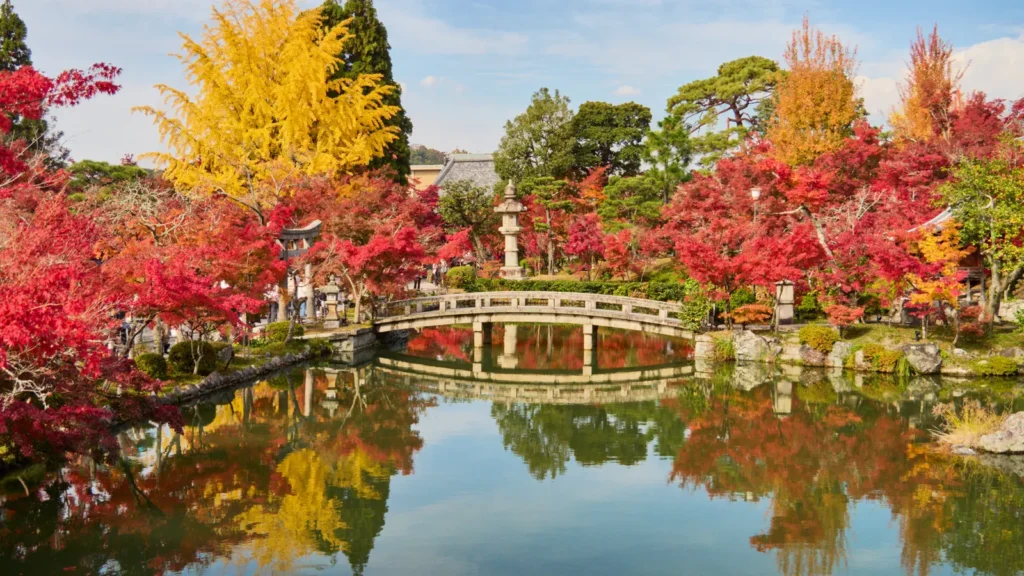
- Fall color: mid-November into early December in Kyoto. Start earlier for Sapporo: the city tourism bureau points to mid-October through early November. Within either city, species, elevation and the year’s weather shift the best week. Check Kyoto’s dated reports for individual gardens and temples rather than assuming they peak together.
- Snow: January or February for a Hokkaido ski trip. These are the core winter months for Niseko. Pick an actual ski area and check its operating lifts; snow at the Sapporo weather station cannot tell you whether a particular slope is open.
- City sightseeing: mid-to-late May for Tokyo and Kyoto. Choose this for warmer walks, not for the main blossom display. Take November instead if you prefer a jacket to summer heat and want lower average precipitation than in October.
Dates fixed for June? If your priority is long outdoor days rather than seeing Tokyo or Kyoto, consider switching the trip to Hokkaido. Sapporo records 2.4 in (60 mm) of June precipitation against Kyoto’s 7.9 in (200 mm). Those are monthly averages, not the odds of getting wet on your dates.
These are planning windows, not guarantees. For blossoms, watch for both first bloom and full bloom; they describe different stages. If a particular park matters more than anything else on the trip, give yourself more than one chance to see it.
Japan by month: Where the weather differs
Tokyo and Kyoto are on Honshu. Sapporo is on Hokkaido in the north of Japan, and Naha is on Okinawa’s main island in the southwest. This map of Japan’s island geography shows how far apart these climates sit. Treat each station as a local reference, not an average for a whole island or a mountain.
Each cell shows the average daily high and the average total precipitation for the month, measured by the Japan Meteorological Agency from 1991 to 2020. Monthly totals include the water equivalent of snowfall; they are not snowfall depth or the number of wet days. On a small screen, scroll the table to see all four places.
| Month | Sapporo | Tokyo | Kyoto | Naha |
|---|---|---|---|---|
| Jan. | 31°F (-0.4°C) 4.3 in (108 mm) | 50°F (9.8°C) 2.4 in (60 mm) | 48°F (9.1°C) 2.1 in (53 mm) | 68°F (19.8°C) 4.0 in (102 mm) |
| Feb. | 33°F (0.4°C) 3.6 in (92 mm) | 52°F (10.9°C) 2.2 in (57 mm) | 50°F (10.0°C) 2.6 in (65 mm) | 68°F (20.2°C) 4.5 in (115 mm) |
| Mar. | 40°F (4.5°C) 3.1 in (78 mm) | 58°F (14.2°C) 4.6 in (116 mm) | 57°F (14.1°C) 4.2 in (106 mm) | 71°F (21.9°C) 5.6 in (143 mm) |
| Apr. | 53°F (11.7°C) 2.1 in (55 mm) | 67°F (19.4°C) 5.3 in (134 mm) | 68°F (20.1°C) 4.6 in (117 mm) | 76°F (24.3°C) 6.3 in (161 mm) |
| May. | 64°F (17.9°C) 2.2 in (56 mm) | 74°F (23.6°C) 5.5 in (140 mm) | 77°F (25.1°C) 6.0 in (151 mm) | 81°F (27.0°C) 9.7 in (245 mm) |
| Jun. | 71°F (21.8°C) 2.4 in (60 mm) | 79°F (26.1°C) 6.6 in (168 mm) | 83°F (28.1°C) 7.9 in (200 mm) | 86°F (29.8°C) 11.2 in (284 mm) |
| Jul. | 78°F (25.4°C) 3.6 in (91 mm) | 86°F (29.9°C) 6.1 in (156 mm) | 90°F (32.0°C) 8.8 in (224 mm) | 89°F (31.9°C) 7.4 in (188 mm) |
| Aug. | 80°F (26.4°C) 5.0 in (127 mm) | 88°F (31.3°C) 6.1 in (155 mm) | 93°F (33.7°C) 6.1 in (154 mm) | 89°F (31.8°C) 9.4 in (240 mm) |
| Sep. | 73°F (22.8°C) 5.6 in (142 mm) | 82°F (27.5°C) 8.9 in (225 mm) | 85°F (29.2°C) 7.0 in (179 mm) | 87°F (30.6°C) 10.8 in (275 mm) |
| Oct. | 62°F (16.4°C) 4.3 in (110 mm) | 72°F (22.0°C) 9.2 in (235 mm) | 74°F (23.4°C) 5.6 in (143 mm) | 83°F (28.1°C) 7.1 in (179 mm) |
| Nov. | 48°F (8.7°C) 4.5 in (114 mm) | 62°F (16.7°C) 3.8 in (96 mm) | 63°F (17.3°C) 2.9 in (74 mm) | 77°F (25.0°C) 4.7 in (119 mm) |
| Dec. | 36°F (2.0°C) 4.5 in (115 mm) | 54°F (12.0°C) 2.3 in (58 mm) | 53°F (11.6°C) 2.3 in (57 mm) | 71°F (21.5°C) 4.3 in (110 mm) |
June is not “Japan’s rainy month” in quite the same way everywhere. The JMA’s usual rainy-season transition dates put tsuyu, the early-summer rainy season, around June 6–July 19 in the Kyoto region and June 7–July 19 in the Tokyo region. In Okinawa the usual window is earlier, roughly May 10–June 21. The JMA does not designate a tsuyu season for Hokkaido, though rain is still possible there.
Three trips, three different calendars
A Tokyo and Kyoto trip: May or November?
For a week divided between both cities, take mid-to-late May if you want more warmth for walking and don’t need cherry blossoms. May’s average high is 74°F (23.6°C) in Tokyo and 77°F (25.1°C) in Kyoto. Put a flexible day in each city rather than tying every outdoor plan to one date. If you’re arriving at Narita or leaving early for Kyoto, choose a Tokyo neighborhood that fits those train plans. If you add a day trip from Kyoto to Nara, that is an easy one to move within your Kyoto stay.
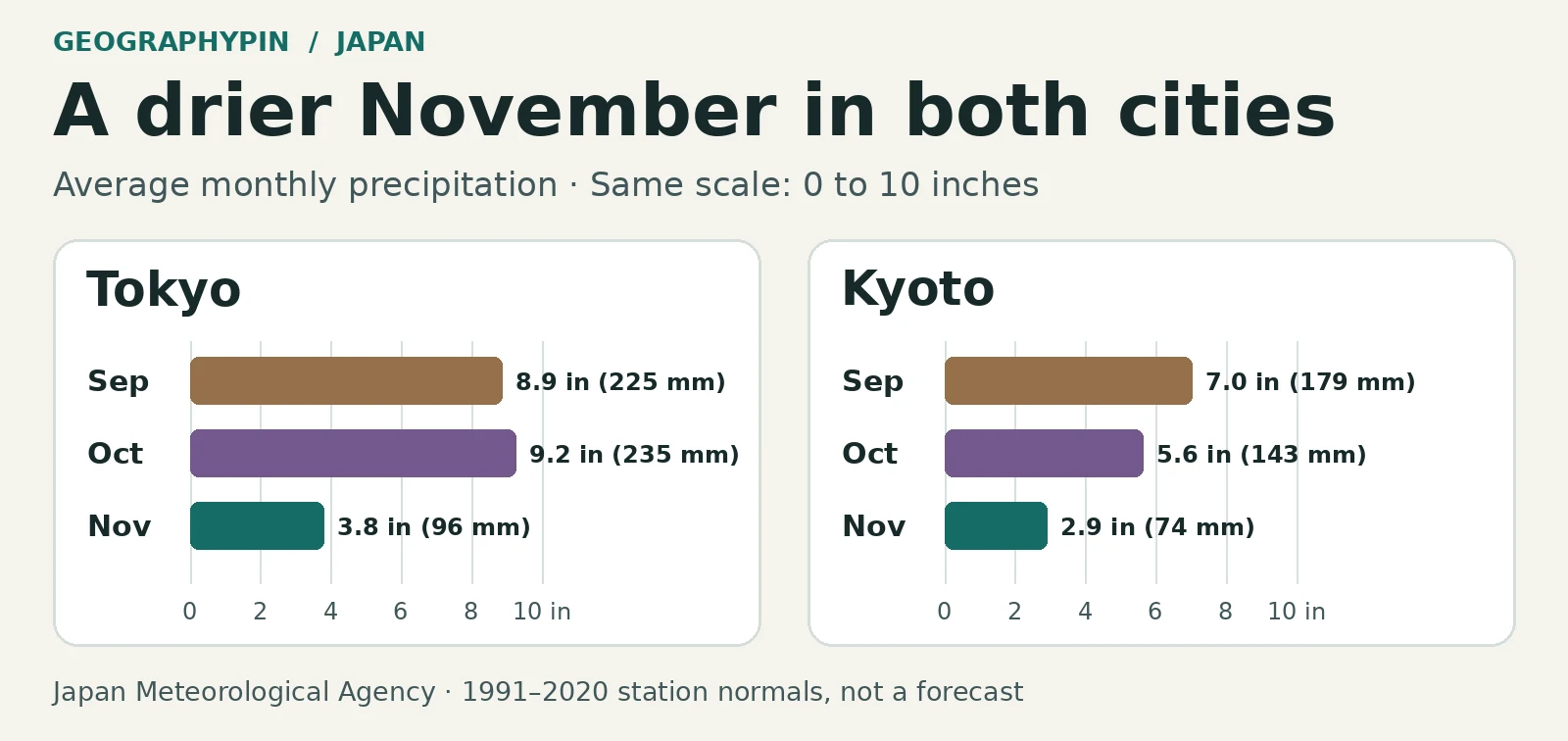
November is cooler and substantially drier on average than October in both city records: Tokyo drops from 9.2 in (235 mm) to 3.8 in (96 mm), and Kyoto from 5.6 in (143 mm) to 2.9 in (74 mm). Choose later in November if fall color is a priority; leave a day uncommitted for the park or temple that’s looking best. For a detour to the Fuji Five Lakes without a car, save the day with the clearest forecast. A dry month does not guarantee a clear view of the mountain.
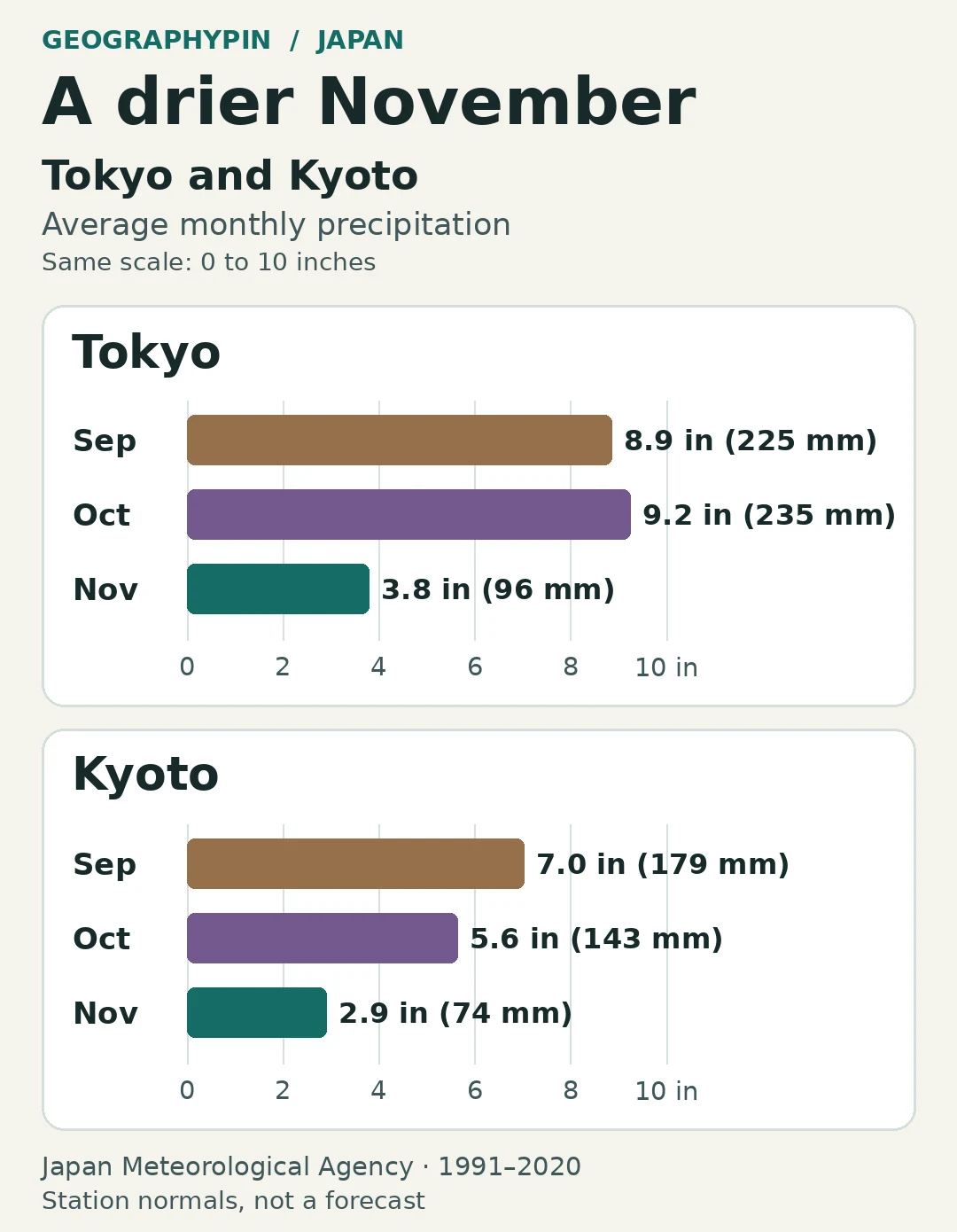
Enlarge the chart: phone layout or desktop layout.
A Hokkaido snow trip: January or February
If skiing is the point, base your dates on your resort rather than on Tokyo’s weather or the first snowfall in Sapporo. For example, Niseko United lists December 24, 2026 through February 28, 2027 as its peak period. Early-season and spring dates vary across its ski areas. For any winter, check the operator’s posted season and live lift status; pack a spare day if you only have a short trip.
An Okinawa island trip: October warmth or April flexibility
October is a reasonable starting point for a warm island trip: Naha’s average high is 83°F (28.1°C) and the average monthly precipitation is lower than in August or September. That does not put October outside tropical-storm season. The JMA records approaches to Okinawa in October, and the local tourism board advises checking the swimming season at the specific beach.
If you mainly want coastal walks and sightseeing and cannot move your dates, consider April instead. Naha’s average high is 76°F (24.3°C), April precedes the usual onset of the rainy season, and water activities still depend on the beach and sea conditions. If a ferry trip is the centerpiece, don’t put it on the only day before an inflexible flight. Check the ferry operator and JMA storm information close to departure.
When holidays affect a route
Golden Week: A string of public holidays and adjacent travel days in late April and early May affects trains and accommodation even when you are not going to an event. The Japanese Cabinet Office lists April 29 and May 3–5 as public holidays in 2027; that is the holiday calendar, not a prediction that every train is full on every intervening day. If dates overlap, book the long transfer first or keep that part of the trip in one city.
Obon and New Year: Japan’s national tourism organization flags mid-August and late December to early January as busy domestic travel periods. Obon observances are not a single nationwide public-holiday date. Check the operator’s travel notices and individual venue hours if your dates are fixed. The 2027 holiday dates and the 2026–27 Niseko example were checked November 25, 2026.
Frequently Asked Questions
Is April a good month everywhere in Japan?
Not for the same plans. A single suitcase for Sapporo and Naha needs layers: their average April daytime highs differ by about 23°F (12.6°C). Early April can work for a Tokyo and Kyoto blossom trip, while Sapporo’s flowers often arrive toward the end of the month or in May. Decide which stop gets priority if you only have a week.
Which region makes sense if I can only travel in summer?
Start with Hokkaido in July or August if you want less heat than in Kyoto or Tokyo. In August, Sapporo’s average daytime high is 80°F (26.4°C) against Kyoto’s 93°F (33.7°C). If the cities are fixed, put your longest walks in the morning and keep an indoor option for the afternoon; don’t treat Hokkaido as a guarantee of cool or dry weather.
What Did We Learn Today?
A useful Japan itinerary starts with what you would be disappointed to miss. Choose a place and the right window for blossoms, leaves, snow or comfortable walking, then account for the weather and holiday trade-offs on that route. The climate table helps choose a month; local conditions and transport notices help choose the day.
Sources & Data Notes
The climate comparison uses Japan Meteorological Agency station normals for 1991–2020. Daily highs are rounded to whole °F and one decimal °C; monthly precipitation is rounded to one decimal inch and the nearest millimeter. Flower and foliage windows are local seasonal guidance, not climate normals or predictions for individual dates.
Show the sources and photo credit
- Japan Meteorological Agency station tables: Sapporo, Tokyo, Kyoto, Naha; original comparison by GeographyPin from JMA data, under its public data terms.
- Japan Meteorological Agency: regional rainy-season normals and regional tropical cyclone statistics.
- Japan National Tourism Organization: seasonal weather, spring blossoms, Kyoto Tourism’s usual viewing periods, and May and Golden Week.
- Flower and leaf timing: Sapporo’s cherry trees, Sapporo’s fall foliage, and Kyoto’s leaf reports.
- Niseko United: winter dates and mountain operations.
- Visit Okinawa Japan: April and October conditions; JNTO: Okinawa’s cherry trees.
- Cabinet Office: Japan’s public holiday calendar and Japan National Tourism Organization: domestic travel periods.
- Featured photo: Eikandō temple garden, Kyoto by lumoplank, CC0 1.0; cropped.