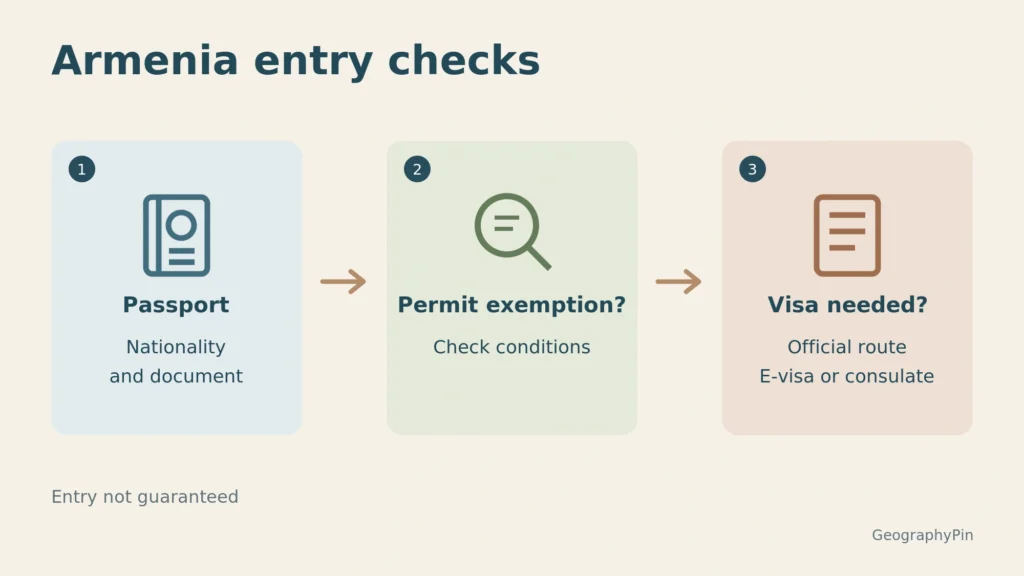
Two visitors on the same flight to Armenia can need different documents. The answer starts with the passport you will travel on, then any qualifying residence permit, and finally the purpose and length of your stay.
Your passport and supporting documents decide the route
Armenia visa requirements depend on your nationality, travel document and any applicable exemption. Check the Ministry of Foreign Affairs’ passport selector first, including its current residence-permit exception. If a visa is required, confirm whether you qualify for the official e-visa or need a consular application; neither route guarantees admission.
How to use this article: Start with your passport category, check the temporary permit exemption, or prepare documents for an Indian-passport application.
Entry information checked November 18, 2026. Rules depend on the individual document and can change; recheck the linked official guidance for your travel dates.
1. Find the route for your passport
Use the document you will actually present
Open the official MFA visa checker and select your citizenship and travel-document type. The government application destination is evisa.mfa.am. Do not treat an ordinary-passport answer as applying automatically to a refugee, emergency, diplomatic or other travel document.
The unilateral visa-free list includes the United States and United Kingdom and states a maximum of 180 days in a year. Separately, bilateral agreements distinguish between all-passport exemptions and exemptions limited to particular official passport categories.
| Check | Next step |
|---|---|
| Your passport is visa-exempt | Confirm the permitted stay and any treaty conditions. |
| You hold a qualifying foreign residence permit | Check the dated exception below before applying. |
| A visa is still needed | Follow the official result for e-visa or consular eligibility, including invitation requirements. |
Write down the result for each traveler separately. A family member’s different nationality or document may produce a different route, even when everyone has the same booking.
2. Check the residence-permit exception first
The current exception runs through July 1, 2027
The June 30, 2026 MFA notice exempts nationals of 111 listed countries from visas between July 1, 2026 and July 1, 2027 when they hold a qualifying residence permit valid for at least six months from entry. Issuing jurisdictions are the United States, EU or Schengen states, UAE, Bahrain, Qatar, Saudi Arabia, Kuwait and Oman. The stay limit is 180 days within one year.
The permit must be a physical card or passport sticker. The notice specifies Latin-script document title, name and nationality, with birth and validity dates in the Gregorian calendar. A foreign visitor visa is not the same document as a residence permit under this exemption.
India and Pakistan are both on this temporary list. Check the nationality list, issuer, remaining validity and physical document together; residence in an eligible country alone is not enough.
Pakistan also appears on the invitation-only visa list. That is why the exemption check comes first. Where no exception applies, the listed nationalities generally need an invitation and an application at an Armenian diplomatic or consular mission abroad, rather than an ordinary e-visa application.
3. Apply through the official process
Indian ordinary passports have a specific document checklist
For Indian citizens who still need a visa, the Armenian embassy’s June 30, 2026 guidance sets out alternative e-visa supporting-document routes. One uses medical insurance plus an eligible foreign visa or residence permit. Another uses insurance, an air reservation, a local invitation and evidence of sufficient funds. The return-reservation requirement has stated exceptions for education, work and other justified cases.
Its supporting visa/permit issuer list differs from the temporary visa-free list: it includes, among others, the UK, Canada, Australia, Japan and Russia. Read the exact embassy checklist rather than substituting a permit from any country. It also publishes a separate consular checklist including passport, application, photograph and supporting evidence. For this Indian-passport guidance, the passport must remain valid throughout the stay.
The official e-visa terms give normal processing as three working days, counted from the business day after online submission. Additional information or document requests can delay a decision. The visa fee is non-refundable; payment is not an approval.
Before submitting, compare every passport field with the application, check the requested dates, and keep a copy of what you sent. Leave room for corrections or follow-up requests rather than building the trip around the shortest advertised processing time.
4. Separate the fee, validity and permitted stay
The MFA’s consular fee schedule effective January 1, 2026 provides these examples for diplomatic missions and consular offices abroad. They are not a verified quotation of the online portal’s final checkout total.
| Category | Listed fee |
|---|---|
| Stay up to 21 days | 3,000 AMD / US$8 |
| Stay up to 120 days | 15,000 AMD / US$39 |
| Multiple entry, stay up to 60 days, six-month validity | 20,000 AMD / US$52 |
| Multiple entry, stay up to 120 days, one-year validity | 40,000 AMD / US$103 |
Validity is the period in which a visa can be used, not permission to remain for that whole period. Read the issued document’s dates, entry count and authorized stay together. A one-year multiple-entry category in this table is not a year-long visitor stay.
5. Arrive with your evidence and watch your stay limit
The National Security Service’s border rules require border-control permission as well as the applicable valid travel and entry documents. A visa is therefore not an admission guarantee. Carry the passport and the visa or exemption evidence on which you rely, not just a payment receipt or an application confirmation.
The border guidance describes recording arrivals and stamping passports with the arrival date. Check that date against your permitted stay. It also distinguishes visitor-visa extensions from initial entry: the general visitor-visa framework allows up to 120 days, with a possible extension of no more than 60 additional days, subject to applicable exceptions.
For an extension, the Migration and Citizenship Service directs applicants or authorized representatives to apply before the issued visa expires, with a reason for extending. Its published process lists a passport, color photograph and fee-payment evidence; the usual charge is 500 AMD per extension day, with listed exemptions. An extension must be obtained, not assumed.
If your plans become a move for work, study or residence, ask the service which status and registration requirements apply. Its residence-registration service concerns recording an address in the State Population Register. Do not substitute that process for an entry visa or assume one visitor’s obligations cover every kind of stay.
Once the entry route is settled, use the Armenia travel guide to plan the journey itself. Keep the entry decision with your travel documents so that a later change of passport, permit or dates prompts a fresh check.
What Did We Learn Today?
Check the passport first, then any residence-permit exemption, then the visa process that remains. Keep nationality-specific evidence, visa validity and permitted stay separate. The official application, the issued document and the border decision are different steps, so an application receipt is not the end of the entry check.
Sources & Data Notes
View official entry and application references
Checked November 18, 2026. This guide covers the stated passport examples and points other travelers to the official selector; it is not an individualized eligibility decision. The temporary-exemption PDF is the June 30, 2026 notice, not the expired January–July 2026 version. Consular fees are separately scoped and dated above.
- MFA: visa information and passport selector
- MFA: unilateral visa-free list
- MFA: bilateral passport-category exemptions
- MFA: current temporary residence-permit exemption notice
- MFA: invitation-only nationalities
- Armenian embassy in India: ordinary-passport visa guidance
- Official e-visa: general terms and processing
- MFA: 2026 consular fee schedule
- National Security Service: border-crossing rules
- Migration and Citizenship Service: entry-visa extension
- Migration and Citizenship Service: residence registration