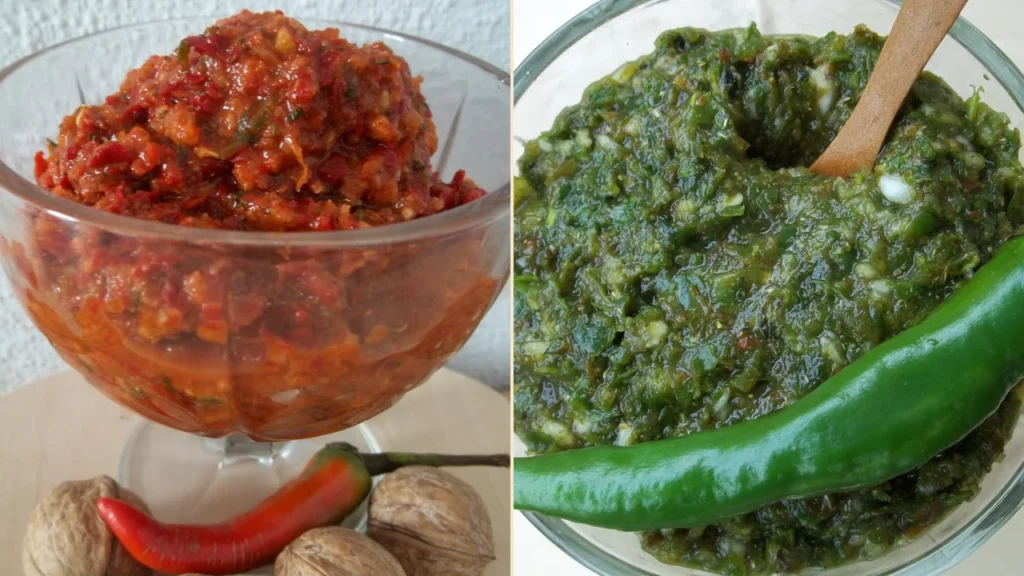
Adjika, also spelled ajika, is a hot chile-and-garlic condiment with roots in the western Caucasus. A spoonful of thick red or green paste can season a whole dish. Dry blends and tomato-based sauces use the same name, but they behave differently in the kitchen.
Red and green adjika pastes get their color chiefly from the peppers and, in many green versions, herbs. Dry adjika is a ground spice blend. A tomato-based adjika is closer to a spoonable sauce. Color alone does not tell you how hot it is or whether it contains nuts.
How to use this article: Start with red and green pastes, read four real ingredient lists, or jump to three ways to use it.
Where adjika comes from
Abkhazia and neighboring Samegrelo, near the eastern Black Sea coast, have related but distinct traditions. Georgia’s national heritage order of 2018 recognizes the methods for making Abkhazian apirpil-jika, or pepper salt, and Megrelian ajika. The Georgian intellectual-property office registered Ajika as a geographical indication in 2022. The specification traces the condiment’s origin to Abkhazia and its spread through Samegrelo and the rest of Georgia.
The pepper, salt and garlic give the paste its backbone. Dried spices such as ground coriander and herbs such as summer savory can change the aroma without changing the basic idea. The Georgian specification allows additions such as walnuts, sunflower seeds and fresh herbs. You can see how the condiment fits alongside other dishes in GeographyPin’s Georgian food and Tbilisi menu guide.
Red, green, dry and tomato-based adjika
Red and green pastes
Red adjika can lean toward dried red chiles and ground spices. The walnut version in the opening photo also contains fresh coriander and savory. Green adjika is typically made with green peppers; fresh herbs can give it a brighter flavor. A batch made mostly from hot green chiles can be hotter than a red one softened with sweet peppers.
What four maker labels actually list
| Type and maker | Listed ingredients, grouped for comparison |
|---|---|
| Red paste Suneli Valley | Red chile powder and crushed red chiles, paprika, coriander, blue fenugreek, garlic, salt, water and sunflower oil. |
| Green paste Suneli Valley | Green bell peppers and green chiles, garlic, salt, fenugreek, powdered dill, coriander, oil and red chile powder (listed last). |
| Dry blend World Spice | Two kinds of chile flakes, two paprikas, fenugreek seed and leaf, coriander, garlic and calendula. Salt is not listed. |
| Tomato sauce TERi Foods | Tomatoes (50%), sweet red peppers and hot peppers, garlic, carrots, sugar, salt and acetic acid. |
The tomato version gives you a sauce with its own body, whereas a dense chile paste adds concentrated flavor with less liquid. That does not make every jar with a little tomato a tomato sauce. The proportion and consistency matter more than a red label.
How to use the version you have
Three places to start
- Grilled chicken or fish: Serve red or green paste on the side and let diners add it by the dab.
- A pot of beans: Stir a small amount of paste into the liquid near the end. Taste before adding extra salt, especially if the paste is salty.
- Roasted potatoes: Toss them with a dry blend rather than a wet sauce. If the blend has no salt, season separately.
If the dish needs moisture as well as heat, the tomato version makes more sense as a topping than as a direct replacement for the dry blend.
Frequently Asked Questions
Does adjika always contain walnuts?
No. Walnuts are optional in some pastes and absent from others. The red paste in the opening photo does contain them, so check the label or ask the maker rather than judging by color.
Is adjika the same as tkemali?
No. Adjika’s main flavor comes from peppers, garlic and spices. Georgian tkemali is a sour plum sauce. They may be served with some of the same foods, but the plum sauce brings acidity rather than chile intensity.
What Did We Learn Today?
Adjika grew out of Abkhazian and Megrelian pepper-seasoning traditions. Today the name can mean a dense paste, a dry blend or a tomato sauce. Read the ingredients and check the texture: those details tell you more about how to use it than the color alone.
Sources & Data Notes
View the heritage records, maker labels and photo credits
Maker listings checked November 28, 2026. Ingredients are grouped for readability, not ranked in recipe order unless stated. Each label illustrates a particular formulation, not a standard for its whole category.
- Georgia’s National Agency for Cultural Heritage Protection, Order 02/67 (2018); Sakpatenti’s registered Ajika specification (2022), preparation, origin and typical ingredients.
- Georgia Travel: Ajika, variation and use; Sakpatenti’s bulletin with the Tkemali specification, the plum sauce comparison.
- Maker ingredient disclosures: Suneli Valley’s red paste and green paste, World Spice dry blend and TERi Foods tomato sauce.
- Cover: GeorgianRecipes.net / Georgia About, red ajika with walnuts and green ajika with hot peppers (2013), CC BY 3.0. Both cropped and combined; they are not photographs of the maker products in the table.