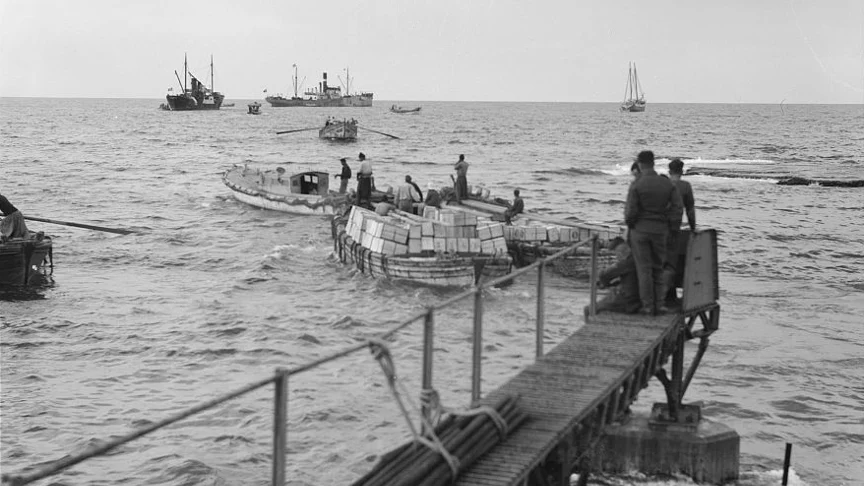
In a 1936 photograph taken at Jaffa, wooden boxes sit piled in a low cargo boat. The larger ships are still out at sea. The oranges in those boxes had already passed through several hands, but they had one more boat ride ahead of them before they could leave the coast.
Jaffa became famous for the Shamouti, a thick-skinned, nearly seedless sweet orange first cultivated by Palestinian Arab growers near the city. Its rind helped it withstand long journeys. Arab and Jewish growers and exporters built a trade around it, and the name of the port became a name buyers recognized on the fruit.
How to use this article: See what made the fruit travel well, why the crates changed boats, or read the 1938 Pardess label.
1. An Orange Built for a Long Trip
The Shamouti’s Thick Rind
Jaffa is now part of Tel Aviv–Yafo on the Mediterranean coast of Israel. The Shamouti appeared in an Arab orchard near Jaffa in the nineteenth century, when the area was under Ottoman rule. The University of California, Riverside’s citrus collection gives the likely explanation: a branch on a local Beledi orange tree began producing a different fruit. The exact tree and date are not established.
The contrast with the Beledi mattered. A contemporary U.S. agricultural survey describes the Beledi as round, seedy and thin-skinned, better suited to local sale. The Shamouti was oval, typically had few seeds, and had a firm rind that held up in storage and shipping. It peeled readily despite that rind. A grower had a fruit that could travel; a buyer in England could still open it and eat it fresh.
Who Grew It Before 1948?
Palestinian Arab orchard owners built the early trade around Jaffa. Jewish farmers also developed citrus orchards, including at Rishon LeZion, where a U.S. agricultural survey photographed Shamouti trees. By 1945, the British Mandate government listed about 25,900 acres (105.0 km²) of Arab-owned Shamouti groves and 21,300 acres (86.2 km²) of Jewish-owned Shamouti groves across the three orchard-condition classes in its table. Those are areas of groves across Mandate Palestine, not shares of Jaffa’s cargo or a count of fruit harvested.
2. From the Grove to a Ship at Anchor
Why the Crates Changed Boats
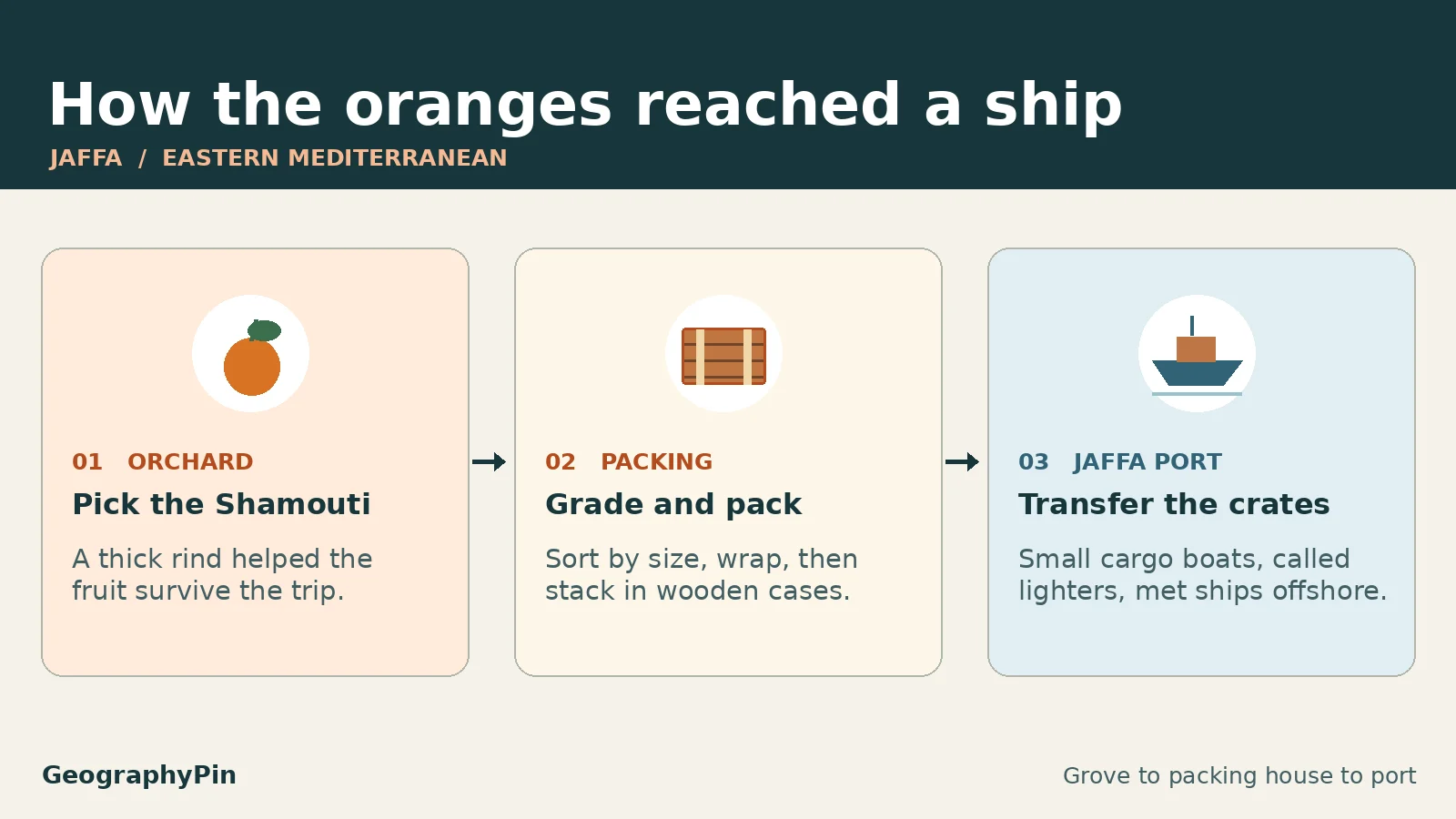
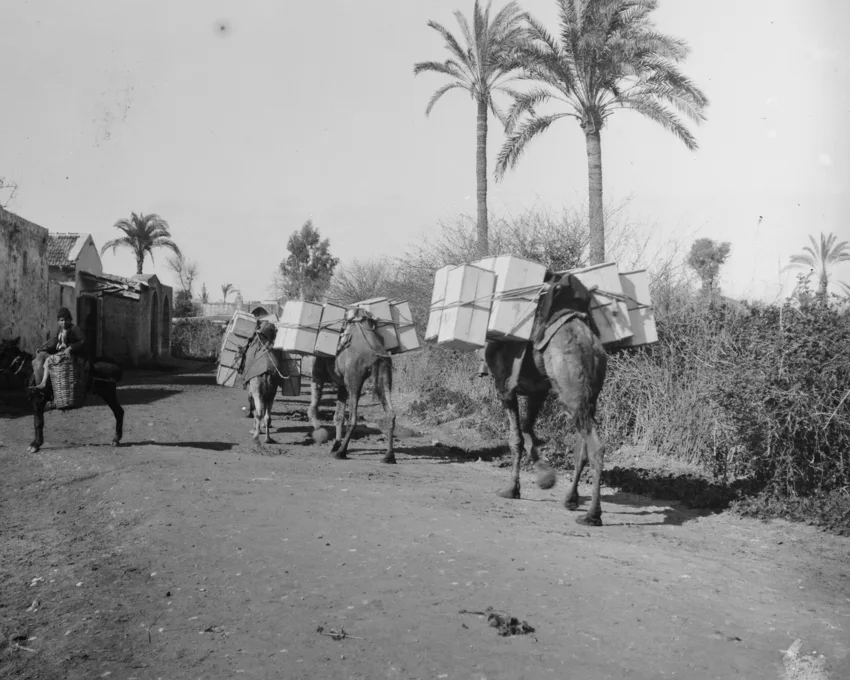
Workers sorted the fruit, wrapped oranges in thin paper and packed them into wooden cases. Most export fruit went onward by truck or wagon by the late 1930s. Growers near loading points or on roads trucks could not use sometimes still sent cases by camel. At Jaffa, small cargo boats called lighters took the cases out to ships anchored offshore. In the opening photograph, the smaller boats carry stacked cases; the ships that would take the fruit farther are visible behind them.

Why Haifa Overtook Jaffa
Jaffa was close to the groves, but its offshore transfers took time, especially in rough seas. Haifa’s deep-water harbor allowed ships to load at a wharf. The 1936 Arab general strike also interrupted traffic through Jaffa; Jewish exporters shifted to other outlets, including Haifa and the new lighter port at Tel Aviv. In 1935–36, Jaffa handled 59.0% of Mandate Palestine’s citrus exports to Haifa’s 38.0%. The next season, that changed to 33.5% for Jaffa and 62.0% for Haifa. The figures cover all exported citrus, not just Shamouti oranges; the name Jaffa outlasted the port’s lead.
3. How Jaffa Became a Name on the Box
How to Read the 1938 Pardess Label
Shamouti was the name of the variety. Jaffa oranges was the better-known sales name. Tel Aviv University’s reconstruction of the Mandate trademark registry shows that the words themselves were shared by traders rather than reserved to one exporter. But a trader could use a distinctive design to set its fruit apart.
These Polish registrations document what the cooperative registered for export marketing. They do not show that Pardess owned the plain words in Mandate Palestine or that the photographed crates carried this label. The place name and the exporter’s mark answer different questions.
What Changed After 1948
The 1948 war displaced Palestinian growers and interrupted the work that kept their orchards productive. A United Nations field report from 1949 describes neglected groves and damaged irrigation equipment in the Jaffa district. Those visits covered only a sample of the groves; the report also describes some groves elsewhere that were kept in production. In the decades that followed, Israel’s Citrus Marketing Board promoted the Jaffa name. A 1969 international registration in the board’s name covered not only Shamouti oranges but also certain late oranges, grapefruit and lemons from defined growing areas. It is a historical example of how much broader an export name can become than the variety that made it famous.
Frequently Asked Questions
Is Jaffa an orange variety or a brand?
In the original trade, Jaffa was a name buyers used for the Shamouti variety. It also became a wider marketing name. A historical Jaffa label can therefore identify an export brand without necessarily naming the exact variety. If you need to identify the fruit, look for “Shamouti” separately.
Did every Jaffa orange grow near the port?
No. By the twentieth century the Shamouti was grown well beyond the city, including in what are now Lebanon and Cyprus. The fruit’s name records where it became famous, not where every tree grew.
What Did We Learn Today?
The Shamouti’s thick rind made a local orange a good candidate for export, but growers, packers and port workers made that trade possible. Jaffa’s port gave the fruit a familiar name. The name was broad enough to survive a shift to other ports, while labels like Pardess still told buyers which exporter had put its name on the fruit.
Sources & Data Notes
View the citrus surveys, trademark records and photograph credits
The acreage figures convert the published 1945 inspection areas (104,988 and 86,203 dunums, respectively) at 1,000 square meters per dunum. Ownership is the survey’s classification; neither acreage figure measures the number of people who worked or marketed the crop. Port shares use all recorded citrus exports in the specified seasons.
- University of California, Riverside, Shamouti sweet orange accession, and National Library of Israel, Fresh Citrus Fruits, for fruit traits, origin and later marketing.
- Government of Palestine, A Survey of Palestine, volume I, printed p. 339, table 3, for the 1945 inspection areas as originally published.
- U.S. Bureau of Agricultural Economics, The Citrus Industry of Palestine, especially table 5, the fruit variety descriptions and the Rishon LeZion photograph. The GeographyPin diagram also draws on its port and packing descriptions.
- Tel Aviv University, Mandate Palestine trademark registry: Jaffa Oranges, and Polish Patent Office gazette, issue 5 (1938), p. 224, entries 28770–28771. The label above is annotated in words, not reproduced.
- UN Conciliation Commission for Palestine, Delbès field report (July 1949), pp. 2–3, and Lisbon appellations of origin bulletin, February 1970, p. 4 (registration 512).
- Photographs: Library of Congress, Prints & Photographs Division, G. Eric and Edith Matson Photograph Collection, orange lighters, 1936 (LC-DIG-matpc-18250) and camels carrying boxes (LC-DIG-matpc-04991). Cropped and converted to WebP; one of the stereo frames is used for the camel photograph. No known publication restrictions.

