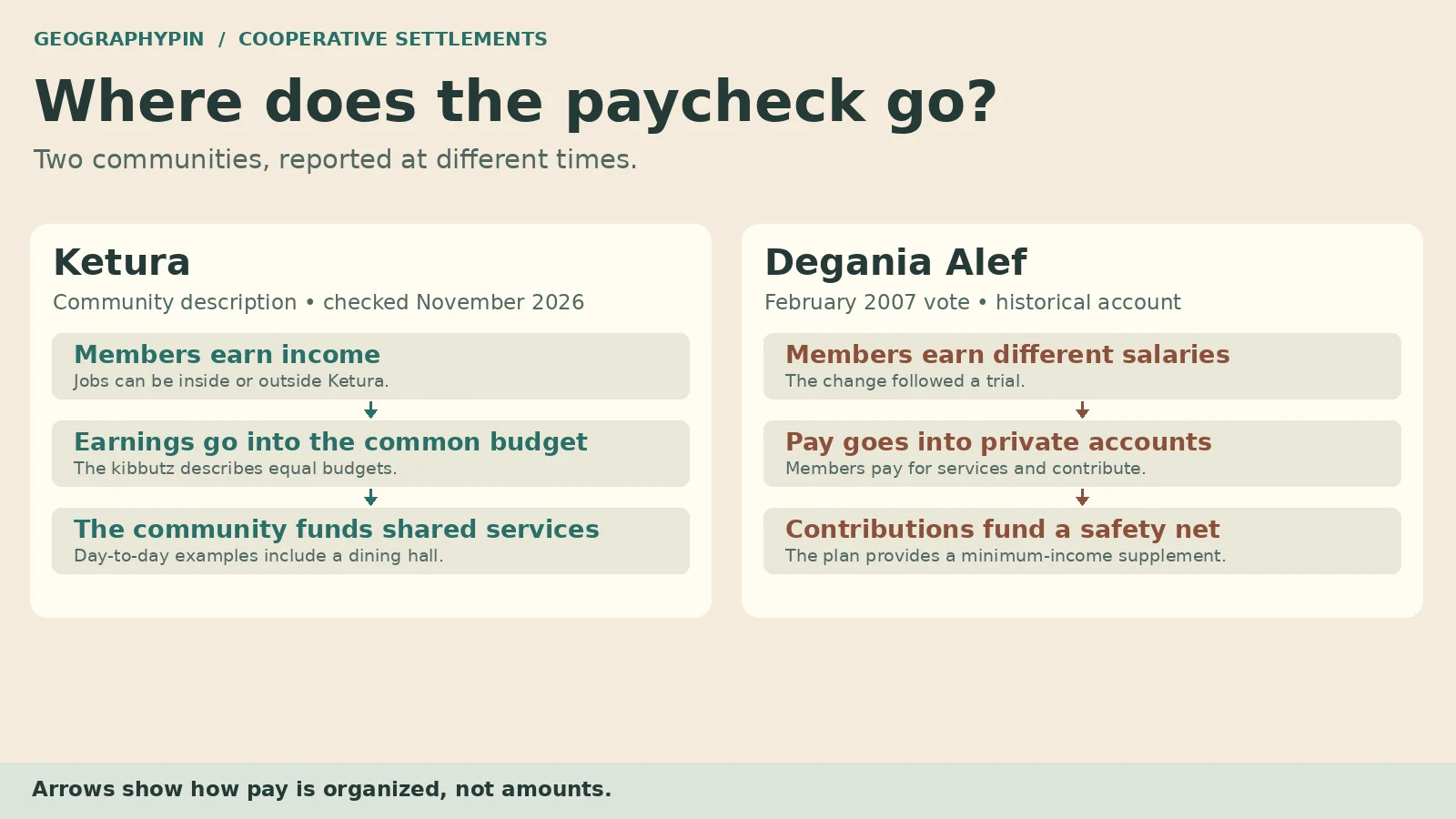
At Ketura, a paycheck earned outside the community can still support the common budget. In Degania Alef, members voted in 2007 to keep their individual salaries while retaining a shared safety net. Both examples help answer the same question: what do people actually share in a kibbutz?
A kibbutz is a cooperative community in Israel that historically pooled work and income and provided services to members collectively. Some still share income, as Ketura describes doing. Others introduced individual pay while retaining some shared services and support. The word kibbutz tells you more about the community’s cooperative roots than about any one member’s paycheck.
How to use this article: Start with the difference between work and pay, then see what Degania Alef changed in 2007 or who runs the farm in a moshav.
1. What a Kibbutz Is
A kibbutz is both a place to live and a way to organize parts of economic and social life. In the traditional model, member earnings went into a common budget, from which the community provided services and allowances. A dining hall, a shared enterprise or a budget for education did not mean the same thing as every member doing the same job. The question was how the fruits of different jobs were distributed.
Work and income are separate questions
Early kibbutzim were closely associated with farming, but it is possible to work outside the settlement and still share the earnings. The reverse is possible too: members can work locally, retain individual earnings and continue to fund selected services together. The easiest questions to remember are where the work is done, where the pay goes, and which expenses are still covered together.
2. What Ketura Shares
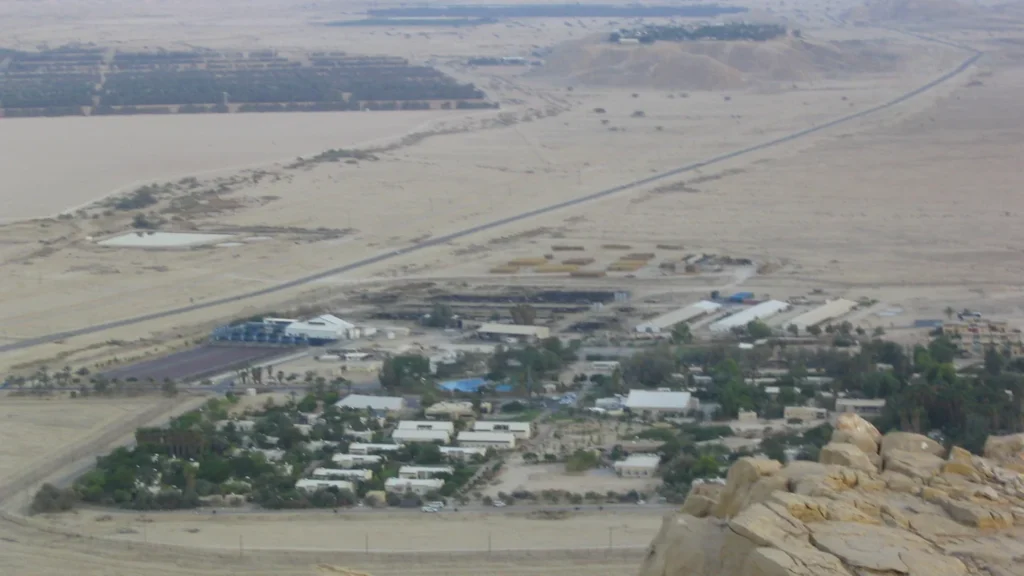
Ketura is in the southern Arava, north of Eilat. Its own description emphasizes common ownership of assets, equal budgets and mutual responsibility. On its English work page, the kibbutz says that some members work elsewhere and bring their salaries into the shared budget; its local jobs range from childcare and maintenance to work in date orchards. This is a self-description of the community’s arrangements, not a statement about every resident’s membership status.
Shared income need not mean a shared home
Ketura describes a communal dining hall, which the Arava Institute also documents. Members can eat together without living in one household. Sharing some services or spaces does not tell you who has legal title to a particular home, and the descriptions used here do not establish that.
The community’s governance page puts the general assembly of members at the center of decision-making. Its committees make decisions in specific areas or bring recommendations to the assembly. Pay-sharing is thus more than a formula: it requires people to decide which services and responsibilities the common budget should cover.
3. What Degania Alef Voted to Change
Degania Alef emerged near the southern end of the Sea of Galilee in the early twentieth century and is widely regarded as the first kibbutz. Its historical courtyard grouped common buildings, including dining and working spaces. That layout helps explain what it once meant to organize daily life cooperatively. It does not describe everyone’s arrangements today.
The 2007 vote changed pay without ending mutual support
Reuters reported that about 85 percent voted to make a trial permanent in February 2007. The change moved different salaries into members’ private accounts, and members paid for services they received from the kibbutz. The secretary said a local contribution, described as an equality tax, would fund a safety net and supplement earnings below a set minimum. He also said that the dining hall and subsidized education would continue. Those were the arrangements described at the time, not a report of how Degania Alef operates now.
The decision fits a wider set of kibbutz reforms that economists Ran Abramitzky and Victor Lavy studied. Some communities kept equal sharing; others retained a safety net while tying take-home earnings more closely to the work a member did. Degania Alef’s vote is one case, not the date every kibbutz changed.

| Question | Ketura, self-description checked November 2026 | Degania Alef, February 2007 vote |
|---|---|---|
| Where does pay go? | Members share income through the common budget. | Different salaries went into members’ private accounts. |
| What remains collective? | Examples include the common budget and dining hall. | A local contribution supported a safety net; the secretary said dining and subsidized education would continue. |
| What about housing? | The community describes separate family homes; the legal title to individual homes is not established here. | The report documents the pay vote, not property titles or housing rights. |
| Who decides? | The general assembly of members and committees. | Members voted to make a trial arrangement permanent. |
4. How a Kibbutz Differs From a Moshav
Who runs the farm or business?
In a classic moshav, families operate their own farms while working together on activities such as buying supplies or marketing produce. In a traditional kibbutz, the cooperative organizes production as a community enterprise. Put simply, sharing the cost of supplies is different from pooling a business and its returns. The Hebrew University study also describes the moshav shitufi, an intermediate model in which production was shared but consumption was handled by households. The distinction helps explain the historical models; it is not a shortcut to every community’s rules today.
These communities help explain one part of Israel’s economic history. Their arrangements don’t describe the economy of the whole country.
Frequently Asked Questions
Do all members of a kibbutz earn the same amount?
Not necessarily. Wages from different jobs may be pooled. An equal basic budget is not the same as equal wages at work. Other kibbutzim keep individual pay while sharing selected costs.
Is everyone living there automatically a member?
No. Ketura’s own account distinguishes members, candidates for membership and residents. The distinction matters because the general assembly is made up of members.
What Did We Learn Today?
A kibbutz can share work, income, facilities and support in different combinations. Ketura describes shared earnings and community services. Degania Alef’s 2007 vote redirected individual pay while keeping a safety net. The useful comparison is what goes into the community budget, what households keep and who decides.
Sources & Data Notes
Show sources and date notes
- Ketura: overview in Hebrew, work and shared income and committees; Arava Institute for the common dining hall. These are the community’s own published arrangements, not a survey of all kibbutzim.
- Reuters, February 19, 2007: Degania Alef’s vote and the secretary’s description of the reform. The chart is a dated comparison, not a claim that the two systems were surveyed in the same year.
- Ran Abramitzky and Victor Lavy, 2014: wider kibbutz pay reforms. Hebrew University study on Israeli farm specialization: distinctions among the kibbutz, moshav and moshav shitufi.
- Israel’s Degania and Nahalal Tentative List submission: the historical layout. A tentative listing is not World Heritage inscription.
- Cover: Ketura from Mount Grofit, Tomer Chelouche, August 2004, public-domain release, cropped. Diagram: GeographyPin.