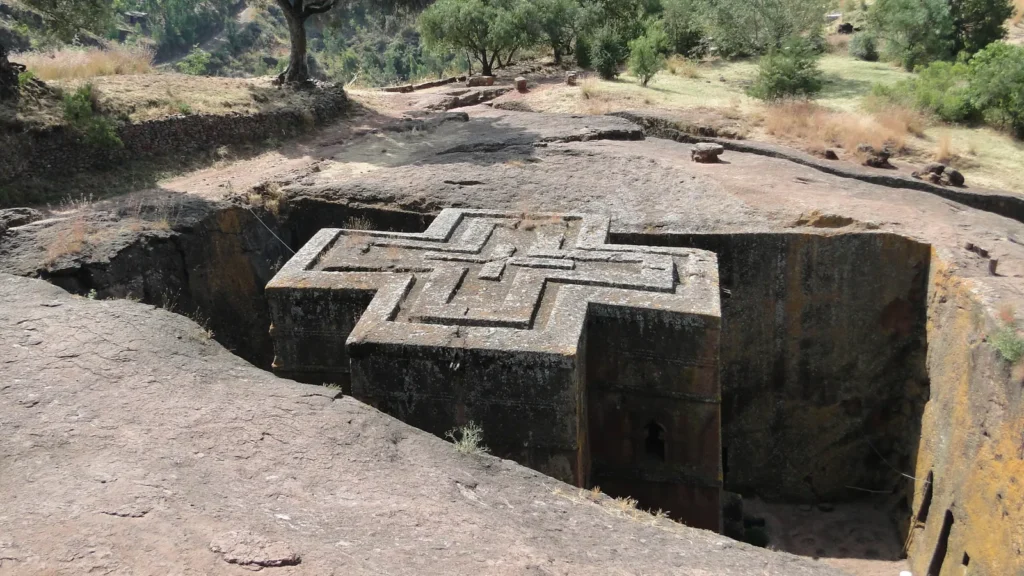
In a photograph of Lalibela’s rock-hewn churches, the cross-shaped roof of Saint George looks almost level with the ground. Its doorway is much lower. That gap is the clue: the church stands where its builders left rock in place and cut the courtyard down around it.
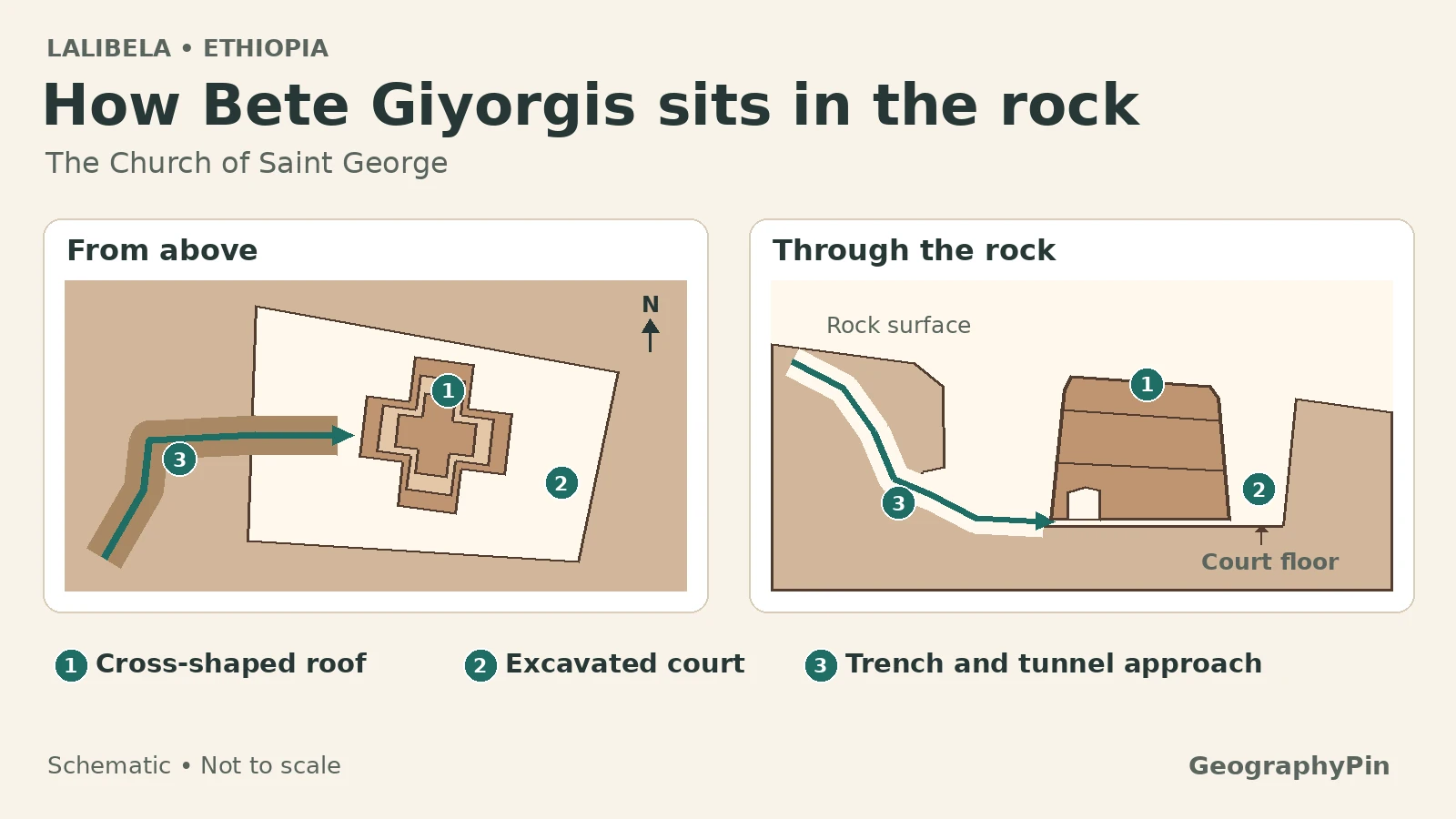
Lalibela’s builders carved downward into volcanic rock. For freestanding churches such as Bete Giyorgis, they cut around a solid mass, shaped its roof and outside walls, then hollowed out the interior. A trench and tunnel let worshippers descend to the court. Other churches were left attached to the surrounding rock.
How to use this article: match the photograph to the cutaway, see how the rock was removed, or compare a church that remained attached.
The roof is near the surface, the doorway is not
Find the roof, the court and the route down
Look at the opening photograph of Bete Giyorgis, the Church of Saint George. The cross is the top of the building, not a platform on which it rests. The lip in the foreground is the original ground surface outside the cut. It hides part of the church’s wall and the courtyard below. At court level, the same building looks tall rather than sunken.

In plan, you see the sideways relationship: a cross standing inside a wider cut. In section, you see the missing rock below the surface and how the approach from the west reaches the lower court. The green line follows the idea of the trench and tunnel, not every turn or step in the actual passage.
How carving a church differs from building one
A roof first, then walls and rooms
A stone building usually grows upward as workers add material. At Lalibela, the Metropolitan Museum of Art’s account describes workers outlining structures in volcanic rock, then isolating the mass they intended to keep. They worked down the exterior and removed stone inside to create usable rooms, leaving the pieces needed for walls, ceilings and supports. Retaining a pillar in that process means not cutting it away in the first place.
At Bete Giyorgis the open cut also made a deep courtyard that could collect runoff. Drainage channels and trenches are part of the broader complex, not incidental gaps between buildings. The same act of removing rock made structures and defined the spaces between them: courts, connecting passages and routes for water.
Not all eleven churches stand free
Bete Giyorgis and Biete Abba Libanos keep different parts of the rock
Bete Giyorgis is freestanding within its court. The rock was cut away around all four sides of the church, leaving the building connected to the bedrock at its base. Biete Abba Libanos, in the southern group, remains connected to the rock above its roof. The façades and the spaces around them were carved, but the roof was not fully separated from the overhanging rock. The Zamani Project’s survey views show this contrast.
That is why rock-hewn does not necessarily mean freestanding. The first describes how builders made the church; the second describes what they left connected. UNESCO counts eleven churches in the complex, not eleven detached buildings of the same form.
What can be dated, and what tradition tells us
Ethiopian Orthodox tradition credits King Lalibela with the churches and remembers the complex as a New Jerusalem. Those traditions explain the place’s religious significance. They are not a year-by-year construction record. Archaeologists have reconstructed relative phases from cuts that cross or interrupt earlier features and from evidence such as quarry debris. Those relationships can show which feature came first without giving a calendar date for every church.
Lalibela remains a place of Ethiopian Orthodox worship and pilgrimage. Its passages are not simply service corridors around a historic building; they are routes into a living sacred space. Our Ethiopia country profile puts Lalibela in the wider northern highlands.
Frequently Asked Questions
Are all eleven Lalibela churches freestanding?
No. Saint George is carved free around its sides, but other churches retain connections to the surrounding rock. Biete Abba Libanos is a clear example because its roof remains joined above.
How certain are the construction dates?
The connection to the medieval kingdom and the tradition of King Lalibela are well documented. Precise dates for individual cuts and churches are less certain. Researchers find evidence of successive phases, so a single date for all eleven would overstate what is known.
What Did We Learn Today?
The roof of Saint George sits near the rim because the builders cut down around it, leaving a solid core to shape and hollow. The court and the passage are part of that design. At other churches, such as Biete Abba Libanos, builders left more of the surrounding rock connected.
Sources & Data Notes
Open the architectural surveys, chronology and image credit
- UNESCO World Heritage listing for the eleven churches, drainage works and pilgrimage; Kristen Windmuller-Luna’s Metropolitan Museum of Art essay for the carving method, architecture and traditional account.
- Zamani Project survey and Bührer and colleagues’ photogrammetry paper for the court, outline and trench-and-tunnel access. GeographyPin’s independent schematic simplifies the terrain and is not a measured section.
- Fauvelle-Aymar and colleagues, rock-cut stratigraphy study (2010), on reading successive cuts, openings and archaeological deposits.
- Cover: Bernard Gagnon, Bete Giyorgis from the rock rim, November 8, 2012, CC BY-SA 3.0. Cropped.