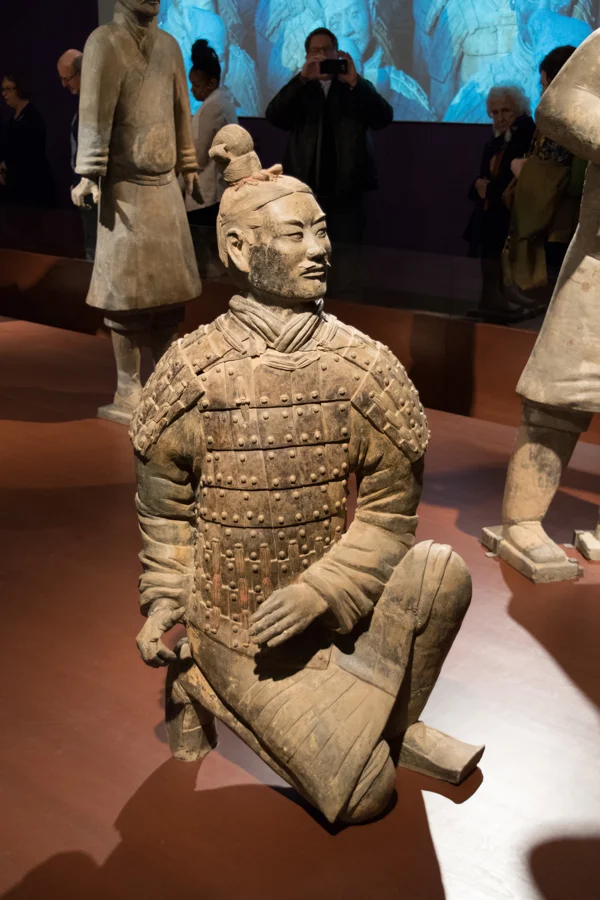
Look at the bent leg of a terracotta archer from Pit 2 rather than at the famous ranks of soldiers. That small change in posture is a clue to what the distant rows can hide: not every figure was meant to do the same job, and not every pit was designed for the same purpose.
The Terracotta Army is a set of life-size clay warriors and horses buried near Qin Shi Huang, the first emperor of a unified China. Pit 1 holds the main formation, Pit 2 mixes archers, cavalry and chariots, and Pit 3 is often interpreted as a command post. The emperor’s burial chamber is separate.
How to use this article: Compare the Pit 2 archer with the evidence for a command post, then see what happened to the painted surfaces.
What the three Terracotta Army pits contain
The warrior pits are in Lintong, east of central Xi’an in Shaanxi province. Within the mausoleum complex, they lie about 0.9 mile (1.5 kilometers) east of the emperor’s burial mound. Local farmers digging a well encountered Pit 1 in 1974. The underground deposits belong to the same World Heritage property, but the pit halls and the burial mound are different places. The China geography guide puts Shaanxi in its wider regional setting.
| Pit | Look for | What it helps explain |
|---|---|---|
| 1 | Standing soldiers arranged in long ranks | A large formation with an infantry core, accompanied by chariots and horses |
| 2 | A kneeling archer; separate groups of figures and horses | Different kinds of troops arranged together rather than another copy of Pit 1 |
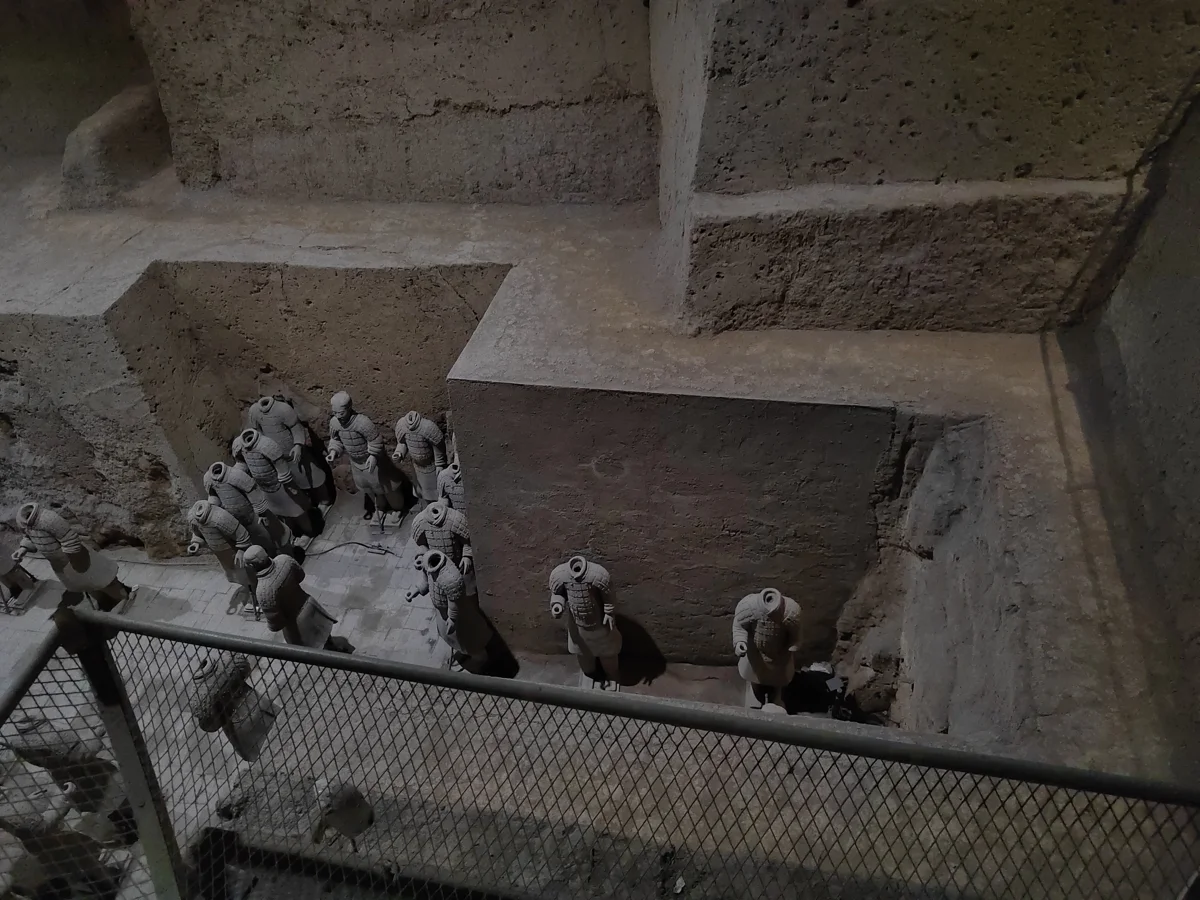
| 3 | Small side chambers and a chariot group | Why archaeologists have proposed a command function, rather than a field formation |
The site museum estimates that Pit 1 alone originally held around 6,000 pottery figures and horses, extrapolating from the density in trial excavations. That is not a tally of complete figures already unearthed, restored or on public display. Much of the excavated material was found in pieces.
How to read the army’s formations
Pit 1: Follow the rows, not just the faces
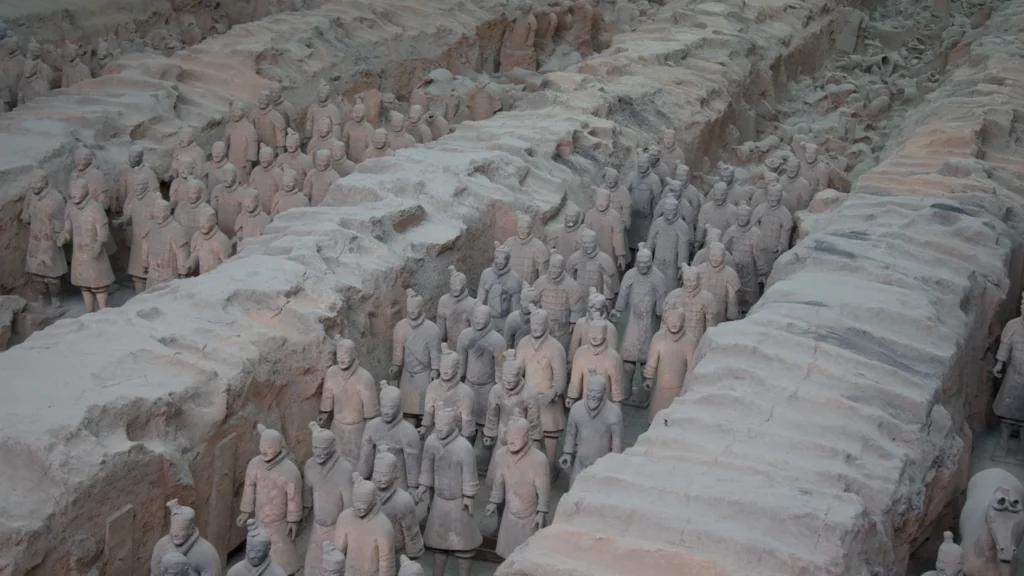
The view in the cover photograph is Pit 1. Rows of soldiers stand between earthen partitions. Instead of looking for an unusual face first, look down one corridor and across to the next. The repeated alignment shows a formation, while differences in armor and equipment help distinguish roles within it. An excavated formation tells archaeologists more about organization than a single isolated figure can.
Pit 2: One bent knee tells you where to look
The figure below was excavated from Pit 2 and photographed during a museum display in Chicago. Its bent leg and body position are clues to its role as an archer. The pit also contains evidence of cavalry and chariots, so it preserves more than one military grouping. The pose identifies an intended role; it does not tell us whose face, if anyone’s, was modeled.
Excavation can also change the reading of a formation. In the museum’s 2025 work in part of Pit 2, archaeologists uncovered two chariots, 15 sets of vehicle and horse equipment and nine weapons. The position of the finds led the museum to assign that corridor to a different unit than previously thought. The reported counts refer to that excavation, not the whole pit.
Pit 3: Why the smallest pit looks like a headquarters
Pit 3 has a smaller, compartmentalized layout, with side rooms and a space for a chariot. The separate rooms and the small group around the vehicle are part of why specialists interpret the pit as a possible command post for the larger formations. No surviving sign labels it as one.
The warriors’ original colors and weapons
The surviving clay is not the original finish
The warriors were once painted. Researchers have found remnants of bright pigments and an underlying layer of lacquer, a hardened coating applied to the fired clay. After excavation, a change in moisture can cause the coating and paint to shrink and flake. That helps explain why a sculpture can look mostly earth-colored today without having looked that way when buried.
Paint traces are evidence for particular preserved surfaces. They do not tell us that every soldier wore the same colors, and a modern painted replica should not be mistaken for an original figure with intact paint.
Some weapons were real, even though the soldiers were clay
Excavators found bronze weapons and fittings, including crossbow triggers and arrowheads, in the pits. Wooden parts such as shafts and stocks generally survive less well. The position of durable fittings can help explain how missing pieces were once arranged, but a metal trigger does not mean an entire crossbow remains.
A chemical study also tested the claim that Qin artisans deliberately gave the weapons a chromium coating to stop corrosion. The researchers found that chromium traces were consistent with contact with nearby lacquer, not a systematic anti-rust treatment; they pointed to the burial soil as part of the explanation for the good preservation.
What lies beyond the army pits
The army makes most sense as part of an imperial burial landscape. Other deposits in the complex included nonmilitary figures, so the warrior pits are only one piece of what was placed around the first emperor. Qin Shi Huang created a unified empire in 221 BCE; putting a representation of military power in his mausoleum was consistent with the scale of that project. Protection in the afterlife is a common interpretation of the army’s purpose, not a written instruction recovered from the pits.
The central burial chamber is not open to visitors and has not been excavated. The mound can be located on UNESCO’s site maps, but an aerial map cannot tell you what is inside it. Later written accounts describe elaborate features in the tomb; they are historical testimony, not a record of a modern excavation. The Terracotta Army is also not one of the conventional Seven Wonders of the Ancient World, a separate list from the Mediterranean world.
Frequently Asked Questions
Were the warriors originally painted?
Yes. Traces show that color was applied over lacquer. In addition to explaining the present clay color, that distinction matters when comparing two finds: one figure may have preserved more paint because of its burial and excavation conditions, not because it was painted more richly.
Is the emperor’s burial chamber open to visitors?
No. The museum’s warrior pit halls and the archaeological park around the mound are parts of the same complex. Visiting the park means seeing the mound area, not entering the chamber.
What Did We Learn Today?
The long ranks of Pit 1, the different kinds of troops in Pit 2 and the compact rooms of Pit 3 give three different views of the same buried army. Surviving weapons and pigment make the figures easier to understand, but they do not tell us what is inside the emperor’s unopened burial chamber.
Sources & Data Notes
Open archaeological sources and photo credits
Pit numbers follow the museum’s labels. Counts refer to the scope stated: the museum’s estimated Pit 1 total is distinct from the finds in the museum’s 2025 excavation. A proposed function for Pit 3 is marked as interpretation.
- UNESCO: Mausoleum of the First Qin Emperor
- Mausoleum Site Museum: archaeological park and warrior-pit guide
- Xi’an: findings from the 2025 work in Pit 2
- Smarthistory: The Tomb of the First Emperor
- Smarthistory: the army and the sealed burial chamber
- Quinn and colleagues: study of figure manufacture and find context
- Scientific Reports: chromium and preservation of the bronze weapons
Photographs: Pit 1, Maros Mraz, CC BY-SA 2.5, cropped and resized; Pit 2 archer, Difference engine, CC BY-SA 4.0, resized; Pit 3, 沈澄心, CC0 1.0, resized. All via Wikimedia Commons.