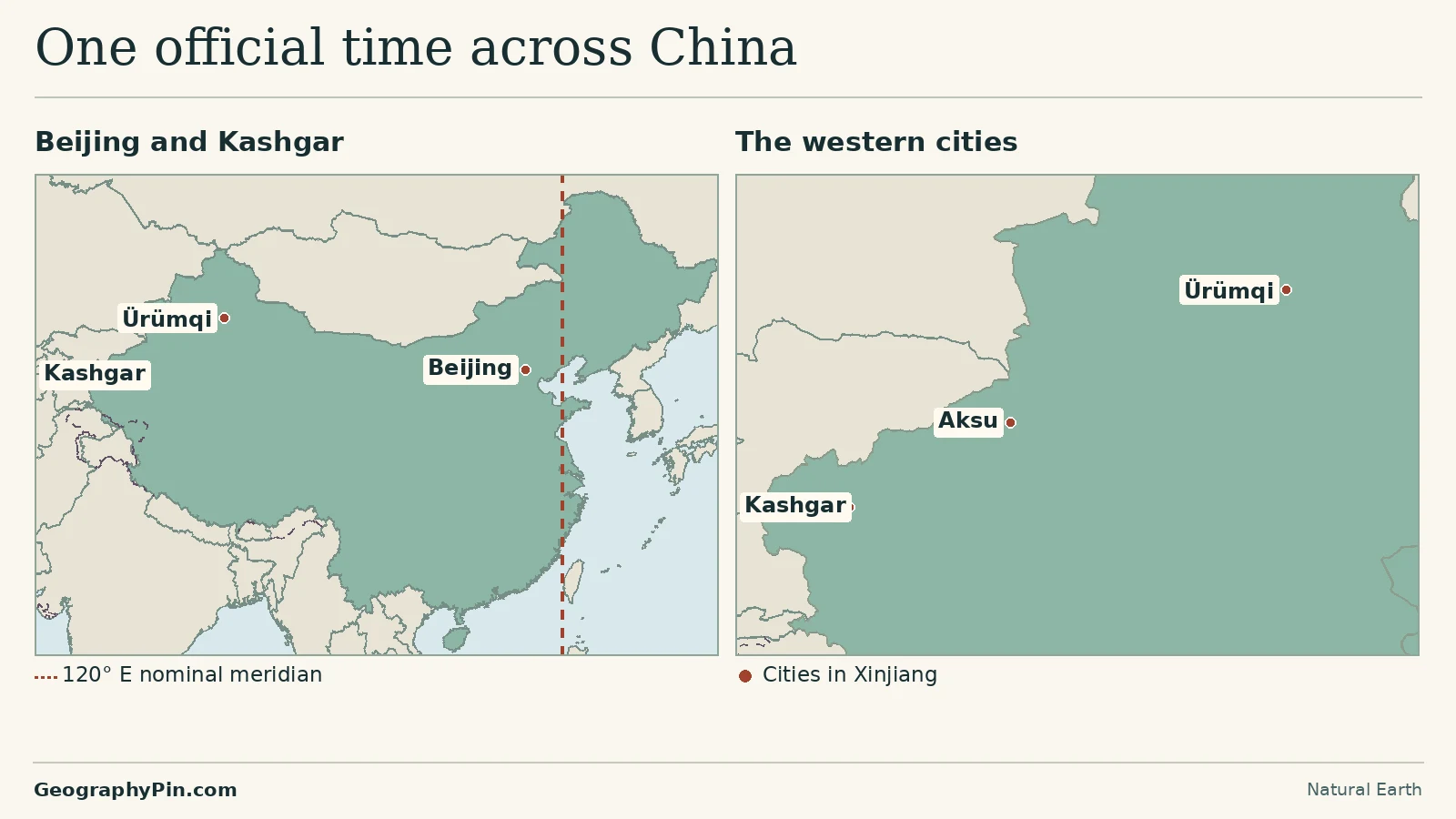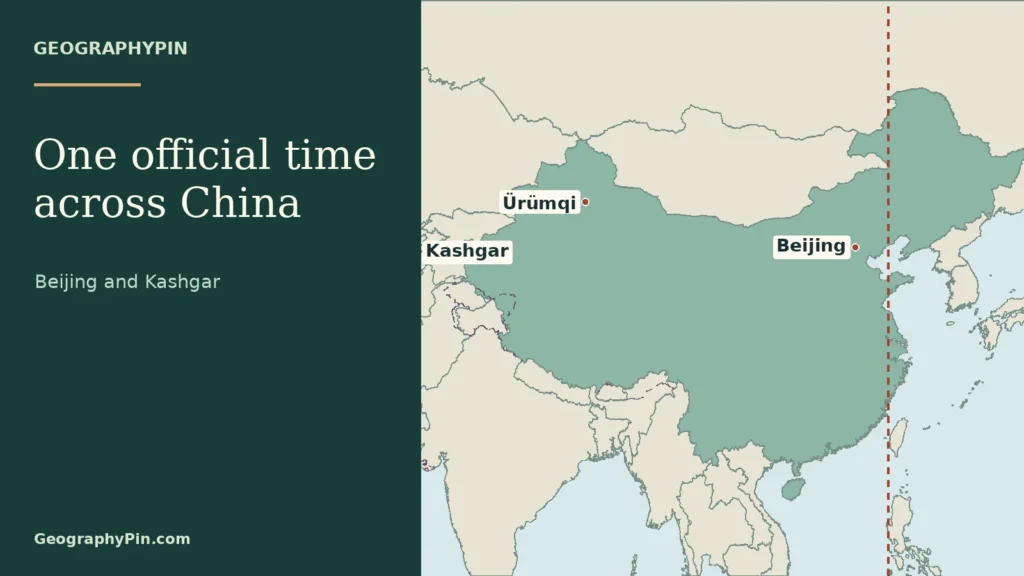
At 12:00 on the official clock, Beijing is close to its solar noon. In Kashgar, in the far west, the sun still has nearly three hours to go on a June day. Both cities are using the same civil time correctly.
Mainland China uses one official civil time, Beijing Time, at UTC+8. A common standard keeps national transport, communications and government schedules on one clock across a wide span of longitude. Daylight occurs much later by that clock in western China. Some people in Xinjiang also use a local UTC+6 convention, making it important to identify the clock being quoted.
How to use this article: Jump to the discussion you need: What Beijing Time refers to, The same appointment on two clocks or What a traveler means by “at ten”.
Compare Beijing and Kashgar at similar latitudes
| City | Longitude | Calculated sunrise | Calculated solar noon |
|---|---|---|---|
| Beijing | 116.41° E | 4:46 a.m. | 12:16 p.m. |
| Kashgar | 75.99° E | 7:29 a.m. | 2:58 p.m. |

The cities lie near 40° north. Their summer daylight lengths are therefore relatively similar, even though daylight occurs at different hours on the clock. Their longitude difference is about 40.4 degrees. At four minutes per degree, that gives about 162 minutes between solar noons. The calculation explains the late western clock time without requiring a difference of nearly three hours in day length.
What Beijing Time refers to
UTC+8 corresponds to a nominal standard meridian of 120° E. The city of Beijing lies west of that meridian. The name of the national clock does not mean that its noon is the exact solar noon of Beijing on every date. The National Time Service Center distributes the standard using timekeeping infrastructure, not a daily observation at a particular Beijing street corner.
How one official time spread across a broad country
Different regional standards had been considered and used in China before the People’s Republic was established in 1949. The national use of Beijing Time consolidated official timekeeping around a common reference. The wider geography of China makes the compromise visible: a one-clock map removes civil clock changes on long journeys while leaving considerable local differences in daylight.
What a traveler means by “at ten”
A schedule printed in Beijing time uses the same official clock throughout the trip.
Local convention and official schedules
The same appointment on two clocks
A train listed at 10 a.m. Beijing time (UTC+8) departs at 8 a.m. on the local Xinjiang clock (UTC+6). A railway timetable identifies its convention. A dinner invitation may leave it unstated.
In a phone’s time-zone settings, Asia/Shanghai represents the national clock; Asia/Urumqi represents the local convention documented by IANA. For a meeting, ask the host, “Is that Beijing time or Xinjiang time?”
Why the whole-hour offset cannot fix solar noon everywhere
Moving Kashgar’s clock back two hours would put the June example’s solar noon at about 12:58 p.m., closer to clock noon but still almost an hour later. Cities within a zone have different longitudes and the sun’s apparent timing varies seasonally. The same principle explains why time-zone boundaries zigzag instead of providing exact solar time at every location. A nearby pair of cities on the Spain–Portugal time-zone boundary shows how places at almost the same longitude can keep legal clocks an hour apart.
Frequently Asked Questions
Is 2:58 p.m. solar noon the same every day in Kashgar?
No. Longitude sets the largest part of the difference, while the sun’s apparent timing varies through the year. The table applies to the specified date.
Can a phone show a different time from a national train schedule?
A device can be manually set to a different zone. Use the time basis printed by the operator and compare offsets explicitly when agreeing on a meeting.
What Did We Learn Today?
Beijing and Kashgar share an official clock while their daylight follows longitude. The UTC+6 convention in Xinjiang adds a second clock reading for some activities, not a second physical sunrise.
Sources & Data Notes
Calculated times use Astral 3.2 and city-center coordinates at zero elevation, with a clear horizon and standard refraction. The table uses June 21, 2026 and UTC+8 throughout. Civil-time examples were checked against IANA Time Zone Database release 2026f.