An Icelandic employee and a Norwegian employee may both work under collectively negotiated terms. That tells us little about whether each belongs to a union, who owns the employer or which level of government finances health care.
Denmark, Finland, Iceland, Norway and Sweden combine open market economies with broad public services and influential collective bargaining. They differ in how agreements extend to workers, how many employees are union members, and where the state owns companies. The Nordic model is a family of institutions with measurable differences across the five countries.
How to use this article: Jump to the discussion you need: Where is the national minimum wage, Why Norwegian petroleum stands out or One public-service measure for the same five countries.
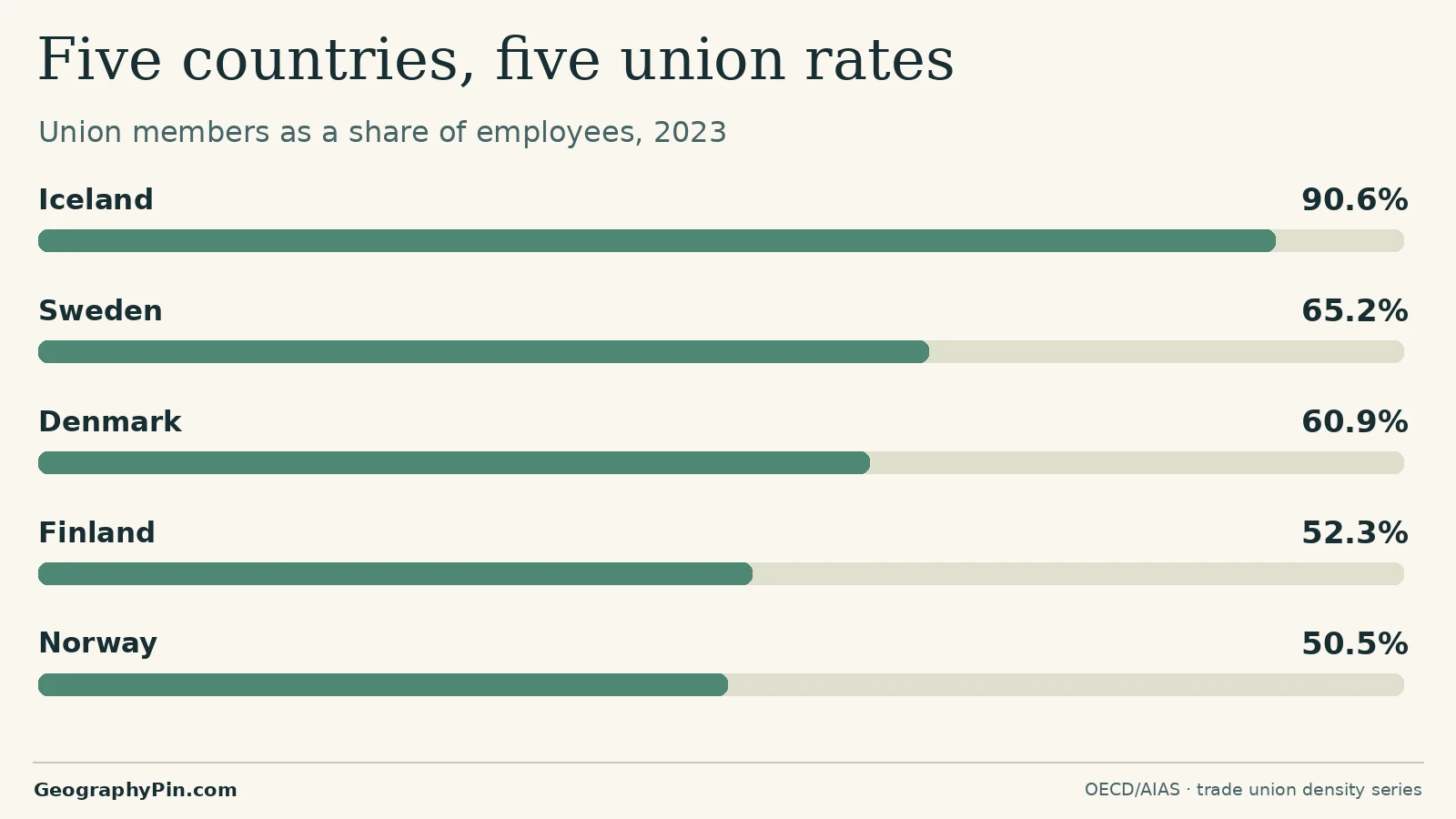
Five labor markets measured in the same year
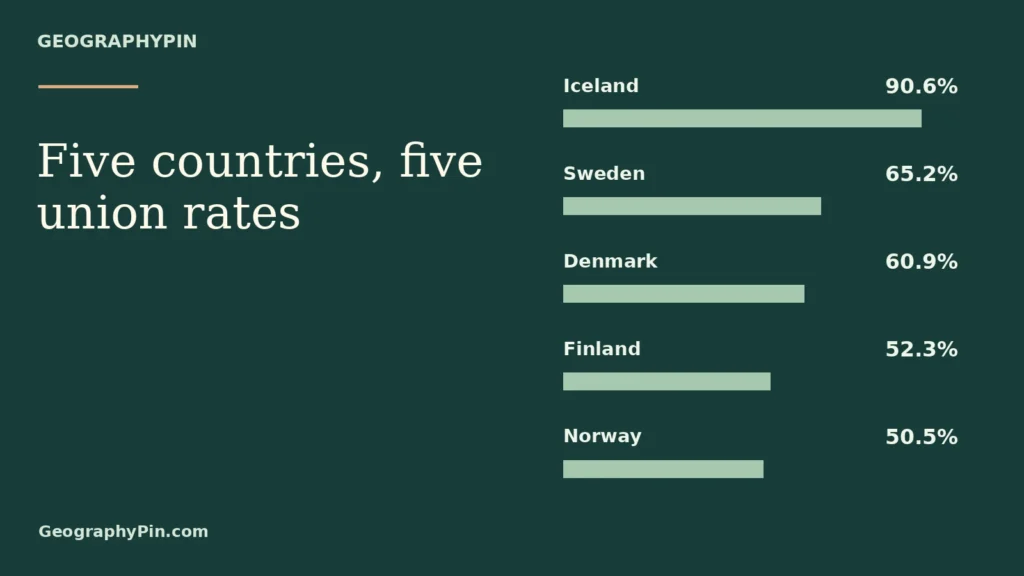
| Country | Union density | What to notice |
|---|---|---|
| Denmark | 60.9% | Major wage standards come through agreements. |
| Finland | 52.3% | Generally binding agreements can cover nonmembers. |
| Iceland | 90.6% | The highest membership share in this five-country comparison. |
| Norway | 50.5% | Some sectoral terms are extended by law. |
| Sweden | 65.2% | Unions and employers negotiate wage standards. |

The comparison uses an OECD series on trade union density and the same reference year for all five. Iceland and Norway differ by 40.1 percentage points. That is the difference between percentages of employees, not the difference between their labor forces in numbers of people. The five sovereign states are the unit here. The wider Nordic region also includes autonomous areas with their own institutions.
How agreements reach beyond the membership list
Suppose a firm applies the same negotiated rates to 100 workers and 60 belong to the union. Density inside that firm is 60%. Coverage can reach 100%. Conversely, an agreement might cover workers in one industry while leaving workers in another subject to different arrangements. OECD bargaining coverage and union density therefore cannot substitute for each other.
A new hire can receive the negotiated rate without joining the union. That can happen because the employer applies a collective agreement across the workplace or because its terms have been extended to the industry. To check coverage, look at the applicable agreement and extension rules.
Where is the national minimum wage?
There is no single statutory national minimum wage shared by these five economies. In Denmark and Sweden, agreements negotiated by the social partners do much of the work associated with minimum-wage legislation elsewhere. Finland and Iceland have mechanisms that give negotiated minimum terms broader effect. Norway applies statutory minimum rates in designated sectors through extension. An employee comparing job offers needs the country, industry and applicable agreement.
Public services and ownership answer different questions
All five countries arrange broad access to health care through public systems, although the responsible authorities, charges and choice of provider differ. A publicly financed visit can take place in a practice owned by someone outside government. To compare service provision across countries, specify whether the indicator measures access, public spending or ownership of clinics. These are distinct measures even when they point to similarly broad access.
Why Norwegian petroleum stands out
Norway’s state holds a controlling interest in Equinor and also manages petroleum interests through other institutions. State ownership of a large energy producer is a specific feature of the Norwegian economy. It cannot be transferred by analogy to a Swedish manufacturer or a Danish shipping company. The market value of one company also cannot establish a Nordic regional public-ownership share.
A reader asking whether Sweden is socialist will get further by identifying the asset or institution in question. Broad labor agreements constrain wage-setting. Public budgets finance services. Shareholders own companies. Each can influence the others without doing the same job.
One public-service measure for the same five countries
WHO and UNICEF’s 2023 estimates for three doses of childhood DPT vaccine were 97% in Denmark, 91% in Finland, 92% in Iceland, 96% in Norway and 94% in Sweden. The World Bank publishes this series for children aged 12–23 months. Iceland leads the union-membership table above, while Denmark leads this particular health indicator. The two rankings measure different institutions and different populations.
Comparing public services and company ownership
The same discipline improves a comparison of public services and ownership. Ask how many children received a defined set of doses to describe vaccination coverage. Ask who controls votes in a named enterprise to describe corporate ownership. Ask where a hospital obtains its funds to describe financing. Each comparison can say something about a Nordic institution. Adding their percentages together would produce an index without a meaningful denominator. A comparison with the word socialist in India’s constitution shows what is lost when a legal label replaces a measure of how a particular institution works.
Frequently Asked Questions
Why use 2023 when later observations exist?
The OECD series gives a value for all five countries in 2023. Selecting a more recent observation for only some countries would quietly change the reference period across rows.
Are Sweden and Denmark required to use identical bargaining rules?
No. The countries have separate labor institutions. The common feature is the importance of negotiation by workers’ and employers’ organizations, not a single Nordic legal code.
What Did We Learn Today?
The size of a union, the reach of a contract and the ownership of a firm each describe a different institution. Looking at the same measure across all five countries reveals both the family resemblance and the national differences.
Sources & Data Notes
Evidence checked November 23, 2026. The table uses the OECD/AIAS trade union density series for 2023, rounded to one decimal place. Coverage concerns workers under agreements and has its own definitions and reporting years.
- OECD Data Explorer, trade union density
- International Labour Organization, minimum wages in Nordic countries
- Nordic Council of Ministers, wage formation in the Nordic model
- WHO and UNICEF via the World Bank, childhood DPT immunization
- OECD, labour mediation in the Nordic countries
- OECD, mediation and collective bargaining in Nordic labor markets