A cash price in a Vientiane market reveals little about how national political power is organized. In Laos, the constitution itself describes how party leadership and market activity fit together.
Laos is a communist-party-led state. The Lao People’s Revolutionary Party holds the leading political role, and the constitution describes a socialist-oriented market economy with several forms of ownership. The New Economic Mechanism introduced in 1986 expanded reliance on prices, trade and enterprise decisions. It did not establish competitive multiparty government.
Compare a farm and a power project, see who owns Nam Theun 2, or distinguish changing economic rules from changing who governs.
Read the party provision and the economy provision together
| Date | Political framework | Economic ownership or policy |
|---|---|---|
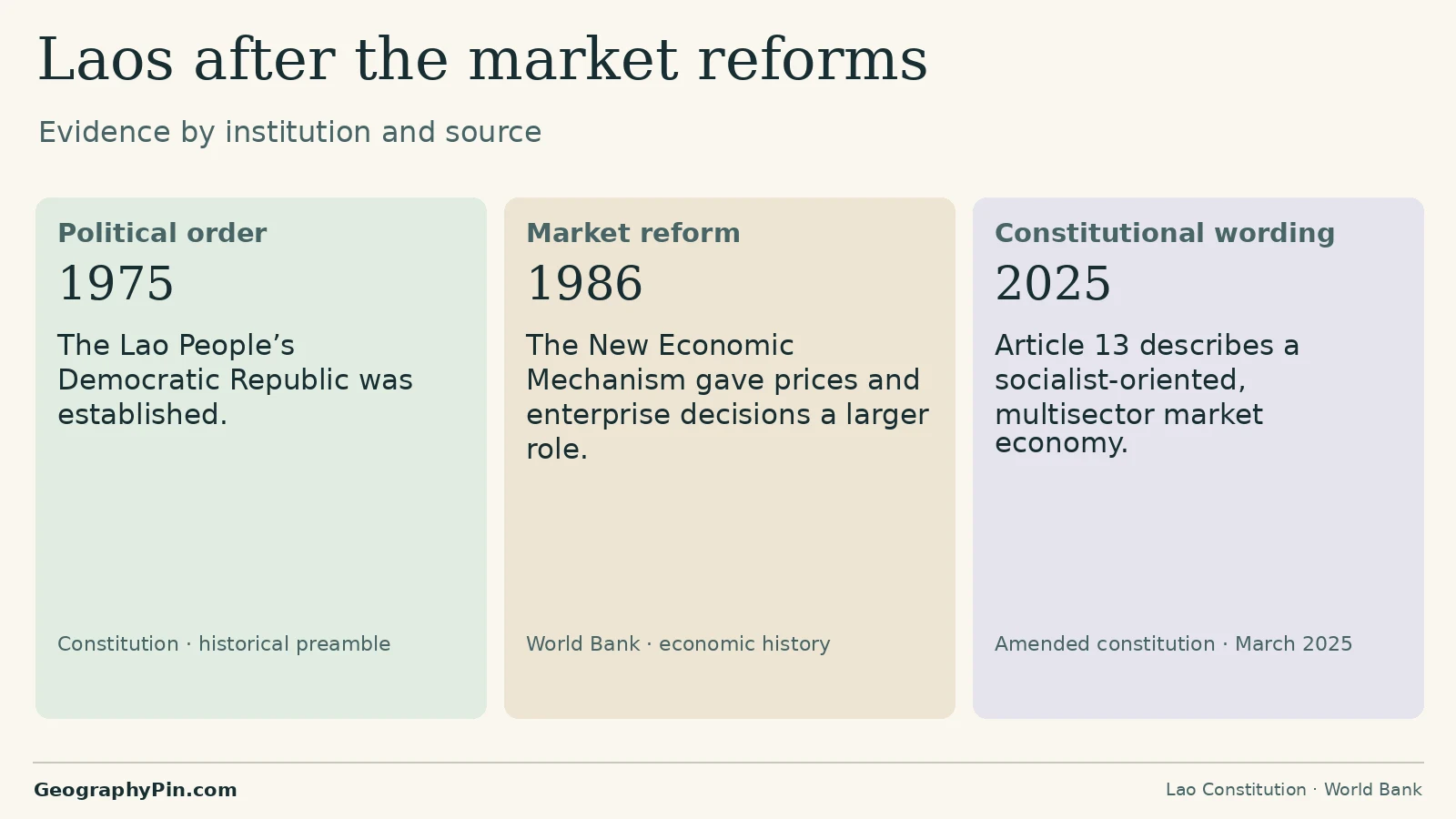
| 1975 | Lao People’s Democratic Republic formed under the revolutionary party. | A centrally directed socialist economy became the policy framework. |
| 1986 | Party leadership continued. | New Economic Mechanism broadened market pricing and enterprise decisions. |
| 1991 | First constitution of the Lao PDR formalized the political order. | The constitution recognized more than one economic sector. |
| 2025 | Article 3 of the amended constitution identifies the party’s leading role. | Article 13 sets out a multisector, socialist-oriented market economy. |

When a list of communist countries uses the governing party as its criterion, Laos fits. If the question is whether a private firm may trade, that list has answered the wrong question. The 2025 constitution places both types of institution inside one system.
What changed with the New Economic Mechanism?
An administered price is set through a public decision. A market price emerges through exchange between buyers and sellers, even where the state regulates the market. The reforms weakened the role of centrally assigned prices and production decisions and opened space for private initiative and trade. Their effects unfolded over years. A reform announced in 1986 did not transform every farm or enterprise that year.
A farm and a power project
A grower on the Bolaven Plateau can sell coffee to a trader or cooperative. The sale establishes a price and changes ownership of the crop. It does not transfer ownership of all the land where the crop was grown. The Lao constitution and land system distinguish nationally held land and legally recognized rights to use it. A claim about a sack of coffee and a claim about the field require different documents.
Nam Theun 2 offers a second example on a different scale. The project involves a power company, public and private participants, and arrangements for selling electricity, including across the border to Thailand. One must distinguish the concession, the shareholders, the buyer and the regulator. Calling hydropower a national economic priority alone tells us none of those things.
Who owns the Nam Theun 2 power company?
The company identifies three shareholders. EDF Nam Theun Holding has 40%, Thailand’s EGCO has 35%, and Lao Holding State Enterprise has 25%. Thus the Lao state enterprise holds one quarter of this particular company. It does not follow that Laos owns one quarter of every dam, or that the other three quarters represent private Lao savings. The foreign shareholders and the project concession each have a separate role.
Why the geography of trade matters
Laos has no seacoast. Electricity lines cross its borders, and agricultural goods must reach foreign markets through neighboring countries. This is one reason that cross-border demand can influence production in a party-led state. The country’s river basins and land borders help explain the routes through which that influence arrives.
Changing a rule versus changing who governs
Private investment in a power project can coexist with political authority concentrated in the party. Likewise a government can impose new conditions on an industry without converting every producer into a government department. To trace a specific reform, ask about the decision that moved. Who sets a price, chooses an investment, grants a concession or appoints a public official? Those are observable, separate changes.
Why Thailand appears in a story about Lao economic policy
The Nam Theun 2 station was designed to supply both an export market and the domestic system. World Bank project records give a total installed capacity of 1,070 megawatts, of which about 1,000 megawatts were designated for export to Thailand and 70 for domestic supply. These are capacity allocations. A megawatt measures power at a point in time. Electricity actually delivered over a year is measured in megawatt-hours and depends on generation and operating conditions.
Imagine that a Thai buyer purchases a unit of electricity under the project agreement. The customer’s nationality identifies a destination for the sale. It does not allocate shares in the power company, establish who owns the generating site, or give the buyer an electoral role in Laos. The shareholder list and the purchasing arrangements can be examined separately precisely because a market-oriented project operates across a national boundary.
A coffee shipment makes the same point on a much smaller scale. A highland grower needs a buyer, transport and somewhere to process the beans. Market prices can influence the next planting decision even when the constitution reserves a leading role for one political party. Compare the actual decision being made: crop selection at the farm, investment approval on a dam or selection of political leaders. The actors with authority differ in all three cases.
Frequently Asked Questions
Why do sources use both Laos and Lao PDR?
Laos is the common English short name. Lao People’s Democratic Republic is the state’s formal English name and appears on constitutional texts and international economic reports.
Does a market sale demonstrate private freehold ownership of land?
No. Sellers can own a crop or hold rights to use land under arrangements that differ from private freehold. The commodity transaction identifies neither title nor the extent of land-use rights.
What Did We Learn Today?
Party leadership and the allocation of goods are different questions. Constitutional rules identify the leading party, while farm transactions and power contracts show how markets and public authority operate together.
Sources & Data Notes
Evidence checked November 23, 2026. The legal comparison uses the March 2025 amended constitution. The 1986 policy launch is a historical milestone. Project ownership and land-use rights must be checked separately for any individual case.