The word socialist is easy to find in Portugal’s constitution. The passage that answers a shop owner’s question about starting a business is farther down the document.
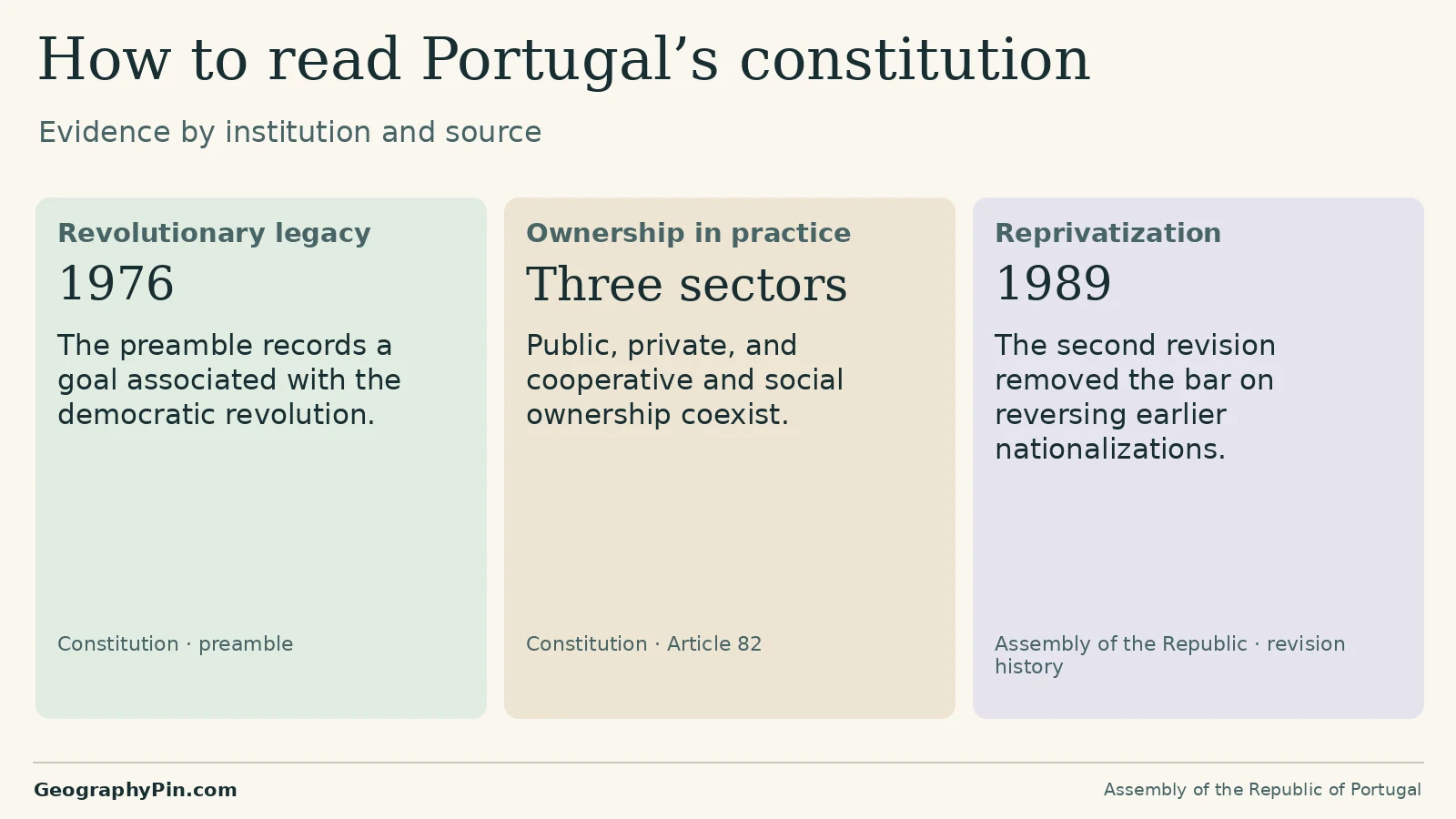
Portugal has a mixed economy. Its constitutional preamble preserves the revolutionary aspiration to open a path toward a socialist society, while Articles 61, 80 and 82 protect private initiative and recognize public, private, and cooperative and social ownership. Both parts belong to the same constitution. They answer different questions about the Portuguese state.
How to use this article: Jump to the discussion you need: The revision that changed the ownership question, Follow an owner, a customer and a regulator or What the enterprise series actually counts.
What Portugal’s constitution says about ownership
| Passage | Its subject | A concrete implication |
|---|---|---|
| Preamble | The purpose associated with the democratic revolution | Explains a political aspiration. |
| Article 61 | Private, cooperative and self-managed initiative | Protects the ability to undertake economic activity within the law. |
| Article 80 | Principles of economic organization | Specifies coexistence of ownership sectors and enterprise in a mixed economy. |
| Article 82 | Sectors owning the means of production | Distinguishes who owns and manages productive assets. |
Follow an owner, a customer and a regulator
Consider a bakery selling bread to a public school. The baker owns the business, the school is the customer, and the municipality enforces food-safety rules. The school’s purchase counts as public spending. If the workers instead own the bakery as a cooperative, it falls in the cooperative sector recognized by Article 82.

The preamble is relevant evidence about the republic’s history. It is a poor source for deciding whether someone can open a bakery today. For that question, start with the guarantee of initiative, then read the economic-organization articles. The distinction also explains how two people quoting the same document can sound as if they are describing different countries.
Why the words from 1976 stayed
Portugal’s democratic revolution began in April 1974. The constitution adopted in 1976 followed a period of nationalizations and deep disagreement about political and economic power. Its opening language records that setting. It has outlived many of the detailed arrangements that accompanied it.
The revision that changed the ownership question
Parliament’s account of the 1989 revision singles out the removal of the principle that post-revolution nationalizations were irreversible. That opened a constitutional route to reprivatization. It did not require the immediate sale of every publicly owned company. The revision history and the effective text therefore serve different purposes. One explains how the rules evolved, the other describes the framework in force.
The seventh constitutional revision dates to 2005. Calling today’s document “the 1976 Constitution” identifies its origin. It does not mean that every clause still reads as it did in the first edition. Across the border, Spain’s constitution also addresses private enterprise, making it a useful comparison with Portugal’s post-revolutionary wording.
A business register cannot measure ideology
Statistics Portugal’s annual enterprise figures count businesses and track such measures as employment and turnover. An enterprise count gives the same unit weight to a small employer and a large corporation. Turnover gives larger sellers considerably more weight. Neither is a count of constitutional aspirations, and neither should be presented as a public-versus-private share unless the series actually separates ownership.
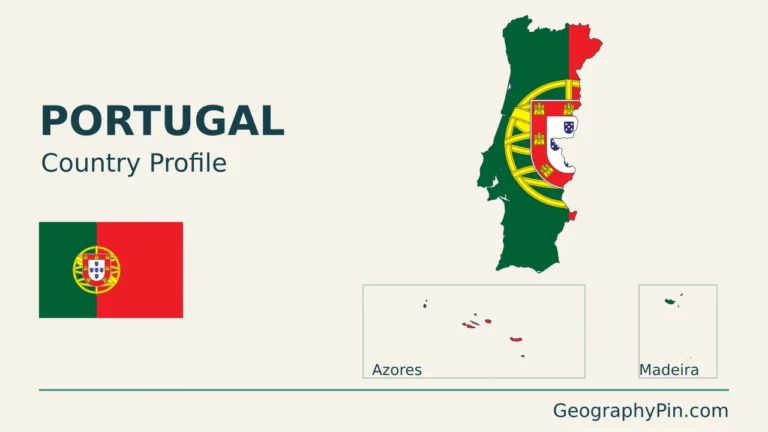
Portugal can retain public services, elect parties with different platforms, and have privately owned firms at the same time. The Portugal country profile gives the national setting. For comparisons across borders, GeographyPin’s guide to different definitions of socialism explains why a country list needs an inclusion rule.
What the enterprise series actually counts
The series compiled by Pordata from Statistics Portugal records 1,526,926 enterprises in 2023 and 1,593,415 in 2024. That is 66,489 more, or about 4.4% growth. A change in the number of enterprises reveals something about business activity. Determining how much production belongs to public enterprises requires both ownership classifications and a measure such as value added.
Public property, a public service and a public purchase
The economic articles make a distinction that matters outside a textbook. Article 82 classifies the ownership of the means of production. Article 84 identifies categories in the public domain, including specified waters and infrastructure. A law protecting a public resource answers a different question from the ownership of a company using that resource. The fishing boat, the water through which it travels and the firm buying its catch need not all fall in the same sector.
For a reader comparing Portugal with another European country, the most revealing comparison would hold the unit constant. Compare ownership of particular utilities, employment across industries or the share of households receiving a service. A count of all enterprises in Portugal and the public spending share in another country could both be accurate and still fail to answer the same question.
Frequently Asked Questions
Does a Socialist Party election victory change who owns Portuguese companies?
An election can change a government’s policy priorities. A change in ownership requires a legal or commercial transaction. The constitutional rules on the ownership sectors continue across changes in government.
Could Portugal reverse a nationalization after 1989?
The revision made reprivatization constitutionally possible. The history of any particular company still depends on the legislation and transactions affecting it.
What Did We Learn Today?
The preamble tells a reader what a revolution hoped to achieve. The economic articles protect several forms of ownership, and the revision record explains why an original 1976 quotation can be accurate yet incomplete today.
Sources & Data Notes
Legal references follow the Portuguese parliament’s consolidated text and revision history. Enterprise statistics use businesses as their unit, rather than households, workers or political parties.