Paraguay protects private property in its Constitution and shares ownership of a major hydroelectric company with Brazil. Those facts fit together once you separate what a government does from who owns the farms and businesses that produce goods and services.
No, not if “socialist economy” means that most productive assets are socially owned or controlled rather than privately controlled. Paraguay’s 1992 Constitution calls it a social state under the rule of law. It protects private property and market competition while assigning the state social duties. The 50–50 public ownership of Itaipú in its 2025 accounts describes one electricity producer, not the entire economy.
How to use this article: Start with the Colorado Party and the presidency, compare the Constitution’s economic rules, or go straight to the farm census and Itaipú’s two public owners.
| Source and date | What it shows |
|---|---|
| 1992 Constitution Articles 1, 107, 109 and 114 | Social duties, market competition, protection of private property and a commitment to agrarian reform. |
| 2022 agricultural census Ministry of Agriculture and Livestock | How many farm holdings reported land with definitive title and how much farm area fell under that form of tenure. |
| 2025 financial statements Itaipú Binacional | Paraguay’s ANDE and Brazil’s ENBPar held equal shares of this one hydroelectric company’s capital. |
Why “social” and “socialist” are not the same
Article 1 uses the Spanish phrase Estado social de derecho. A social state under the rule of law takes responsibility for protecting social rights. For instance, Article 68 says the state must protect and promote health as a fundamental right. That provision tells us what the state is supposed to do, not who owns the businesses in the health sector.
The Colorado Party and the presidency
The Colorado Party, formally the Asociación Nacional Republicana (ANR), describes its ideology as republican nationalism and also calls for social justice. The two ideas are not mutually exclusive. Santiago Peña and Pedro Alliana were elected on the ANR ticket in 2023. Vice President Alliana was sworn in as president on November 6, 2026, after Congress removed Peña. He took office to complete the same 2023–2028 term. That tells us who was governing at a particular date, not who owned Paraguay’s productive assets.
What Paraguay’s Constitution says about the economy
Private property, market competition and land reform
Article 107 protects the right to pursue a lawful economic activity and guarantees market competition. Article 109 guarantees private property but lets legislation define its limits in light of its economic and social function. Expropriation for public utility or social interest must be determined by law in each case. The article generally requires fair compensation in advance but makes an exception to that rule for unproductive large estates designated for agrarian reform. Article 116 says the law sets how and when compensation is paid for those estates.
Article 114 makes agrarian reform a goal. It calls for more equitable distribution and tenure of land and provides for measures such as rural credit, technical assistance and support for cooperatives. In other words, a commitment to widening access to land sits alongside the protection of private property. Neither provision measures how evenly land is distributed today.
What farms and Itaipú show about ownership
What a farm title does and does not tell us
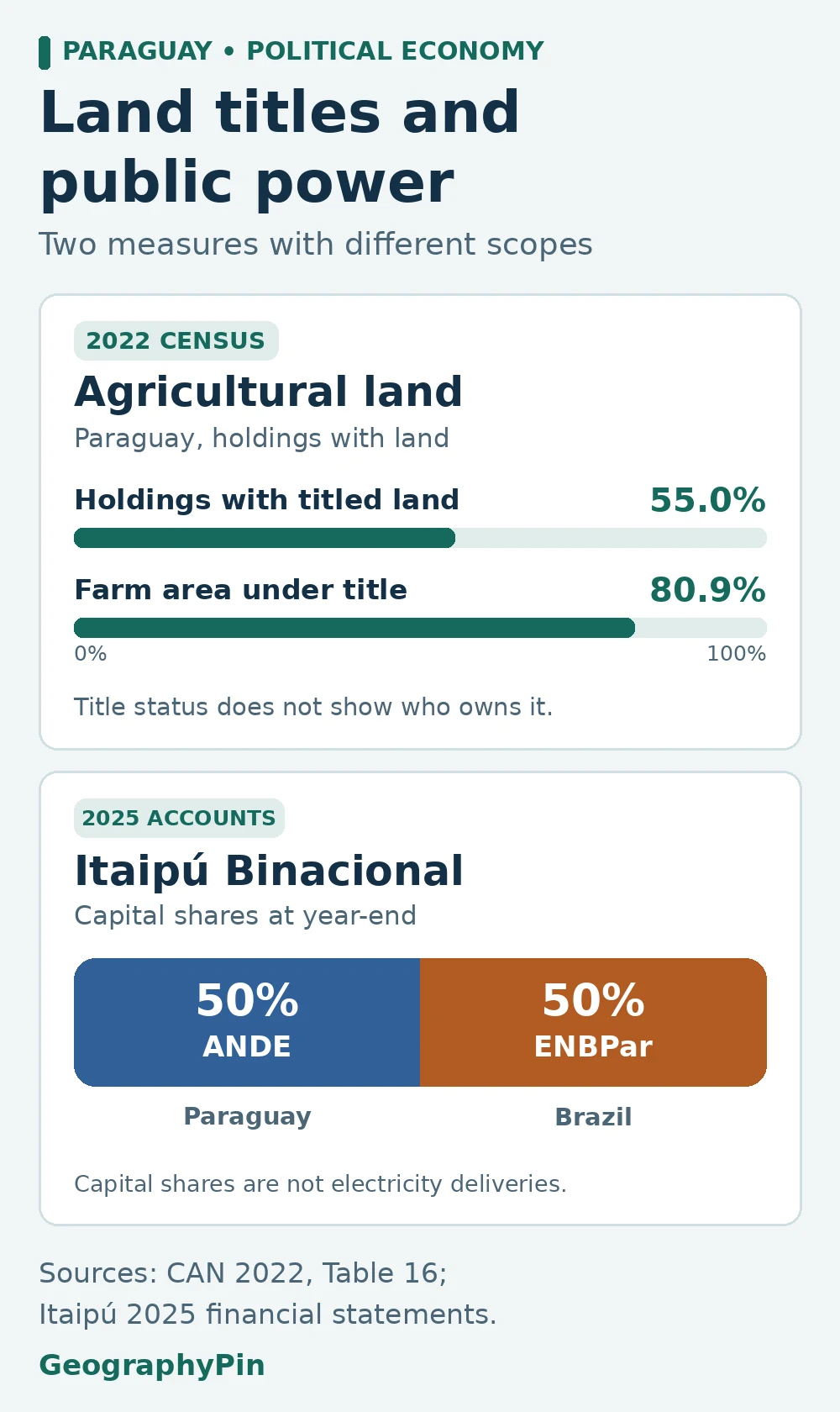
In Paraguay’s 2022 agricultural census, 160,273 of 291,497 agricultural holdings with land (55.0%) reported at least some land with definitive title. That form of tenure covered 80.9% of the land in all holdings counted. Some farms reported more than one form of tenure. Neither percentage is the share of all Paraguayan land that is privately owned, nor do the figures tell us how many individual people ultimately own the land.
Who owns Itaipú?
Paraguay and Brazil established Itaipú by treaty in 1973 to generate electricity using a shared stretch of the Paraná River. The company’s audited 2025 statements show equal shares of capital: 50% for Paraguay’s public electricity authority ANDE and 50% for Brazil’s federal company ENBPar. This is a clear case of public ownership, but the shares belong to one binational company. They do not tell us the public share of electricity production in either country.
For the broader geography behind these examples, see how Paraguay’s rivers and regions shape its economy.
Frequently Asked Questions
Does the Constitution recognize Indigenous communal land?
Yes. Article 64 recognizes Indigenous peoples’ right to communal ownership of land. It says those lands cannot be divided, transferred or leased. This is a distinct form of ownership alongside the private-property rights discussed in Article 109.
Does each country actually use half the electricity from Itaipú?
Not necessarily. Article XIII divides rights to the energy equally but also allows each country to acquire energy the other does not use for its own consumption. The 50–50 capital split does not establish how much electricity either country used in a given year.
What Did We Learn Today?
Paraguay’s Constitution combines social duties with protection for private property and market competition. The farm census measures how land is held, and the Itaipú accounts identify the two public owners of one power company. Each is useful evidence as long as you keep its scope in view.
Sources & Data Notes
The census counts agricultural holdings, not landowners. The figures shown here use the 2022 totals and are rounded to one decimal. Itaipú’s financial statements record capital as of December 31, 2025, not annual electricity deliveries. English renderings of the Constitution’s wording are translations.
- Chamber of Deputies: 1992 Constitution of Paraguay, 2024 edition, Articles 1, 64, 68, 107, 109, 114 and 116.
- Superior Tribunal of Electoral Justice: proclamation of the elected candidates, May 2023; Chamber of Deputies: Alliana’s swearing-in, November 2026; and ANR: the party’s own statement of ideology.
- Paraguay’s Ministry of Agriculture and Livestock: VI Censo Agropecuario Nacional 2022, Tables 16 and 18, hosted by FAO.
- Itaipú Treaty, Articles III and XIII; Itaipú Binacional financial statements, 2025, balance sheet and Note 19; ANDE charter, Law 966; and ENBPar institutional profile.
- Stanford Encyclopedia of Philosophy: Socialism, ownership-based definition and distinctions among forms of socialism.
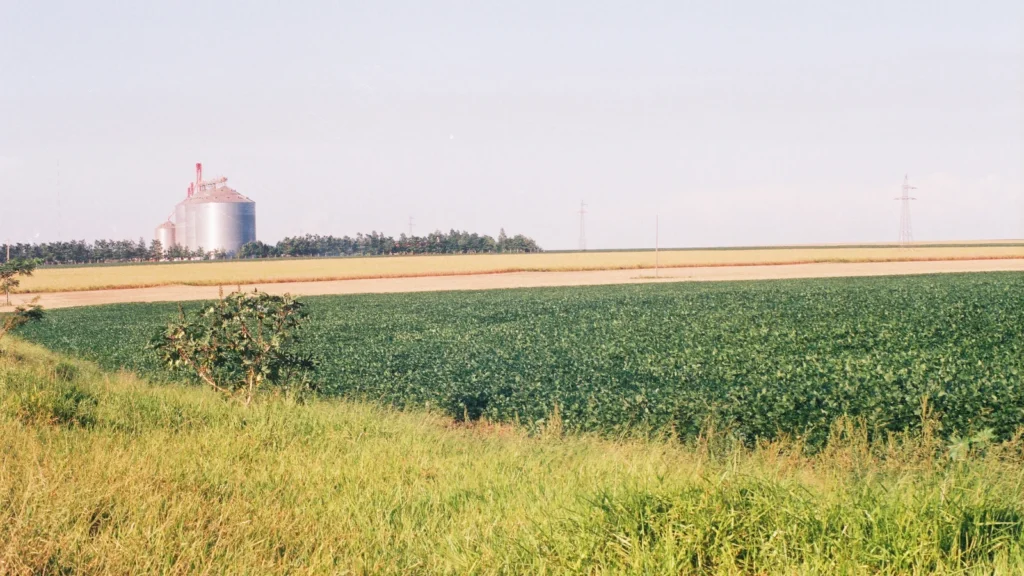
- Featured photo: soybean fields and grain silos in Paraguay by Yenia Rivarola, released into the public domain by the photographer; cropped and resized.