A car-free Fuji Five Lakes itinerary works best when you plan it around bus corridors rather than the number of lakes on the map. Kawaguchiko Station is the useful starting point, but it is not on the northern lakeshore and there is no single sightseeing bus around all five lakes.
Start at Kawaguchiko and choose one corridor
For a short Fuji Five Lakes itinerary without a car, pair Kawaguchiko with Saiko on the Red and Green buses. Choose the Blue Line for Shojiko or Motosuko, or spend a separate day on Fujikko-go toward Yamanakako. Plan the ride back before adding another stop.
Plan your trip: Kawaguchiko and Saiko in one day · three western buses · Fujikko-go detour.
Which lakes fit in one day?
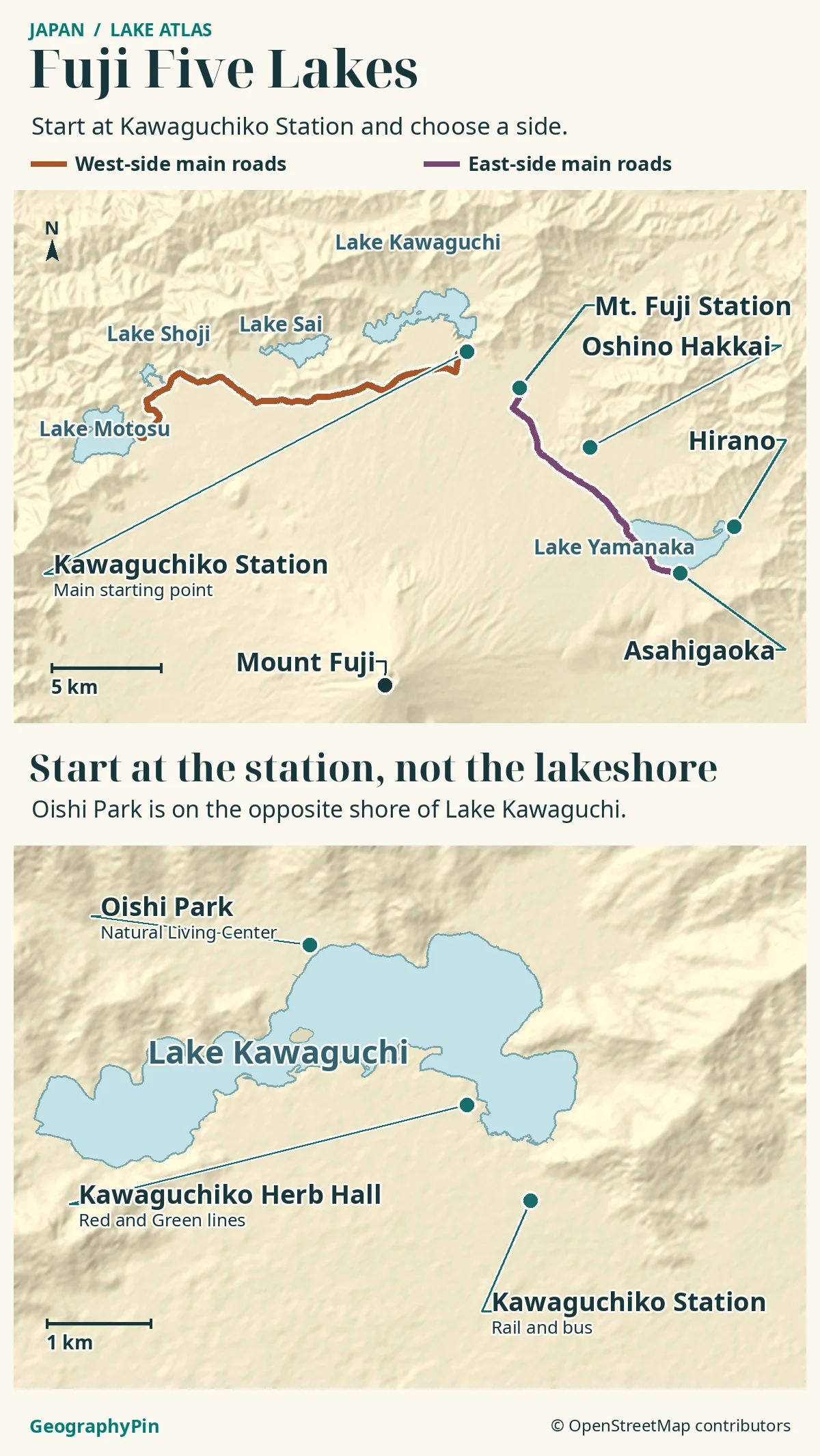
The Fuji Five Lakes are Kawaguchiko, Saiko, Shojiko, Motosuko and Yamanakako. The first four are served by the Red, Green and Blue sightseeing routes from Kawaguchiko Station. Yamanakako lies east of that group, beyond Fujiyoshida and Oshino on the Fujikko-go corridor.
Which two lakes work together on a short visit?
Choose Kawaguchiko and Saiko if you want a north-shore view and a second lake without committing to the far-west or east run. Pick one stop at each, such as Oishi Park and Saiko Iyashi-no-Sato Nenba. Returning to the station between lines is easy to plan; the operator also marks a shared transfer at Kawaguchiko Herb Hall, if your timetable works better there.
| Day plan | Bus and transfer | What controls the day |
|---|---|---|
| Kawaguchiko only | Red Line from Kawaguchiko Station. | Time for the shore and the last return to the station. |
| Kawaguchiko + Saiko | Red and Green; change at the station or a verified shared stop. | The Green Line return from your exact Saiko stop. |
| Shojiko or Motosuko | Blue Line from Kawaguchiko Station. | A confirmed return from the precise stop and route variant. |
| Yamanakako + optional Oshino | Fujikko-go on the eastern corridor. | A trip that serves your stop in each direction, plus the detour notice. |
Operator information checked November 20, 2026. These are alternatives, not stages of one continuous loop. A late arrival at Kawaguchiko Station is a good reason to keep the day to one lake.
Start at Kawaguchiko Station
From Tokyo, the useful comparison is a direct Fuji Excursion train from Shinjuku on an applicable departure, a rail journey with a change at Otsuki, or a highway coach from Busta Shinjuku. Otsuki is the rail interchange, not the lakeshore. JR East gives the local Fujikyu train as an alternative from Otsuki when a through service does not suit.
If booking the highway coach, check who operates your departure. From October 1, 2026, Fujikyu moved sales for its own Shinjuku–Kawaguchiko trips to Fujiyama Connect. The joint route also has Keio Bus trips, so start from the operator’s booking notice instead of assuming every departure is sold through the same site.
At Kawaguchiko Station the October 13 brochure shows boarding position 1 for Red, Green and Blue sightseeing buses. It shows position 4 for S1/S4, even though selected S1/S4 trips appear in the Blue timetable panel. Read the route name and destination on the vehicle, not just the color of a station sign.
Kawaguchiko is both a lake name and a station name. Arriving at the station does not put you at Oishi Park or at a hotel on the opposite shore. Check your first local bus or accommodation pickup before fixing a same-day return to Tokyo.
Take the Red, Green or Blue Line west
Three lines, three different jobs
Red: follow the north-shore corridor to Kawaguchiko Natural Living Center, the stop for Oishi Park. In the October 13 timetable a sample 09:00 from the station reaches stop 20 at 09:27. That is a published 27-minute ride, before any queue, traffic or waiting time.
Green: choose it for Saiko Iyashi-no-Sato Nenba, stop 48. The printed 09:10 from the station reaches that stop at 09:50. Its outward and return loops differ, so use the appropriate column rather than doubling the outward ride time.
Blue: choose it for Shojiko or Motosuko. Lake Motosu Tourist Information Center is stop 98, not the same stop as Lake Motosu Entrance. The brochure’s Blue Line example at 10:35 reaches stop 98 at 11:35. The same published panel has a Blue departure from stop 98 at 14:45 arriving at the station at 15:45. These examples are from the printed timetable, not a promise that buses run on time or that the schedule applies to every future date.
Shojiko and Motosuko sit on the same broad corridor, but getting off at both uses separate rides and can leave a long wait. A more useful short outing is one lake with a chosen viewpoint and two checked directions. Check the operator’s separate notices before using a printed example.
Kawaguchiko and Saiko in one day by bus
For a worked example, use the regular times in Fujikyu’s October 13, 2026 timetable to plan for Sunday, November 22, 2026. Start at Kawaguchiko Station. Transfer back at the station rather than looking for a Green Line bus at Oishi Park.
Red Line · out: Kawaguchiko Station, boarding position 1, 09:00 → Kawaguchiko Natural Living Center (stop 20, Oishi Park) 09:27.
Red Line · back: Stop 20 at 10:27 → Kawaguchiko Station 10:54.
Green Line · transfer: Kawaguchiko Station, boarding position 1, 11:40 → Saiko Iyashi-no-Sato Nenba (stop 48) 12:20. The village is a short walk from the stop.
Green Line · back: Stop 48 on the return leg, 15:10 → Kawaguchiko Station 15:45. The published last return from that exact stop is 17:40 → 18:15; avoid making it your only option.
There are 46 minutes between the scheduled Red arrival and Green departure at the station. If the Red bus is late, check the next Green one rather than assuming a protected connection. Fujikyu’s western sightseeing coupon covers all four rides in this example; Fujikko-go and the onward Tokyo journey are separate. Recheck your travel date and any special timetable before setting out.
Use Fujikko-go for Lake Yamanakako
For the eastern lake use Fujikko-go. The published route links Kawaguchiko Station, Mt. Fuji Station in Fujiyoshida, Oshino Hakkai and places around Yamanakako. Hirano and Yamanakako Asahigaoka are different stops; the right one depends on the shore or accommodation you need. The operator’s timetable contains runs that skip individual stops.
September 28, 2026 to March 11, 2027: use the temporary park stop
Fujikyu’s detour notice suspends Fujikko-go service at Benifuji-no Yu Onsen and Hana-no-Miyako Park Entrance A and B during those dates. Use Hana-no-Miyako Park Entrance C instead for the park. Wait at the C stop toward Yamanakako Hirano and on the opposite side toward Mt. Fuji Station or Kawaguchiko Station. The notice concerns those stops and that service, not cancellation of the eastern corridor.
If adding Oshino Hakkai, check which onward departure actually serves the next lakeshore stop and which bus gets you back. Treat one lakeside visit as the priority. A map shows how close places appear; it cannot tell you whether a usable connection exists on your date.
Choose a pass and plan your way back
Compare coverage, not just the pass name
The Kawaguchiko, Saiko and Lake Motosu sightseeing free coupon covers Red, Green and Blue, not Fujikko-go. The separate Mt. Fuji & Fuji Five Lakes Passport lists all three plus Fujikko-go and specified local routes; its basic two-day version also lists the Fujikyu rail segment between Kawaguchiko and Shimoyoshida. Do not infer that all rail or local routes are included. The operator separately sells other passes with similar names; compare the actual coverage map and exclusions.
Neither a western sightseeing coupon nor the wider Passport substitutes for a Tokyo highway-bus ticket; the Passport excludes highway buses and the climbing bus to the Fuji Subaru Line 5th Station. A sightseeing-bus ride generally needs no reservation, but an onward reserved coach or train is a different booking. Keep each receipt and boarding instruction available.
Plan backward from your fixed return booking. Choose a local bus with enough time to get off, find the return boarding point and handle delays. At the farther lakes, make a note of the stop name in both directions before walking away. Fall traffic, winter weather and event diversions are good reasons to recheck the timetable, not reasons to assume a specific cancellation.
Frequently Asked Questions
Is the Mount Fuji view the same from every northern lakeshore?
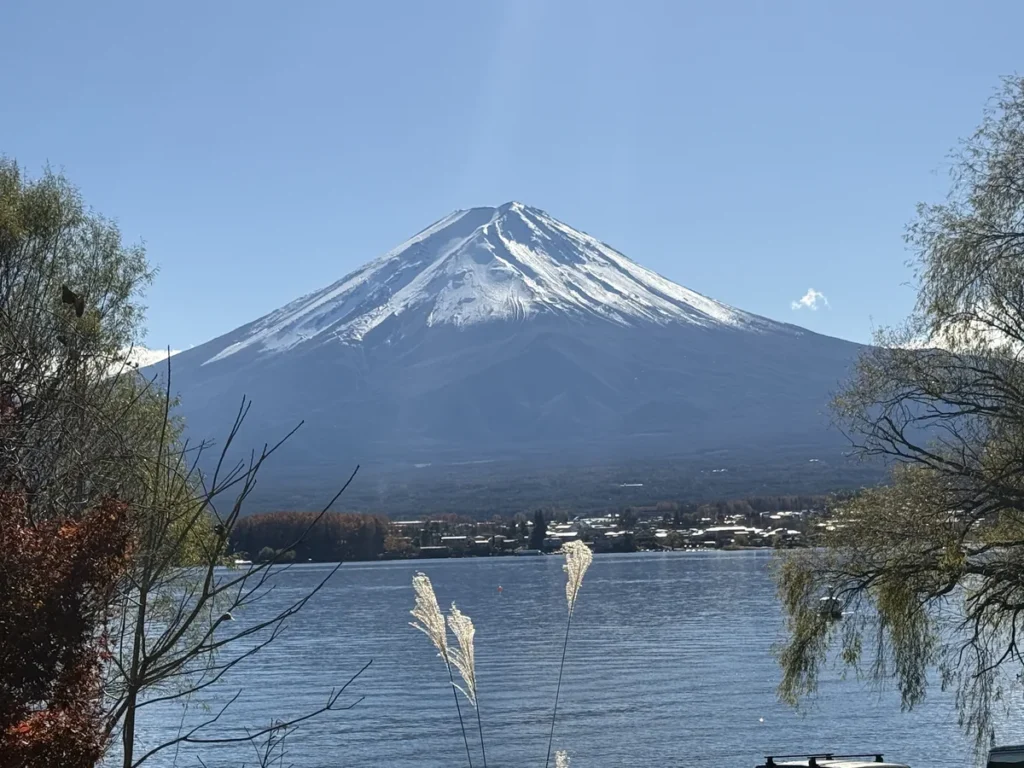
No. At Oishi Park, the mountain is across Lake Kawaguchiko; other shores and viewpoints frame it from different angles. The Japan National Tourism Organization gives different viewing locations around Kawaguchiko, Motosuko and Yamanakako. No stop guarantees an unobstructed summit or a reflection.
Can I roll a wheelchair or stroller straight onto these buses?
Do not assume it. Fujikyu says wheelchairs and strollers generally need to be folded and advises checking ahead, because ramp-equipped vehicles, stop layout and crowding can affect boarding. Ask about the exact stop and service you plan to use.
Can I take a bus straight from Oishi Park to Lake Saiko?
The Red Line reaches Oishi Park, and the Green Line serves Saiko; the Green Line does not call at the Kawaguchiko Natural Living Center stop for Oishi Park. For those two stops, the straightforward option is to change back at Kawaguchiko Station. For a different lakeshore stop, check whether both services call there in the direction you need.
What Did We Learn Today?
Kawaguchiko and Saiko make a practical short pairing. The Blue Line reaches the farther western lakes, while Fujikko-go serves the separate Yamanakako corridor. Pick your stop and return before buying a pass, and check temporary changes before relying on an ordinary timetable.
Sources & Data Notes
Reviewed November 20, 2026: Fujikyu’s October 13, 2026 sightseeing timetable, western routes and coupon, Fujikko-go timetable, dated Fujikko-go detour, wider Passport coverage, Shinjuku coach booking changes, JR East rail alternatives, JNTO lake geography, JNTO viewpoints, Fujikyu accessibility guidance. Bus times are examples from the October 13 brochure, not live departures or reservations. Service names, stop variants and pass coverage are kept separate; the temporary detour applies only to the specific operator and stops described. The two-lake example uses the Red and Green tables under their standard interval rules in the October 13 PDF, not travel-day observations. The 09:00 Red Line is scheduled to reach stop 20 at 09:27, and the last Green return calls at stop 48 at 17:40.
Photograph: Mount Fuji viewed from Lake Kawaguchi, LMP 2001 / Wikimedia Commons / CC BY-SA 4.0, December 1, 2024. Resized and converted to WebP without cropping; derivative remains under CC BY-SA 4.0.

The atlas uses lake outlines, roads and location pins from OpenStreetMap contributors (ODbL), extracted November 20, 2026 UTC, and AWS Terrain Tiles. The western timetable and Fujikko timetable support named stops, not full bus route lines.