“Gobustan” can describe a settlement, an archaeological outing or a trip that also includes mud volcanoes. The distinction matters before you leave Baku: getting to the area is not the same as reaching both attractions and arranging a way home.
Two attractions need two named stops
Travel from Baku to Gobustan by a road arrangement that names the rock-art reserve and your chosen mud-volcano site separately. They are not the same stop. A bus toward Gobustan does not establish a connection to both entrances; arrange the local transfers and the return before relying on public transport.
Check where the bus journey ends, the museum and outdoor rock art, or which mud-volcano site to name.
Choose a trip that reaches both attractions
For a first visit combining rock art and mud volcanoes, I would choose a prearranged road trip with both destinations named in the agreement. That could be a tour or a private driver. The useful difference is not the label on the vehicle: it is whether the journey includes the reserve entrance, the particular volcano site and the return to your address in Baku.
A public bus can form part of the journey, but reaching the Gobustan area does not establish a connection to either attraction’s entrance. Arrange transport for each attraction rather than counting on a through bus.
| Option | Useful feature | Connection to arrange |
|---|---|---|
| Organized excursion | One itinerary can combine the rock-art visit and a mud-volcano stop. | Exact volcano name, admission inclusions, pickup and Baku return point. |
| Private driver or taxi by agreement | Choose your stops and time at each site. | Both entrances, waiting time, return and total agreed charge. |
| Public bus plus local transport | Use a scheduled road service for part of the journey. | Current boarding and alighting stops, both local transfers and the Baku-bound return. |
Transport and visitor information rechecked November 20, 2026. This is a comparison of arrangements, not a live departure board. No bus fare, tour price or guaranteed door-to-door duration is assumed.
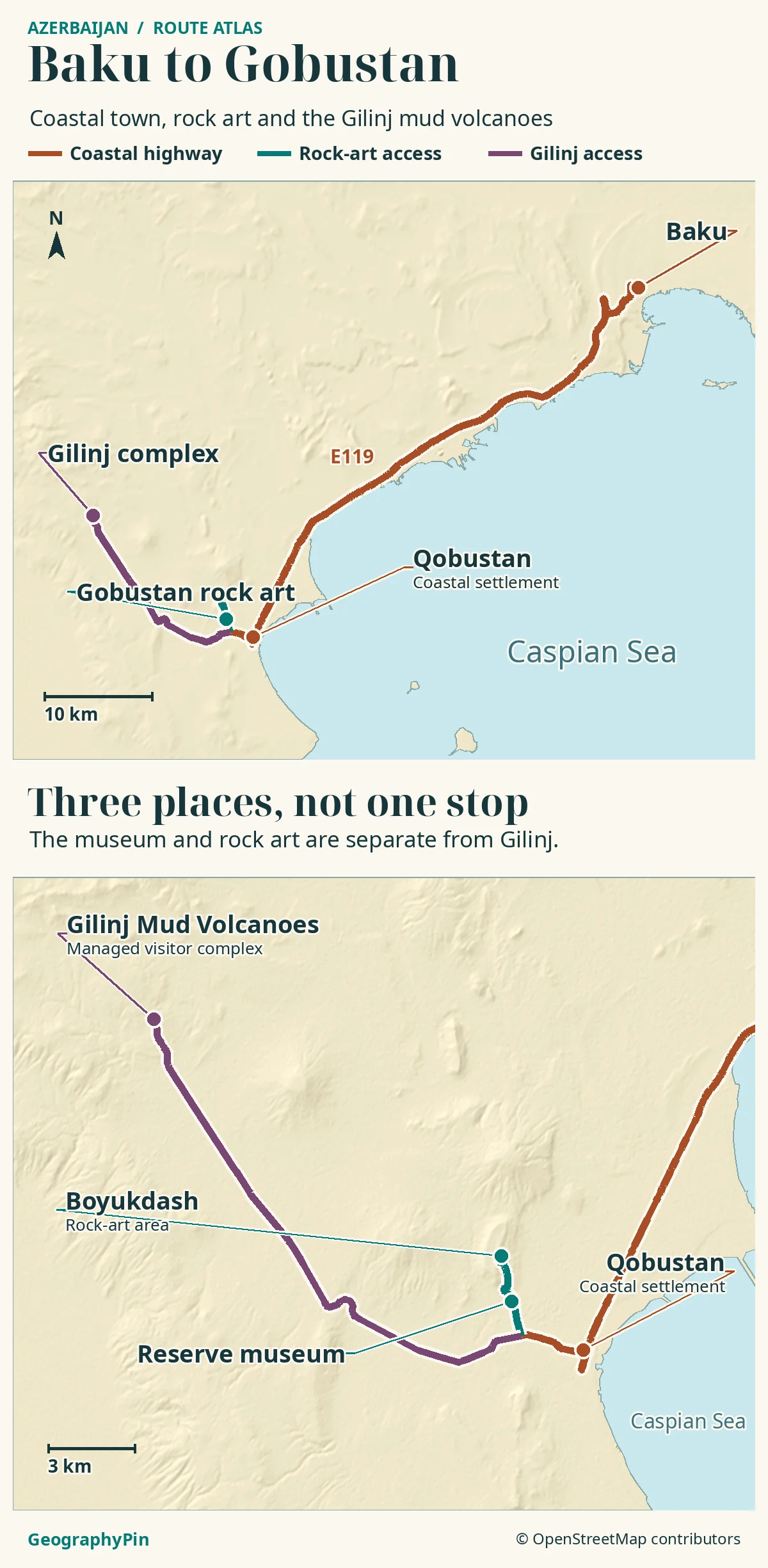
Gobustan town is not the reserve entrance
The coastal Gobustan settlement is a place to orient a road journey, not a substitute for the museum or rock-art entrance. Save the attraction’s full name and pin rather than simply asking for “Gobustan.” The Tourism Board places the rock-art reserve about 37 miles (60 kilometers) south of Baku; that rounded destination distance is not a measurement from your hotel to a ticket desk.
What the bus number does not tell you
AYNA, Azerbaijan’s land-transport agency, published a notice on November 3, 2026 announcing changes to routes 195 and 195E from November 4 because of work on the Baku-bound auxiliary part of Gobustan bridge. It directed the buses onto the main carriageway. The notice gives no end date, so it does not prove that the diversion is still operating on your travel date.
The notice does not identify your stop. Use AYNA’s public bus map to look up the route, and check with the carrier where you can get off and where the Baku-bound bus boards. Do not wait on the main carriageway because a map pin is nearby. Arrange the local ride from the settlement separately; a bus to the settlement is not a through ticket to either attraction.
The museum and the rock-art landscape
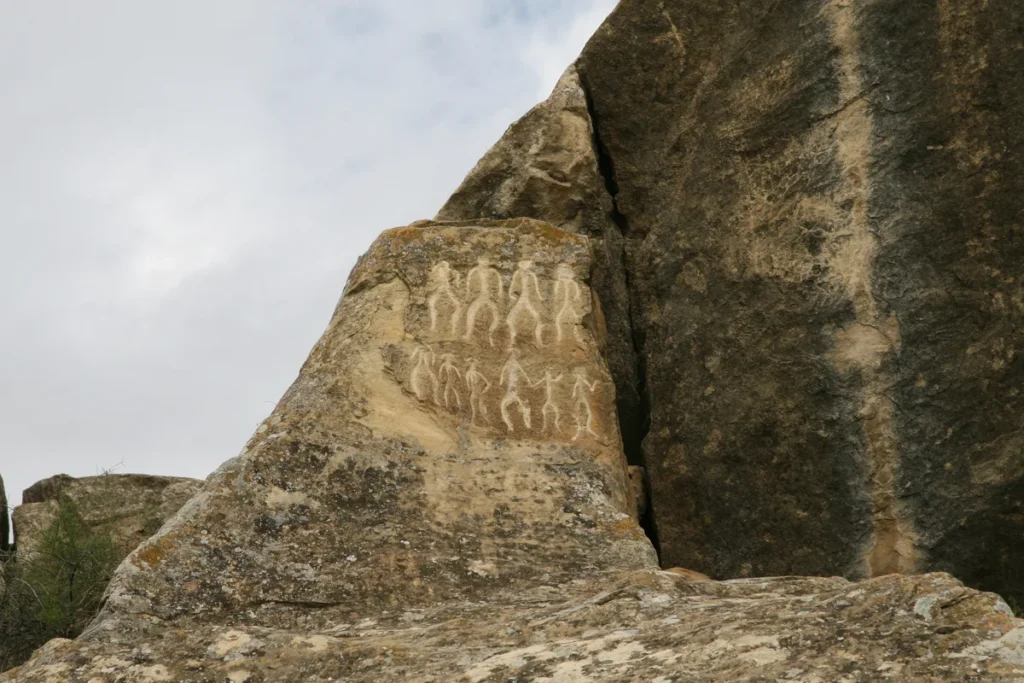
The rock art, not the mud volcanoes, is the reason for the UNESCO designation Gobustan Rock Art Cultural Landscape. UNESCO describes three areas of rocky plateau with more than 6,000 engravings, alongside evidence of settlements, inhabited caves and burials. The inscription covers a cultural landscape, not one museum building and not every place marketed as “Gobustan.”
UNESCO identifies Boyukdash as the most visited area, distinct from Kichikdash and the Jinghirdag–Yazylytepe area. This is useful when comparing excursions: a museum visit, time among the visitor-accessible rock art and an extended archaeological itinerary are different promises.
Check the museum and outdoor visit separately
Ask whether your arrangement includes the museum, the outdoor rock-art visit, a guide and transport between the agreed drop-off and pickup. Do not infer those inclusions from a photograph of petroglyphs. Keep the museum and the rocks as separate labels on your saved map, even when the seller includes them in one visit.
Check the reserve’s current admission details for your date rather than using the mud-volcano complex’s hours. Older dated ticket listings remain searchable; a past session is not proof of the current closing time, admission category or ticket conditions. Confirm the reserve’s price and last entry directly before you go.
If time is tight, choose the visit you most want rather than turning each stop into a photograph from a car. The museum provides interpretation; the outdoor landscape is where the engravings belong. Neither is replaced by a visit to a mud-volcano field.
Choose a named mud-volcano destination
The Mud Volcanoes Tourism Complex at Gilinj is a specific managed attraction, opened in June 2024. It is not another name for the rock-art museum, and a tour advertising “mud volcanoes” does not necessarily mean this complex.
Its operator lists the complex about 50 miles (80 kilometers) from central Baku, approached via E119 and the road passing Gobustan State Reserve. That is a separate destination distance, not an extra 50 miles (80 kilometers) beyond the reserve. The operator also lists natural-history and mineral exhibitions.
Name the volcano before agreeing to the trip
Ask the seller to identify the exact mud-volcano site. If you want the managed Gilinj complex, use its full name. If an itinerary instead visits another field, request that field’s name, the actual vehicle access arrangement and the return pickup. Do not assume the complex’s facilities, tickets or designated paths exist at a different field.
The complex’s official page, rechecked November 20, lists daily opening from 10:00 to 19:00 and tickets at the entrance or through its linked ticket seller. These hours apply to the complex only. They do not establish the reserve’s schedule, the last time every activity runs or availability on a future date.
At Gilinj: Stay on the complex’s designated routes and supervise children. The operator’s rules prohibit fires, drones and bringing in food for a picnic. Ask permission before photographing or filming inside the fauna exhibition; professional commercial photography and filming also require permission. These rules are for this managed site, not for every mud-volcano field.
Plan the return before leaving Baku
Agree on the final pickup, not just the outward ride
Ask before booking: “Will you pick me up in Baku, take me to the Gobustan reserve museum and the outdoor rock art at Boyukdash, then to the Gilinj Mud Volcanoes Tourism Complex? Where will I meet the driver after each stop, and where will you drop me off in Baku?” Ask which admission fees, guiding and waiting time are included. If the driver is not staying at Gilinj, agree on a pickup point and time before getting out.
For a bus-based journey, check the Baku-bound stop before leaving the settlement for the attractions. Leave time for the local ride back and for boarding, rather than aiming for a connection based solely on the attraction’s closing hour. An on-demand car appearing on an app in Baku is not evidence that one will be available at a remote endpoint later.
Check the forecast and the sites’ visitor notices shortly before travel. Outdoor time among rocks and at volcanoes is a different undertaking from an indoor exhibition. Wet or uncomfortable weather may justify shortening the outdoor portion; it is not a reason to improvise a track across the landscape.
Travel-advice check: the U.S. State Department’s Azerbaijan advisory, issued April 28, 2026 and rechecked November 20, remains Level 3, Reconsider Travel, citing terrorism, armed conflict and landmines. Read the current advice relevant to you before making commitments.
Frequently Asked Questions
Are the Gobustan museum and the Gilinj mud volcanoes at the same stop?
No. The reserve museum and the outdoor rock art at Boyukdash belong to the rock-art visit. The Gilinj Mud Volcanoes Tourism Complex is a separate attraction reached by another road approach. Ask your driver or tour provider to name both visits.
Does the bus to Gobustan take me to the rock art and the Gilinj mud volcanoes?
Do not count on it. Reaching coastal Qobustan does not establish a bus to either entrance. Arrange the local rides to the reserve and Gilinj, then check the Baku-bound pickup before leaving town.
Does a ticket for Gilinj include the rock-art reserve?
The operator sells admission to the Gilinj complex. Do not assume it includes the separate Gobustan reserve. If an excursion advertises both stops, ask whether both admissions are included or whether you pay them separately.
What Did We Learn Today?
A useful Gobustan trip distinguishes the coastal settlement, the museum and rock-art visit, and a named mud-volcano destination. The managed Gilinj complex is one specific choice, with its own hours and rules. Choose transport for the whole chain, check changing bus arrangements and settle the return before leaving Baku.
Sources & Data Notes
Checked November 19–20, 2026 against AYNA’s November 3, 2026 diversion notice, UNESCO’s Gobustan description, Azerbaijan Tourism Board’s visitor overview, the Gilinj complex operator, its visiting rules, the June 13, 2024 opening announcement, the U.S. State Department advisory. Distances are rounded figures supplied by the tourism organizations, not measured hotel-to-entrance journeys. The bus notice has no end date; current stop positions and a through-service to both sites were not verified. Reserve hours and fares are omitted rather than carried forward from older ticket sessions.
Photograph: Gobustan petroglyphs, Maris Teteris, April 18, 2008, Wikimedia Commons, CC BY 3.0. Resized and converted to WebP without cropping.
The atlas uses OpenStreetMap contributors (ODbL), the Geofabrik Azerbaijan extract of November 18, 2026, OSM-derived land polygons, and AWS Terrain Tiles. Colored lines are mapped approaches, not bus routes or confirmation of driving conditions.