Commonwealth realms share a monarch without sharing a single Crown in law or a single government. Their separate royal titles and succession statutes reveal how that arrangement works more clearly than a list of countries alone.
One monarch, distinct constitutional offices
As of November 19, 2026, the Commonwealth realms are 15 independent countries sharing Charles III as monarch, including the United Kingdom. Their crowns operate within distinct national constitutional systems. Commonwealth membership is broader: republics can belong too, and the non-hereditary Head of the Commonwealth role is separate from national kingship.
How to use this article: count countries, not one shared government, from imperial equality to country-specific titles, coordinated succession did not require identical laws, the association is larger than the realm category.
Which countries are Commonwealth realms?
Count countries, not one shared government
As of November 19, 2026, there are 15 Commonwealth realms, including the United Kingdom. They are independent countries sharing Charles III as monarch. The phrase “14 other realms” excludes the UK from that subtotal; it does not contradict the total of 15.
The complete roster is: Antigua and Barbuda, Australia, the Bahamas, Belize, Canada, Grenada, Jamaica, New Zealand, Papua New Guinea, Saint Kitts and Nevis, Saint Lucia, Saint Vincent and the Grenadines, Solomon Islands, Tuvalu and the United Kingdom.
This classification counts sovereign countries. It does not add dependent territories as separate realms in the country list, and it does not classify every Commonwealth member as a monarchy. The defining question is whether the shared monarch occupies that country’s head-of-state office.
The more revealing question is how this arrangement works. Separate national titles, domestic laws and constitutional procedures show why one person can occupy multiple crowns without creating one multinational government.
How one monarch came to hold separate crowns
From imperial equality to country-specific titles
The 1926 Balfour Declaration was adopted on November 19, making 2026 its centenary. It articulated equality between Britain and the self-governing Dominions rather than their constitutional subordination to Britain. It was not the unrelated 1917 declaration concerning Palestine.
The Statute of Westminster 1931 gave important parts of that changing relationship legal effect. Its application was not identical everywhere: Australia adopted relevant provisions in 1942 and New Zealand in 1947. These milestones should not be collapsed into one date on which every present-day realm became independent.
Country-specific royal titles offer a concrete modern example. Canada’s 2024 proclamation establishes a Canadian title that omits the earlier references to the United Kingdom and “Defender of the Faith.” The same individual remained monarch; the wording used for Canada changed.
The Canadian Gazette is especially instructive because it contains both the old introductory style and the newly established style. Read the operative proclamation, not just the first royal heading. The instrument is dated January 8, 2024, and registered January 31, 2024.
A title is therefore evidence of the capacity in which the monarch acts, not proof that one country’s Crown is legally identical to another’s. Nor did Canada become independent only when its title changed.
How the realms coordinate succession
Coordinated succession did not require identical laws
The Perth agreement of October 2011 provides a useful test of what separate crowns mean in practice. The realms agreed reforms to succession, but implemented them through their own constitutional arrangements. The UK’s main changes took effect on March 26, 2015, alongside the coordinated changes across the then realms.
These reforms removed male preference for those born after October 28, 2011, ended disqualification caused by marrying a Roman Catholic, and changed royal-marriage consent rules. Removing a bar on marrying a Catholic should not be confused with removing every religious requirement for the monarch.
| Country | Instrument | What the comparison shows |
|---|---|---|
| United Kingdom | Succession to the Crown Act 2013. | UK legislation, with the principal reforms commencing March 26, 2015. |
| Australia | Succession to the Crown Act 2015. | The federal Act records requests from all state parliaments under the Australian Constitution. |
| New Zealand | Royal Succession Act 2013. | New Zealand’s own succession statute, identified by its Governor-General’s office. |
Australia’s Act makes the purpose explicit: to align changes so that Australia’s sovereign remains the same person as the UK’s sovereign. It also says it is not intended to alter the existing relationship between the sovereign and the Commonwealth, states and territories.
Not every realm passed a matching new Act. The UK government’s March 2015 statement reported that six realms besides the UK legislated, while nine concluded that legislation was unnecessary. There were 16 realms then, including Barbados. That historical total must not be copied into a present-day roster.
This is coordination between distinct legal systems, not evidence that a single UK statute simply governs every country. Conversely, distinct systems do not imply an accidental shared succession: maintaining the same sovereign was a deliberate objective.
Why republics can remain in the Commonwealth
The association is larger than the realm category
A Commonwealth member can be a republic. Membership of the Commonwealth is a relationship within a voluntary international association. Being a realm describes a country’s head-of-state arrangement. These are different classifications.
The role of Head of the Commonwealth is also separate from being king of an individual realm. The Commonwealth Secretariat describes that role as non-hereditary, with future heads chosen by Commonwealth leaders. Charles III holds it alongside his national royal offices; the association does not thereby become one state under his government.
Barbados makes the distinction tangible. It became a republic on November 30, 2021, replacing the monarch as head of state with a president, while remaining a Commonwealth member. Its national constitutional category changed without requiring it to leave the association.
The transition was not Barbados’s independence day in the sense of first becoming a sovereign country: independence had already been achieved in 1966. Republican transition and independence can be separate events, just as Commonwealth membership and realm status can be separate relationships.
Which changes actually alter realm status?
Read the legal change, not only the headline
A change of monarch normally changes the office-holder, not the number of realms. A new royal title can change wording without abolishing the office. Replacing the monarch with a president changes the head-of-state arrangement and therefore the realm classification. Those events should not be treated as equivalent.
Proposals also need to be distinguished from operative changes. A government announcement, commission report or planned vote is not by itself an effective constitutional amendment. A dated roster should change when the relevant legal transition takes effect, with the date recorded.
The 1926 declaration, Australia’s 2015 succession law, Canada’s 2024 title and Barbados’s 2021 transition illustrate four different processes: recognition of constitutional equality, coordination of succession, alteration of a national title and replacement of a monarchy. A map using one colour for “Commonwealth” would conceal those differences.
The right comparison is therefore not just a list of countries sharing a portrait. Ask which office the person holds, which country’s legal framework governs it, and whether the document concerns succession, title, representation or the form of the state.
Frequently Asked Questions
Does the word “Crown” always mean a physical royal object?
No. In constitutional writing it can describe the enduring legal institution of the state or monarch in a particular capacity. The context matters: a reference to the Crown in a statute is not simply a reference to a ceremonial crown worn at a coronation.
Must every realm use the same amendment procedure?
No. The applicable constitution and domestic law determine the procedure. Requirements in one realm should not be presented as a universal rule for all fifteen; check the specific country and the specific change.
What Did We Learn Today?
A shared monarch does not merge national crowns. Succession may be coordinated through different domestic mechanisms, titles can change without ending monarchy, and a realm can become a republic while remaining in the Commonwealth. Count countries using effective constitutional status, not old totals or proposals.
Sources & Data Notes
- House of Commons Library: the 1926 declaration centenary and current realm roster
- House of Commons Library: national royal styles and titles
- Canada Gazette: operative 2024 royal style proclamation
- Australian Federal Register: Succession to the Crown Act 2015
- Governor-General of New Zealand: domestic succession law
- UK Parliament: March 26, 2015 implementation statement
- Commonwealth Secretariat: association and Head of the Commonwealth
- House of Commons Library: Barbados republican transition
Status checked November 19, 2026. The 2015 succession statement concerns 16 realms at that time; the current total is 15. Canada’s proclamation is dated January 8 and registered January 31, 2024. Historical constitutional milestones are not a claim that all present-day realms gained independence simultaneously. This is a comparative explainer, not advice on any pending constitutional procedure.
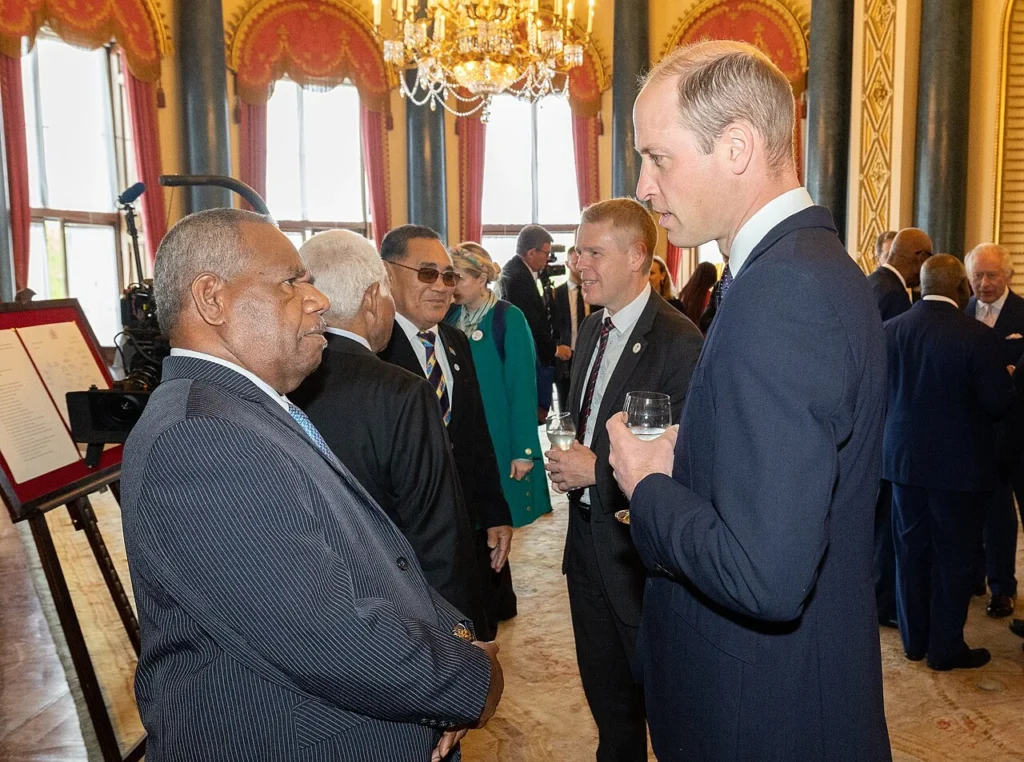
Photograph: Realms Lunch at Buckingham Palace, Ian Jones, May 5, 2023, via FCDO/Wikimedia Commons, CC BY 2.0. Resized and converted to WebP without crop or retouch. Historical event photograph, not a roster of constitutional powers.