
Countries that no longer exist include Austria-Hungary, the Soviet Union and Czechoslovakia, but they did not all end in the same way. A useful list needs more than old names: it needs dates, a defined political entity and an explanation of what followed.
Countries that no longer exist are former political states or unions that ended as distinct entities. Examples include Austria-Hungary, East Germany, the Soviet Union and Czechoslovakia. Their endings involved different processes, from imperial breakup to accession or dissolution. A country adopting a different name does not, by itself, become a former state.
How to use this article: Check the selection rule, read the historical map conventions, or compare continuity claims.
1. What Counts as a Former Country?
A dated selection, not a worldwide total
Selection checked November 17, 2026: these six examples concern twentieth-century states or unions whose separate political organization ended. They were chosen to illustrate different processes, not to rank importance or claim completeness.
The unit is the specified state or union, not its people, culture or land. The list excludes name changes alone, ordinary changes of government, and a separate inventory of contested or unrecognized statehood claims. Inclusion is not a ruling on every later treaty obligation or territorial dispute.
Dates describe the event named in the table. An effective accession date can be precise; a breakup involving declarations, conflict and international recognition may need a period instead. The number six is the size of this selection, not the number of all former countries.
2. Six Examples in Chronological Order
| Former entity | Endpoint used | Successors or outcome | Important qualification |
|---|---|---|---|
| Austria-Hungary | 1918: imperial breakup | Austria and Hungary; other successor states included Czechoslovakia, Poland and Yugoslavia. | Selected outcomes, not an exhaustive territorial allocation. Peace settlements followed. End-year source; settlement context. |
| United Arab Republic (Egypt–Syria union) | 1961: Syria left the union | Egypt and Syria again had separate governments. | The union began in 1958; Egypt kept the UAR name until 1971. Source. |
| German Democratic Republic (East Germany) | October 3, 1990: accession took effect | Its territory joined the Federal Republic of Germany. | Accession, not the dissolution of both German states into a third state. Source. |
| Soviet Union (USSR) | December 26, 1991: formal end | Fifteen former union republics became or re-established independent states; see the distinctions below. | Gorbachev resigned the previous day. Endpoint source; republic roster. |
| Socialist Federal Republic of Yugoslavia (SFRY) | 1991–1992: breakup process | Bosnia and Herzegovina, Croatia, Macedonia (now North Macedonia), Slovenia, and the FRY comprising Serbia and Montenegro. | The later FRY was not the same six-republic federation. Chronology; succession framework. |
| Czechoslovakia | December 31, 1992: dissolution | Czech Republic and Slovakia. | The two successor states entered the UN as new members. Source. |
“Successor” can describe a legal relationship, while “territorial outcome” describes what a map shows. The table uses both deliberately: absorbing territory, restoring independence and sharing a predecessor’s obligations are not interchangeable events.
3. Empires, Unions and Accession Are Different
Empire: Austria-Hungary’s end was not merely a shortening of its name to Austria. Its multinational political structure broke apart. The U.S. Office of the Historian distinguishes the 1918 collapse from the 1919 Saint-Germain settlement. A single end-year should not suggest that every border and diplomatic relationship was settled that year.
Short-lived union: the United Arab Republic joined Egypt and Syria in 1958. Syria’s departure in 1961 ended that two-country union, but not Egypt’s use of the name. This is why a historical label can outlive the political arrangement a reader associates with it.
Accession: the German Bundestag’s account records the East German parliament’s August 23, 1990 decision to accede to the Federal Republic, effective October 3. Saying simply that “Germany replaced East and West Germany” obscures that constitutional route.
Federation: a federation’s internal republics and its international identity are different levels of organization. When the federation ends, a former internal boundary may acquire a new political role. That does not mean every line in an old administrative map automatically becomes an uncontested international border.
4. Two Historical Maps, Two Specific Dates
Read the map date before reading the boundary
The comparison uses complete CIA maps from the University of Texas Libraries collection: Czechoslovakia, March 1985, and Soviet administrative divisions, October 1989. These are snapshots before the endings in the table, not reconstructions of the final day of either state.
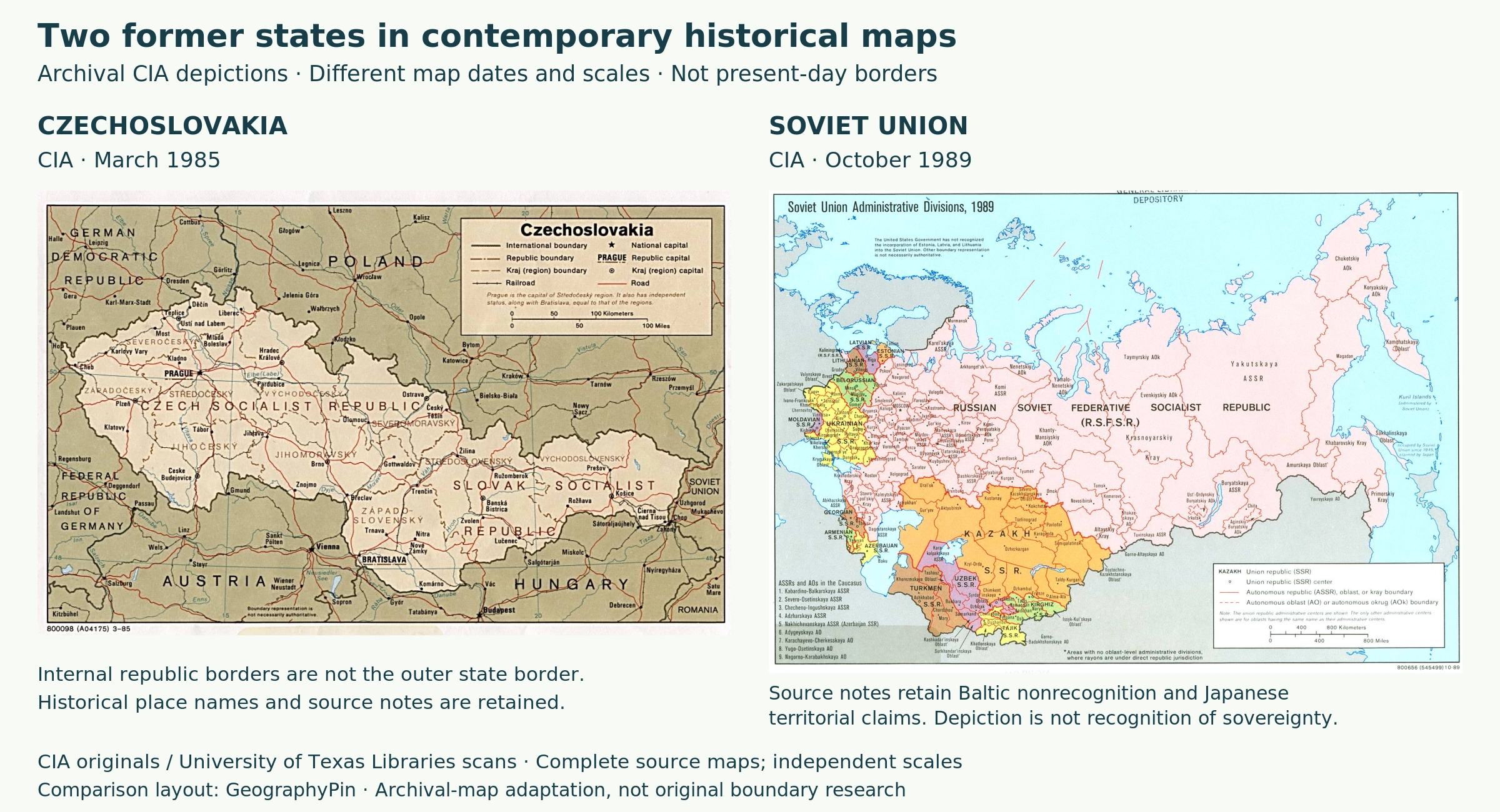
Full-size Czechoslovakia map (March 1985) · Full-size Soviet Union map (October 1989)


The panels have independent scales. Compare their boundary categories and labels, not their apparent sizes on the page. On the Czechoslovakia map, the internal Czech–Slovak republic boundary has a different meaning from the country’s international boundary.
The Soviet map retains its original U.S. nonrecognition note concerning the incorporation of Estonia, Latvia and Lithuania, as well as its Japanese territorial-claim annotations. Showing a historical map does not endorse every boundary depiction or imply universal recognition.
The original comparison layout preserves the archival maps rather than drawing new historical borders from today’s country polygons. For a separate present-day reference, use the world map with countries; it answers a different date-specific question.
5. Successor States and Disputed Continuity
What continued, and for which purpose?
State continuity asks whether the same international legal identity continues; state succession concerns relationships between a predecessor and the state or states that follow it. Membership, assets, archives and obligations can require separate treatment.
The UN membership guide records Russia’s continuation of the Soviet Union’s membership. That institutional continuity does not mean the USSR remains the same territorial union. The distinction between the former union and today’s Russian state is developed in our Russia and Soviet-system explainer.
The former Soviet republics were Armenia, Azerbaijan, Belarus, Estonia, Georgia, Kazakhstan, Kyrgyzstan, Latvia, Lithuania, Moldova, Russia, Tajikistan, Turkmenistan, Ukraine and Uzbekistan. A January 1992 U.S. mapping bulletin treats the twelve non-Baltic republics separately from the three Baltic states; the names alone do not resolve their different continuity histories.
A 2018 International Law Commission special rapporteur’s report describes the prevailing treatment of Estonia, Latvia and Lithuania as continuations of their pre-1940 states, while acknowledging contrary legal scholarship. Calling all fifteen former Soviet republics “new countries created in December 1991” would erase that distinction.
Yugoslavia shows why a retained name does not settle continuity. In Resolution 47/1 of September 22, 1992, the UN General Assembly rejected automatic continuation of the former SFRY’s membership by the FRY, then comprising Serbia and Montenegro. This was a specific membership decision, not a shortcut to every question of legal responsibility.
Slovenia’s government describes the succession agreement as establishing five equal successor states and addressing matters such as property and archives. Later changes must be dated separately: the ICTY chronology records the FRY’s reconstitution as Serbia and Montenegro in 2003 and the union’s end in 2006. Combining all these events into one “Yugoslavia disappeared” date loses essential context.
6. Name Changes That Do Not Belong on the List
Swaziland → Eswatini: the UN guide records the name change in April 2018. The older name belongs in a historical names reference, not automatically in a list of dissolved states.
Czech Republic → Czechia: the 2016 notification concerned the short name; the formal name Czech Republic remained. This differs from Czechoslovakia’s dissolution.
Before adding a name to a former-country list, ask three questions: What exact political entity is meant? Which event ended it? Is the evidence about statehood, or only about a name, government or diplomatic recognition? An unfamiliar name on an old map is a starting point for those questions, not their answer.
What Did We Learn Today?
A reliable former-country list identifies the entity, the endpoint and what followed. Imperial breakup, accession and dissolution should not be treated as one process, and a new name alone proves none of them. Historical maps need their own dates and boundary conventions, while claims of continuity need an identified institution or legal context.
Sources & Data Notes
This is a six-case historical selection checked November 17, 2026, not an exhaustive inventory or universal legal classification. Endpoints follow the events identified in the table; map dates describe separate archival snapshots. Detailed source links accompany each case. Principal references and map catalogs are collected below.
- Office of the Historian: Austrian Empire and Austria-Hungary
- Office of the Historian: Egypt and the United Arab Republic
- German Bundestag: the GDR accession resolution
- George H.W. Bush Presidential Library: dissolution of the Soviet Union
- UN Dag Hammarskjöld Library: membership histories and name changes
- ICTY: the successive Yugoslav entities
- UN General Assembly Resolution 47/1, September 22, 1992
- International Law Commission: 2018 special rapporteur report, paragraphs 84–87
- University of Texas Libraries: CIA Czechoslovakia map, March 1985
- University of Texas Libraries: CIA Soviet administrative map, October 1989
The Berlin Wall at the Brandenburg Gate in December 1989, before German reunification in October 1990. Photograph: SSGT F. Lee Corkran, U.S. Department of Defense, via Wikimedia Commons, public domain; resized and converted to WebP.
