Russia’s Soviet history still shapes how people describe it, but historical association is not a reliable guide to its present system. To answer the question properly, separate the Russian Federation from the USSR and distinguish political control from economic ownership.
No. Modern Russia is not a communist country. The Soviet Union dissolved in 1991, and the Russian Federation has a different constitutional and economic framework. Private ownership and markets coexist with state-controlled enterprises. A Communist Party still operates, but its existence does not mean Russia is governed by a Soviet-style communist party-state.
How to use this article: Follow the transition timeline, compare markets with state ownership, or clarify why authoritarianism is a different label.
1. Russia is not another name for the Soviet Union
The Russian Federation and the Union of Soviet Socialist Republics (USSR) are not interchangeable names. Russia was a constituent republic of the Soviet Union. The union also included other republics, whose histories and present-day sovereignty should not be erased by calling the entire former USSR “Russia.”
The Library of Congress account of the USSR’s creation dates its establishment to December 30, 1922. The founding participants were Soviet Russia, Ukraine, Belarus and the Transcaucasian federation. This matters because the Bolshevik seizure of power in 1917 and the formation of the Soviet Union were different events, five years apart.
Continuing a UN seat did not preserve the Soviet system
The United Nations records that Boris Yeltsin’s letter of December 24, 1991, notified it that the Russian Federation would continue the USSR’s membership, including in the Security Council. Institutional continuity at the UN is not the same as continuity of communist-party rule. Nor does it mean that the other former Soviet republics became parts of modern Russia.
A useful reading rule is to ask whether a source means the Soviet union-wide government, the Russian republic within that union, or the Russian Federation after its dissolution. An old map or Cold War headline may refer to a different state from the one being discussed today.
2. What changed between the Soviet system and modern Russia
A before-and-after comparison should not pretend that the Soviet system remained unchanged until its final day. The left column below describes the established constitutional model before the late-Soviet reforms; the right describes the modern framework and recent evidence, not a claim that every constitutional promise is fulfilled.
| Question | USSR before late-Soviet reforms | Russian Federation |
|---|---|---|
| Party position | The original 1977 Constitution assigned the CPSU a leading role. | No equivalent constitutional leading role for a communist party. |
| Economic framework | Socialist productive ownership and state planning were constitutional foundations. | Several forms of ownership are recognized; securities markets and state-controlled companies coexist. |
| Ideological rule | Marxism-Leninism guided the constitutionally privileged party. | The Constitution bars a compulsory state ideology. |
| What the name describes | A union of Soviet republics. | A separate federation, continuing the USSR’s UN membership. |
The 1977 Soviet Constitution is especially revealing: Article 6 privileged the Communist Party, Article 10 established socialist ownership of production, and Article 16 described state economic planning. These were connected features of a specific system. A contemporary government owning an energy company does not reproduce that entire arrangement.
3. The transition happened in stages
There is no single day on which all Soviet politics, law and economic life switched to their modern forms. The legal weakening of party monopoly preceded the breakup of the union, while the Russian Federation’s current constitutional framework followed it.
A short timeline of the institutional break
- December 30, 1922: the Soviet Union was established. Soviet Russia was one of its founding participants.
- 1990: a constitutional amendment removed the CPSU’s special predominance under Article 6. The USSR still existed.
- December 25, 1991: Mikhail Gorbachev resigned as Soviet president.
- December 26, 1991: the Soviet Union formally ceased to exist.
- December 12, 1993: Russia adopted the Constitution that, with subsequent amendments, provides its present constitutional framework.
The Law Library of Congress’s 1992 constitutional study discusses the 1990 Article 6 change in its concluding comparison with the USSR. The George H. W. Bush Presidential Library’s dissolution records distinguish Gorbachev’s December 25 resignation from the union’s formal end on December 26. These are related milestones, not competing dates for the same act.
Saying “Russia stopped being communist in 1991” is understandable shorthand for the decisive Soviet break. A precise explanation adds that party monopoly had already been legally weakened and that the subsequent political and economic transition was a process, not an overnight replacement of every institution.
4. What Russia’s Constitution and economy show
The Russian Ministry of Justice’s constitutional text recognizes private, state, municipal and other ownership in Article 8. Article 13 recognizes ideological and political diversity and prohibits an obligatory state ideology. These provisions differ from the old Soviet party-state model. They describe formal rules, however, not an independent measurement of political freedom.
Markets and state control can exist together
Actual economic institutions also matter. The Bank of Russia’s securities-market overview, with figures for the second quarter of 2026, describes brokers, investors, issuers and individual investment accounts. Its March 2026 review of 2025 share offerings discusses companies raising equity capital and investors buying shares. This is evidence of functioning capital-market mechanisms, not simply a market-friendly sentence in a constitution.
At the same time, Gazprom’s 2025 corporate report says the Russian Federation controls a majority of its shares directly and indirectly. That is a concrete example of state corporate control. Taken together, these sources show why describing Russia as an economy with both market activity and state-controlled enterprises is more informative than choosing between “everything private” and “everything communist.”
This does not establish an exact percentage of the economy controlled by the state, nor does this article offer one. State ownership, regulatory power and political influence over nominally private businesses are different measurements. An economy can rely on private property and capital markets while still being heavily shaped by political authority.
5. A Communist Party exists, but that does not make the state communist
Yes, the Communist Party of the Russian Federation, commonly abbreviated KPRF or CPRF, still operates. Its official report of a November 13, 2026 regional-organizers’ meeting is direct evidence of current party activity. A party’s own website is appropriate for establishing that it is active, but not for independently assessing the fairness of the political system.
The important distinction is between a communist party existing within a country and a communist party occupying the constitutionally protected leading position associated with the Soviet system. Those are not equivalent facts. For the broader list and its inclusion criteria, see GeographyPin’s communist countries guide.
Why “authoritarian” answers a different question
Freedom House’s 2026 Russia report, covering developments in 2025, describes an authoritarian system concentrated around the presidency and identifies United Russia as the ruling party. It assesses restrictions on competition, media and civil liberties. V-Dem’s 2026 Democracy Report likewise places Russia on the autocratic side of its regime classification using data through 2025.
These assessments concern how power can be challenged and held accountable. “Communist” concerns a political and ideological tradition and, in country lists, the character of party rule. Neither word substitutes for the other: a state can be authoritarian without being communist. Our guide to authoritarian countries explains that separate classification.
6. Why the Soviet association persists
The confusion has understandable roots: Moscow was the Soviet capital, Russia was central to the union, and the Russian Federation continued its UN membership. Familiar Soviet-era buildings, monuments or symbols can reinforce that association. But a photograph, a historical anniversary or a person’s nostalgia cannot establish the present economic or constitutional system.
The strongest answer uses three separate checks: identify the state and period; establish the party’s actual institutional position; then examine ownership and economic mechanisms. That avoids both common mistakes: treating modern Russia as the USSR with a new name, or assuming that its departure from Soviet communism automatically made it a liberal democracy.
Frequently Asked Questions
Does Russia’s “social state” wording mean it is socialist?
No. Article 7 describes social protection and conditions for a dignified life. That provision must be read alongside Article 8’s recognition of different forms of ownership. A social-policy commitment does not by itself establish socialist ownership of production.
Was the USSR already the classless society described in communist theory?
Its own 1977 Constitution presented a classless communist society as a goal to be built. Calling the USSR a communist state describes its party-led political system, not proof that this theoretical goal had been achieved.
Does “post-Soviet” mean “Russian”?
No. Post-Soviet describes a historical relationship to the former USSR, not membership in today’s Russian Federation. Apply the name of the particular country when discussing its present government or territory.
What Did We Learn Today?
Russia’s break with Soviet communism involved several changes: the weakening of party monopoly, the dissolution of the USSR and a new constitutional framework. Market institutions and state corporate control now coexist, while communist-party activity is not the same as communist-party rule. The useful comparison keeps state identity, ownership and political accountability separate.
Sources & Data Notes
The timeline separates legal reform, presidential resignation and state dissolution. The institutions table compares the original 1977 Soviet framework with modern Russian provisions, not the USSR’s changing final months. Constitutions establish formal rules; corporate and central-bank sources establish specific economic arrangements. Party material establishes activity, not political legitimacy. Democracy assessments are attributed to their publishers and reference years, not presented as a live score. No state-ownership percentage or disputed-border map is inferred.
- Library of Congress: Treaty on the Creation of the Soviet Union (2013 historical analysis)
- USSR Constitution (1977 original text), Articles 6, 10 and 16; Bucknell University archive
- Law Library of Congress: The Constitution of the DPRK (1992), concluding USSR comparison, printed page 24
- George H. W. Bush Presidential Library: Records on the Dissolution of the Soviet Union
- United Nations: Russian Federation membership note
- Russian Ministry of Justice: Constitution, with 2020 amendments; Articles 7, 8 and 13
- Gazprom: 2025 report, About the Gazprom Group
- Bank of Russia: Securities Market, Q2 2026 figures
- Bank of Russia: IPO and SPO market in 2025, published March 26, 2026
- KPRF: regional-organizers’ meeting report, November 13, 2026
- Freedom House: Russia, Freedom in the World 2026 (2025 developments)
- V-Dem: Democracy Report 2026, data through 2025
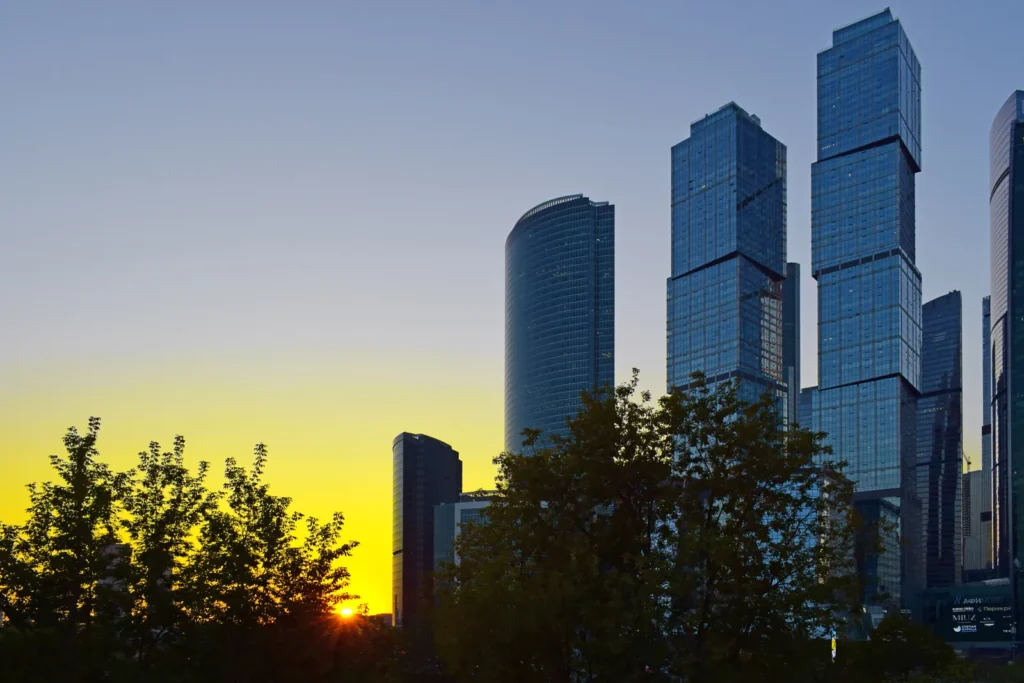
Featured photo: Юрий Д.К. / Wikimedia Commons, CC BY 4.0. Photographed August 29, 2024; resized and converted to WebP. The image shows Moscow City, not a government building or evidence of company ownership.