A private shop, a stock exchange, and a Communist Party government can exist in the same country. The confusion comes from treating political power, business ownership, and the way prices are set as if they were one question.
China is communist in the sense that the Communist Party leads its political system. Its economy, however, combines state and collective ownership with private businesses and markets. The official label is a socialist market economy. Neither “everything is government-owned” nor “China has simply become capitalist” adequately describes this combination.
How to use this article: Compare the evidence table, distinguish ownership from policy influence, or check what official labels do not prove.
1. Start with three different questions
The most useful answer separates who governs, who owns productive assets, and how economic decisions are made. A market is a mechanism for exchange; it is not a political party. Private ownership describes an ownership relationship, not a guarantee of competitive elections.
The evidence belongs in separate columns
| Question | Relevant evidence | What it tells us |
|---|---|---|
| Who leads the state? | Constitution, Article 1; CRS political-system assessment. | Communist Party leadership is a constitutional and institutional feature. |
| Who may own businesses? | Articles 6, 7, and 11. | Public ownership has a privileged position, but non-public businesses are recognized. |
| How does the economy operate? | Article 15 and IMF economic assessment. | The official market framework coexists with substantial state intervention. |
| What changes in practice? | Private-sector legislation and Research on industrial support. | Ownership, regulation, and access to support are different dimensions. |
A single percentage cannot combine these dimensions meaningfully. A statistic about private-sector employment, for example, would not measure how much political power private businesses possess. Its scope and year would also matter.
2. Communist Party leadership is not just a name
The Communist Party of China, also called the Chinese Communist Party, is abbreviated CPC or CCP. Both names refer to the same organization. The Congressional Research Service’s April 2026 primer describes China as a party-state: party and government institutions are distinct, but linked, and party leadership takes precedence.
Why “one-party” does not mean only one party exists
China has eight recognized minor parties. They operate within a Communist Party-led consultative arrangement, not as independent competitors seeking to replace the governing party through national elections. Counting organizations therefore does not establish whether political power is open to electoral competition.
Likewise, a company’s ability to sell products or earn profits does not change the relationship between party and state. Political classification asks how governing authority is organized; the presence of successful entrepreneurs answers a different question. This is why China appears in GeographyPin’s list of communist countries even though its economy differs from the stereotype of universal state ownership.
3. Different ownership forms coexist
Under the constitution’s economic provisions, public ownership is the mainstay, the state sector has a leading role, and private businesses are recognized within the socialist market economy. These provisions establish the legal framework; they do not supply a current census of every enterprise.
Ownership is not the same as policy influence
Two questions help when reading about an individual business: who owns it, and what rules or incentives shape its decisions? A private company can be affected by state policy without becoming state-owned. Conversely, selling goods in a market does not make a publicly owned enterprise private.
A 2025 IMF working paper on industrial policy examined support reaching both private and state-owned firms, including subsidies, tax benefits, credit, and land. That is a concrete reason not to equate all state influence with direct ownership. The study is research by its authors, not a legal definition of China’s system.
Why private companies are permitted
Private business is not merely an accidental loophole. China adopted its Private Sector Promotion Law on April 30, 2025, with effect from May 20. The official announcement describes provisions covering competition, financing, innovation, and protection of rights. This illustrates legal support for private economic activity within the existing political order, rather than its replacement.
In May 2026, the market regulator reported implementation measures, including action against barriers to market entry and arbitrary charges. These are official accounts of policy and enforcement activity. They should not be treated as independent proof that every firm receives equal treatment.
4. What “socialist market economy” means
“Socialist market economy” is China’s official constitutional economic label, not an outside ranking. It places market exchange within a framework that retains the public sector’s special role. In this usage, allowing markets is not presented as abandoning the state’s socialist identity.
Readers sometimes use “capitalist” to mean the existence of private profit and markets. Others use it for a broader system in which private capital predominates. Those definitions can lead to different shorthand descriptions of China. The careful response is to name the feature being discussed, rather than assume everyone means the same thing.
The official description does not settle how well it works
The IMF’s February 2026 consultation assessment called for further market-oriented corporate reforms and more equal competitive conditions across firms. It also recommended reducing unwarranted industrial-policy support. These are an external institution’s policy judgments, not constitutional provisions or evidence that the government has already adopted those recommendations.
That distinction matters: a law states rules and aims; an institutional assessment describes arrangements; an economic study tests outcomes. None should silently substitute for the others. For the broader problem of country labels, see how socialist countries are classified.
5. Reform changed the economy without replacing the ruling party
The market features are the result of decades of change, not a single moment when China “switched sides.” World Bank economist Bert Hofman’s historical account describes experimentation, gradual reform, and political continuity rather than an overnight conversion to a standard model.
| Date | Milestone | Why it matters |
|---|---|---|
| 1978 | Reform-era policy shift under Deng Xiaoping. | The starting point for the modern reform sequence, not the immediate removal of planning. |
| 1980 | The first four special economic zones were created. | Geographically limited experiments helped test opening to investment and trade. |
| 1993 | A major party decision set out a program to build a socialist market economy. | Market institutions became the subject of a broader reform program. |
| December 11, 2001 | China joined the World Trade Organization. | Membership connected China to WTO trade rules and commitments; it was not a political-system change. |
| May 20, 2025 | The Private Sector Promotion Law took effect. | Private-sector support was given a dedicated legislative framework. |
The timeline is selective. Reform proceeded unevenly across sectors and places, so it should not be read as a smooth progression toward less government involvement in every period. Nor does joining an international trade institution certify a country as capitalist or democratic.
Frequently Asked Questions
Does “communist” mean China has achieved a classless society?
No. The country label identifies its ruling-party system, not the achievement of theoretical communism. Treating the two as identical turns a question about institutions into a claim about an ideal society.
Is state capitalism another name for China’s official system?
No. It is an analytical label, not a single agreed classification. Ming Du’s study in the German Law Journal notes the term’s varied definitions and examines state intervention in production and markets. China’s official label is socialist market economy. If using “state capitalism,” explain which features the term highlights rather than presenting it as the country’s constitutional name.
Can business growth tell us whether China is becoming more democratic?
Not by itself. Business activity and political competition require different evidence. Changes in company ownership or sales do not establish changes in how national leaders can be replaced.
What Did We Learn Today?
The useful distinction is not a choice between a red flag and a private shop. Political leadership, ownership, and market activity describe different parts of a system. China’s reforms changed economic arrangements without replacing Communist Party rule, while legal recognition of private business does not by itself establish equal treatment in practice.
Sources & Data Notes
The institutional and policy evidence was reviewed in November 2026. Constitutional provisions are distinguished from reported implementation and outside economic assessments. The reform timeline is selective; no percentage is used to score the country as capitalist or socialist. Government reports establish official positions, not independent verification of every claimed outcome.
- China: Constitution, incorporating amendments through 2018; Articles 1, 6, 7, 11, and 15
- CRS: China’s Political System, April 2026; hosted by EveryCRSReport
- World Bank: Reflections on forty years of China’s reforms, February 2018
- State Council portal/Xinhua: Private Sector Promotion Law adoption, April 2025
- State Council portal/Xinhua: Reported implementation of private-sector measures, May 2026
- IMF: Conclusion of the 2025 Article IV consultation, published February 2026
- IMF working paper: Industrial Policy in China: Quantification and Impact on Misallocation, 2025
- WTO: China member information
- Ming Du: Unpacking the Black Box of China’s State Capitalism, German Law Journal, 2023; interpretation of state-capitalism terminology.
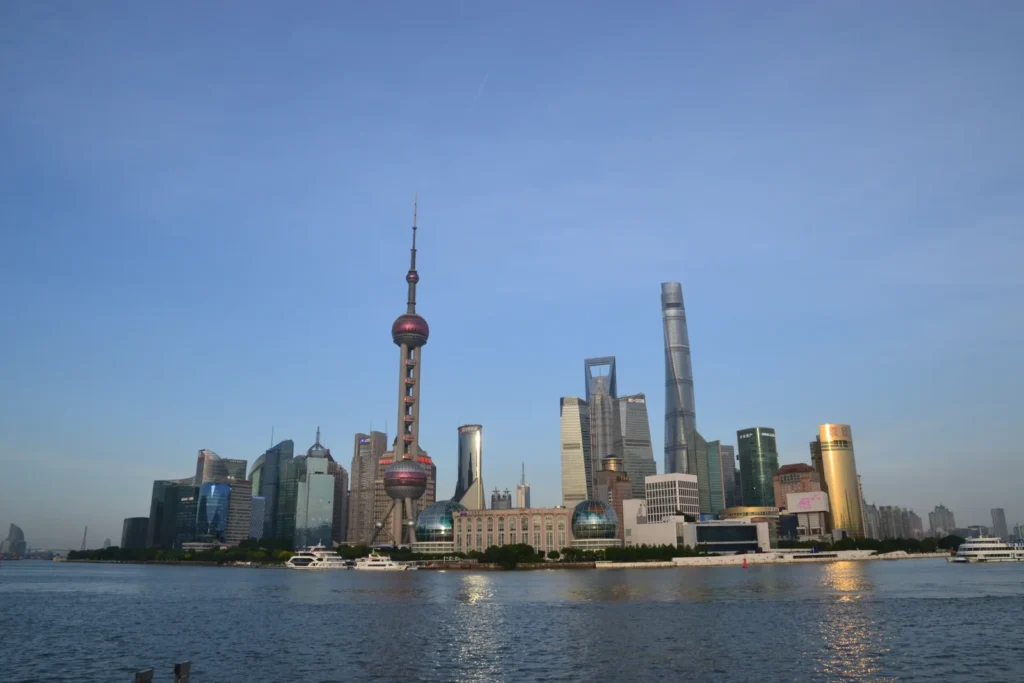
Photo: Ernest Jourdier / Wikimedia Commons, CC BY 4.0; resized and converted to WebP. The Pudong skyline provides geographic context, not evidence of the ownership of individual buildings.