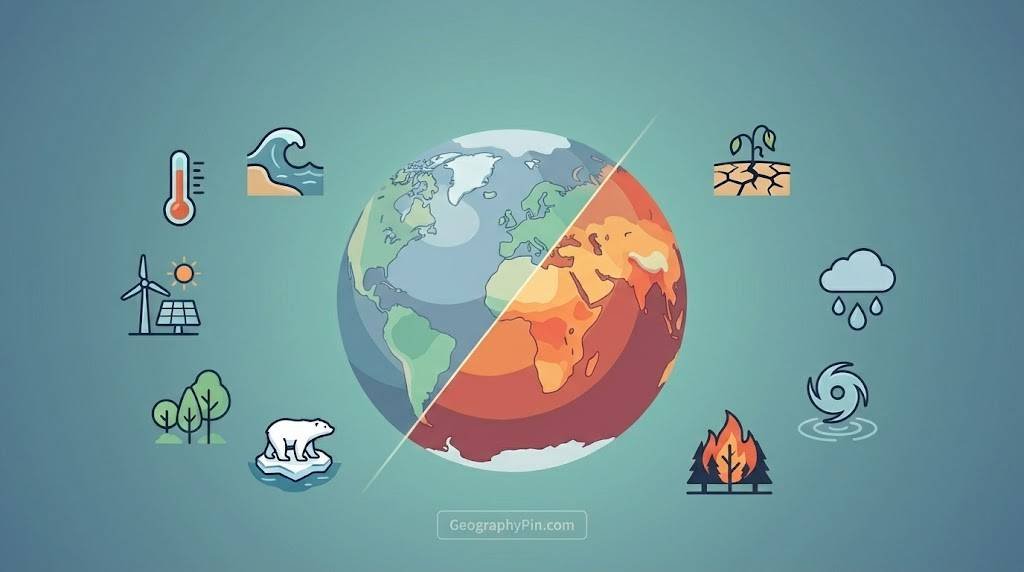
Climate change is the long-term warming and shifting of Earth’s climate, mainly caused by human greenhouse gas emissions from burning coal, oil and gas, cutting forests, and farming. As of the mid-2020s, the planet is about 1.1°C (2.0°F) warmer than in the late 1800s, driving rising seas, stronger extremes, and growing risks for people and nature.
Fact 1: Climate Change Is About Climate, Not Daily Weather
Before we talk about climate change, we need to separate two common words: weather and climate. Weather is what you feel today and tomorrow in a specific place: rain, sunshine, wind, snow, a thunderstorm at night. Climate is the average pattern of that weather over at least 30 years for a city, region, or the whole planet.
So a single hot week in London is weather, but a trend toward hotter, longer summers across the United Kingdom over many decades is climate. Scientists use “climate normals” (usually 30-year averages) to describe typical conditions and extremes. Climate change means those long-term normals are shifting.
A simple way to picture it: your outfit today is like weather; your whole wardrobe is like climate. Your mood today is weather; your long-term personality is climate. One unusually cold winter or one stormy month does not cancel climate change; climate is built from many years of data, not a single season.
Specialists who focus on short-term events are called meteorologists, while experts who study decades of data are climatologists. Meteorologists see the day-to-day swings. Climatologists show how those swings are changing over time as the planet warms.
How Climate Change Shows Up in the Weather You Feel
Climate change does not mean every day is hotter or that snow disappears everywhere. It means that over many years, hot days become more common, heatwaves last longer, heavy rain falls in shorter bursts, and some regions face longer, deeper droughts. The “background conditions” are shifting, so the odds of certain events change.
| Concept | Weather | Climate |
|---|---|---|
| Time scale | Minutes to days | Decades to centuries |
| Question answered | “Will it rain this weekend?” | “Are summers getting hotter over 30+ years?” |
| Science field | Meteorology | Climatology |
| Everyday analogy | Your mood today | Your personality over many years |
Fact 2: Earth Has Already Warmed by Around 2°F (1.1–1.3°C)
Global warming is not a future guess; it has already happened. Climate assessments show that human activities warmed the planet by about 1.1°C (2.0°F) on average during 2011–2020, compared with the 1850–1900 baseline. This is a long-term global average, not just one hot year.
Climate records also show that Earth’s average surface temperature has risen by roughly 0.11°F (0.06°C) per decade since 1850, with warming speeding up in recent decades. In 2024, the global average for a single calendar year reached around 1.5°C (2.7°F) above pre-industrial levels for the first time, even though the long-term average is still a bit lower.
That may sound small, but remember this is an average over the entire planet, day and night, over land and ocean. A 1–2°C (1.8–3.6°F) rise in the global average is enough to move storm tracks, melt large ice sheets, and raise sea levels worldwide.
Fact 3: Human Activities Are the Main Cause of Recent Warming
Natural factors like volcanoes and slight changes in the Sun do affect climate, but the rapid warming since the mid-20th century cannot be explained by natural drivers alone. Multiple scientific bodies and reports conclude that human activities are the dominant cause of recent warming, with very high confidence.
The main driver is the burning of coal, oil, and gas for electricity, transport, heating, and industry. This releases carbon dioxide (CO₂) and other greenhouse gases like methane (CH₄) and nitrous oxide (N₂O) into the atmosphere. Clearing forests, draining wetlands, and certain farming practices add even more greenhouse gases.
These gases act like adding extra blankets around Earth. They trap some of the heat that would normally escape into space, raising global temperatures and shifting patterns of rain, snow, and winds. Without human emissions, the recent warming trend would be extremely unlikely.
Fact 4: CO₂ Levels Are in the Mid-420s ppm and Still Rising
For most of the last 800,000 years, atmospheric CO₂ levels stayed between about 180 and 280 parts per million (ppm). Today, the yearly global average is in the mid-420s ppm, roughly 50% higher than pre-industrial levels of around 280 ppm. Seasonal peaks at some observatories are now above 430 ppm.
Measurements from stations such as Mauna Loa in Hawaiʻi show that CO₂ climbed from about 315 ppm in 1958 to about 425 ppm and rising in the mid-2020s. Some recent years have seen record jumps of more than 3.5 ppm in a single year, boosted by fossil fuel use and large wildfires.
Ice core data and other evidence suggest that current CO₂ levels are the highest in at least 2 million years. Put simply, Earth’s atmosphere now contains a concentration of heat-trapping gases that no human civilization has experienced before.
Fact 5: Global Sea Level Has Risen About 8–9 Inches (21–24 cm)
As the planet warms, oceans expand and land ice melts. Together, these processes have raised global mean sea level by about 8–9 inches (21–24 centimeters) since around 1880. This rise is not a straight line; it has sped up since the late 20th century.
Looking from around 1900 to today, global mean sea level has climbed by roughly 21 centimeters (about 8.3 inches). Some coastal places experience even higher local sea level rise because land is sinking, while others see slightly lower rise due to local currents and land uplift. The global average, however, keeps going up.
Even a few extra inches make storm surges and “sunny day” flooding more frequent. A coastal flood that used to happen once every 50 or 100 years can now occur much more often in some cities, putting homes, ports, roads, and fresh water supplies at greater risk.
Fact 6: Climate Change Is Raising the Odds of Extreme Weather
Because climate is the long-term pattern of weather, a warmer climate shifts the odds of certain events. Heatwaves become hotter and longer. Heavy rainfall events can dump more water in a short time. Some regions face longer, deeper droughts. Storms like hurricanes and typhoons can bring more rainfall and, in some cases, stronger winds.
Warmer air can hold more moisture – roughly 7% more water vapor for each 1°C (1.8°F) of warming. That extra moisture can fuel intense downpours and flash floods. At the same time, hotter conditions dry out soils and forests faster, increasing wildfire risk in many regions.
Scientists now study specific events to ask how climate change altered their likelihood or intensity. Many recent high-impact heatwaves, heavy rain events, and droughts have been found to be made significantly more likely or more severe by human-driven climate change. The key idea is risk: the “climate dice” are now loaded toward more extremes.
Fact 7: Oceans Are Warming, Acidifying, and Losing Ice Neighbors
The ocean absorbs over 90% of the extra heat trapped by greenhouse gases. This means vast volumes of water are warming from the surface downwards. Warmer water expands, adding to sea level rise, and stresses marine life such as corals, fish, and plankton that are adapted to cooler conditions.
Oceans also take up about a quarter of human CO₂ emissions each year. When CO₂ dissolves in seawater, it forms carbonic acid, making the ocean slightly more acidic. This ocean acidification lowers the pH and can weaken shells and skeletons made of calcium carbonate, from tiny plankton to coral reefs.
At the same time, ice sheets in Greenland and Antarctica, along with mountain glaciers from the Andes to the Himalayas, are shrinking. Together with the loss of sea ice in the Arctic, these changes affect sea level, regional climates, and ecosystems from polar bears to penguins.
Fact 8: Polar and Mountain Regions Are Warming the Fastest
Warming is not evenly spread across the globe. The Arctic is heating up around three to four times faster than the global average. As snow and sea ice melt, they expose darker land and ocean surfaces that absorb more sunlight instead of reflecting it, creating a feedback loop that speeds up warming even more.
High mountain regions, sometimes called the “Third Pole”, are also warming quickly. Glaciers in the Andes, Alps, Caucasus, and Himalayas are retreating. This changes the timing and amount of water that flows into major rivers, affecting hundreds of millions of people downstream who rely on this meltwater for drinking, farming, and hydropower.
These regions also store huge amounts of frozen ground, known as permafrost. As permafrost thaws, it can release CO₂ and methane, adding more greenhouse gases to the atmosphere and making long-term climate goals harder to reach.
Fact 9: Climate Change Threatens Food, Water, and Health
Climate change is not just about distant ice sheets; it reaches into kitchens, farms, and hospitals. Heatwaves can reduce crop yields for staples like wheat, maize (corn), and rice, especially when they strike during sensitive growing stages. Droughts and shifting rainfall patterns can lower river flows and groundwater recharge, making water scarcer in some regions.
More frequent extremes challenge infrastructure. Flooded roads and railways can disrupt food supply chains. Warmer coastal waters change fish populations, affecting communities that depend on fisheries. In some places, saltwater pushes farther inland, threatening crops and drinking water.
Health impacts are already visible. Heat stress can be deadly, especially in crowded cities. Warmer conditions can widen the range of disease-carrying insects like mosquitoes, affecting illnesses such as dengue or malaria. Air pollution from fossil fuels and wildfires harms lungs and hearts, with climate change often acting as a stress multiplier.
Fact 10: Small Temperature Differences (1.5°C vs 2°C) Matter a Lot
Global leaders often talk about limiting warming to “1.5°C” or “well below 2°C” above pre-industrial levels. These numbers might look close, but the difference between 1.5°C and 2°C (2.7°F and 3.6°F) is huge for people and ecosystems.
Climate reports show that at 2°C of warming, heatwaves become more intense, many coral reefs face near-total loss, and the number of people exposed to climate-related risks and poverty rises significantly compared with 1.5°C. Flood risks, droughts, and species loss all increase as the temperature climbs.
Every fraction of a degree matters. Keeping warming closer to 1.5°C reduces the risk of crossing tipping points, such as large ice sheet loss or major changes in ocean currents, that could lock in much higher sea levels or rapid regional climate shifts over the coming centuries.
Fact 11: Future Climate Depends on the Emissions Path We Choose
Climate models explore different scenarios that describe how global greenhouse gas emissions might change this century. In low-emissions pathways, the world quickly cuts fossil fuel use, protects and restores forests, and improves efficiency. Warming slows and eventually stabilizes. In high-emissions pathways, emissions stay high or keep rising, leading to much more warming and higher seas.
By 2100, global sea-level projections range from roughly 11–22 inches (28–55 centimeters) in low-emissions cases to more than about 25–40 inches (63–102 centimeters) in high-emissions cases. Beyond 2100, unchecked warming could raise sea levels by meters (several feet) over coming centuries, reshaping coastlines worldwide.
The key message: there is no single “fate” locked in. The amount of warming in the second half of this century, and the risks that come with it, depend strongly on choices made in the 2020s, 2030s, and 2040s about energy, land, and industry.
Fact 12: Many Solutions Already Exist – and System Choices Matter Most
The good news is that we already know many ways to limit climate change and adapt to its impacts. Solar and wind power have become much cheaper over the past decade. Electric vehicles are growing fast. Better home insulation, efficient appliances, and smarter city planning can cut energy use while improving comfort.
Protecting and restoring forests, wetlands, and mangroves helps absorb CO₂ and provides benefits like flood protection and habitat for wildlife. Farming practices such as improved soil management can store more carbon while boosting resilience to droughts and heavy rain. Adaptation measures – from early warning systems for heatwaves and storms to flood defenses and cool roofs – can save lives and reduce damage.
Large-scale cuts in emissions depend mostly on decisions by governments, cities, and big companies about energy, transport, housing, and land use. Individual choices still matter: how we travel, what we buy, how we vote, and how we talk about climate can push those bigger systems in a safer direction.
Key Climate Change Numbers at a Glance (Mid-2020s)
| Indicator | Approximate Value | What It Means |
|---|---|---|
| Global warming since 1850–1900 | ≈1.1°C (2.0°F) 2011–2020 average | Long-term rise in global average temperature, mainly from human emissions. |
| Warmest year so far | ≈1.5°C (2.7°F) above pre-industrial (2024) | Shows how close we are to the 1.5°C line for a full year. |
| Atmospheric CO₂ | Mid-420s ppm (vs ~280 ppm pre-industrial) | Over 50% higher than before large-scale fossil fuel use, still rising. |
| Global sea level rise since 1900 | ≈21 cm (≈8.3 inches) | Higher coastal flooding risk for hundreds of millions of people. |
| Share of excess heat stored in oceans | >90% | Oceans are a huge heat and carbon store, changing slowly but deeply. |
| Global climate goals | Limit warming to 1.5–2°C (2.7–3.6°F) | Targets chosen to reduce the most dangerous and irreversible risks. |
Table downloads (2)
- How Climate Change Shows Up in the Weather You Feel (5 × 3)View tableDownload CSV
- Key Climate Change Numbers at a Glance (Mid-2020s) (7 × 3)View tableDownload CSV
FAQ
Is climate change really caused by humans?
Yes. Many independent lines of evidence – from satellites to ocean measurements – show that recent warming matches the fingerprint of greenhouse gas emissions from human activities, not natural cycles alone. Major scientific organisations worldwide agree on this conclusion.
If the planet is warming, why do we still get cold winters?
Climate change raises the long-term average temperature, but it does not remove normal weather ups and downs. Cold spells still happen, especially in winter, but heatwaves and record-hot seasons are becoming more frequent and often more intense than cold records.
How does climate change affect storms and hurricanes?
Warmer oceans provide more energy and moisture for storms. This can increase heavy rainfall and, in some basins, the share of very strong tropical cyclones. Sea level rise also means storm surges start from a higher baseline, leading to worse coastal flooding even if wind speeds stay similar.
What can one person realistically do about climate change?
One person cannot fix the problem alone, but many people making changes together can move markets and politics. Saving energy, choosing cleaner transport where possible, wasting less food, talking about climate, and supporting leaders and companies that cut emissions all help push the system in the right direction.
Is it already too late to act?
It is too late to avoid all impacts – some warming and sea-level rise are already locked in. But it is not too late to avoid much worse outcomes. Every tenth of a degree we prevent means fewer heatwaves, less sea-level rise, and lower risks for people and ecosystems over the long term.
What Did We Learn Today?
- Climate change is about long-term shifts in climate, not single weather events or one odd winter.
- Earth has already warmed by around 1.1°C (2.0°F) on average, with 2024 near 1.5°C (2.7°F) for a full year.
- Human greenhouse gas emissions are the main cause of recent warming and rising CO₂ levels.
- Rising seas, hotter extremes, and shifting rainfall are clear signs of a changing climate.
- Our choices now – especially in energy and land use – will decide how much more the planet warms.