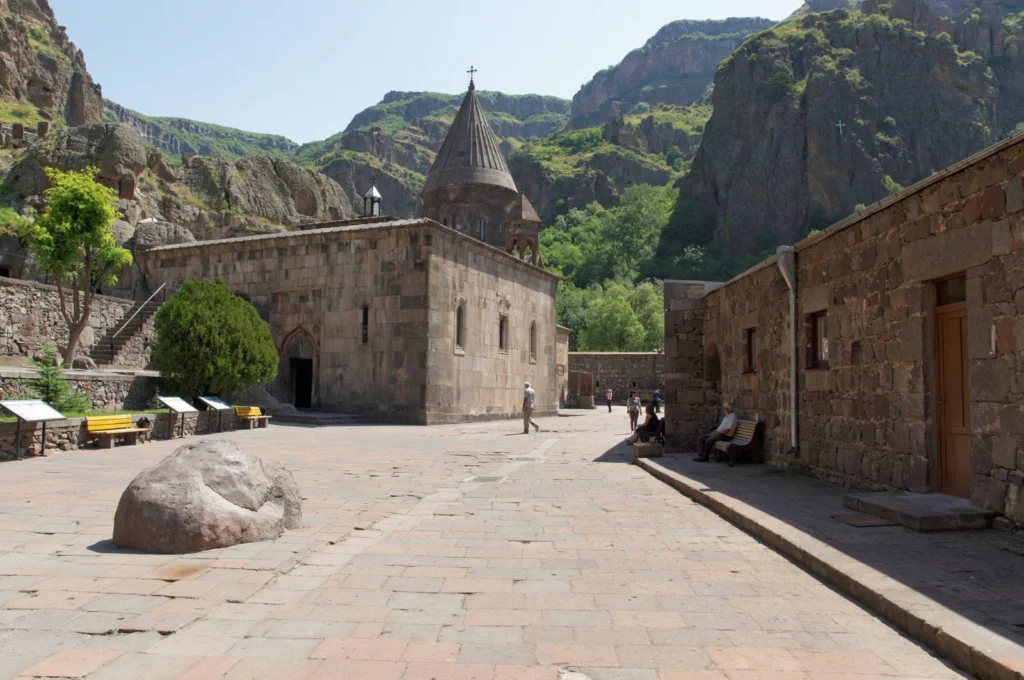
Geghard Monastery is a medieval Armenian monastery where masonry churches meet chambers carved into a cliff. Its Upper Azat Valley setting makes it a natural day trip from Yerevan, but getting there by public transport requires more planning than simply boarding a bus labeled “Geghard.”
Practical source check: November 10, 2026. Transport listings and visitor access should be reconfirmed before departure.
Geghard combines rock-cut churches, tombs and carved cross-stones with a largely 13th-century architectural ensemble. UNESCO inscribed the monastery and the Upper Azat Valley in 2000. Allow roughly an hour to 90 minutes on site as a planning estimate, and arrange the final transfer if traveling via Garni or Goght.
Plan your visit: Compare the bus and its final connection, check hours and admission, or follow a flexible day-trip sequence.
What to see at Geghard
Start by looking at the relationship between the buildings and the rock behind them. Geghard is not one large cave: it is a connected group of built and excavated spaces. Moving between them is the main reason to allow time beyond a quick courtyard photograph.
The main church and entrance hall
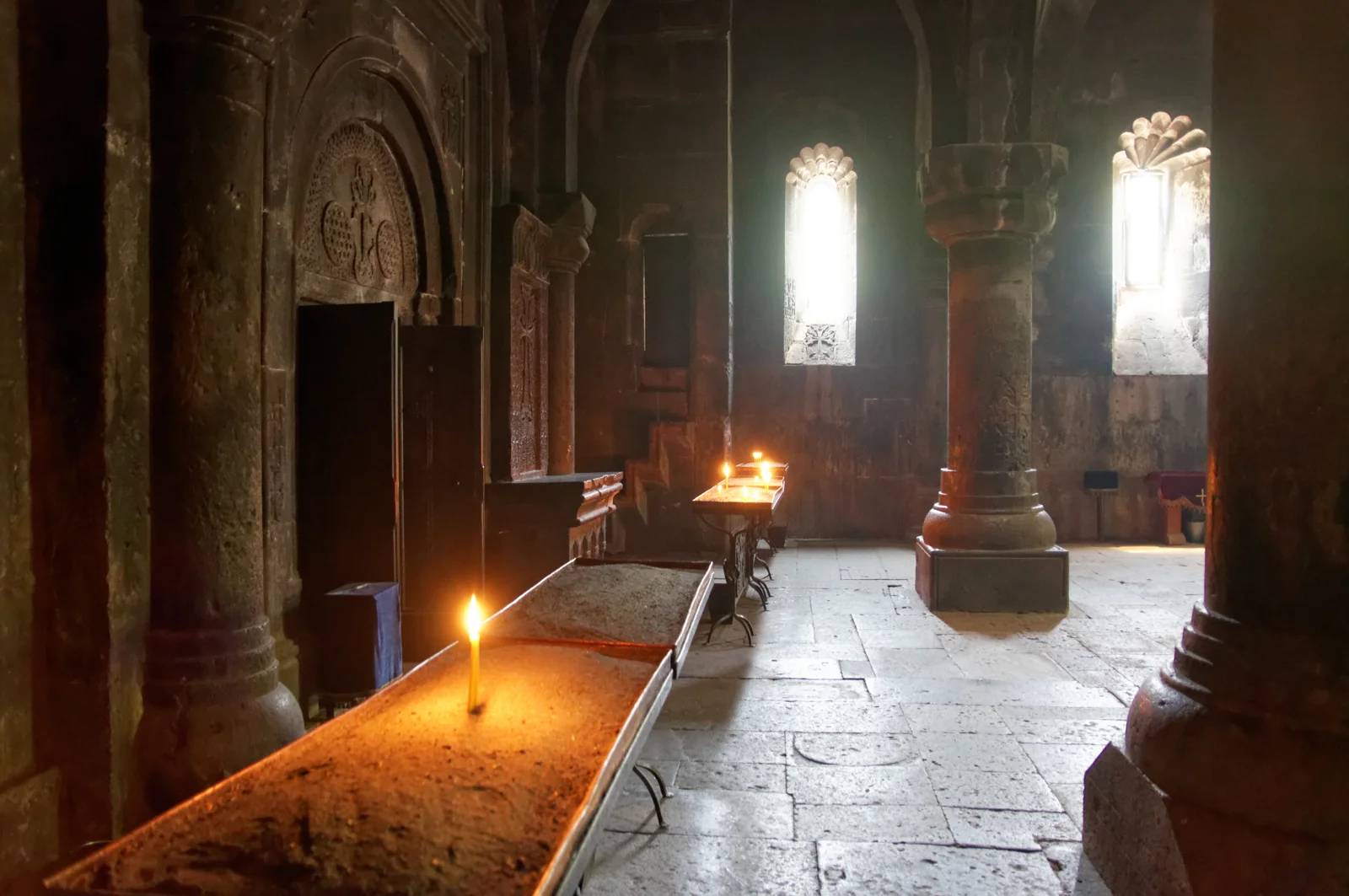
The Katoghike, or main church, dates to 1215. Its adjoining gavit is an Armenian church entrance hall, sometimes described as a narthex. Look at the transition from the exterior stonework to the darker interior, then at the columns and the opening in the roof. The official Armenia Travel description explains how the hall connects the main church with a rock-cut church.
Rock-cut churches, tombs and cross-stones
In the excavated spaces, architectural details were shaped from the surrounding rock rather than assembled solely from separate blocks. Watch how doorways, carved surfaces and light distinguish one chamber from another. The contrast is easier to appreciate if you pause instead of following a group straight through.
The complex includes princely burial spaces and numerous khachkars, Armenian carved cross-stones. Their designs reward close looking, but do not touch or climb the carvings to inspect them. Some spaces involve stairs, and not every area should be assumed open on every visit.
The cave spring belongs to the monastery’s religious history. Treat it as part of a sacred place, not as a tested drinking-water supply. A personal water bottle is a more dependable way to prepare for your day.
Getting to Geghard from Yerevan
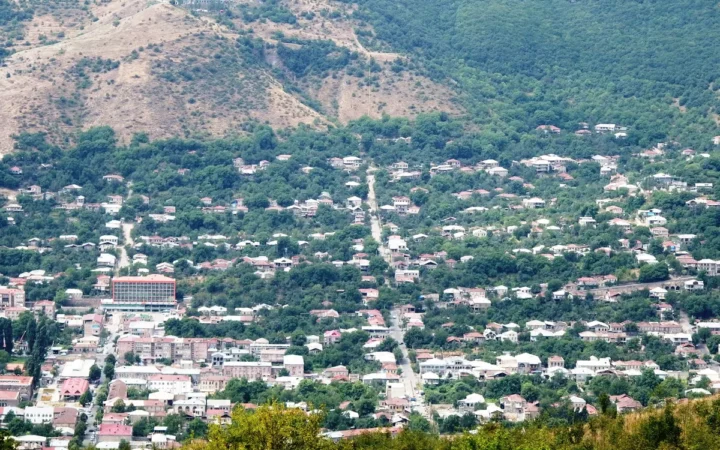
Geghard is in Kotayk Province, beyond Garni along the Azat Valley. Local tour operator Hyur Service lists it as about 23 miles (37 kilometers) from central Yerevan. That is an orientation figure, not a promise about the route from your hotel or the journey time. Check a route to Geghard Monastery, rather than assuming every place called Geghard is the monastery.
For planning with a car, leave around an hour each way and add a buffer for city traffic, stops and conditions. This is an editorial allowance, not a measured or guaranteed transfer time. Public transport needs additional time for reaching the departure station, waiting and completing the final leg.
| Option | Best fit | Arrange before leaving |
|---|---|---|
| Car with driver or taxi | Flexible stops and a less complicated return | Round-trip price, waiting time and included stops |
| Bus plus local transfer | Travelers with time to manage connections | Final transfer, return departure and a backup plan |
| Organized excursion | Combined sightseeing with logistics handled | Stop durations, entry inclusions and lunch arrangements |
The bus does not finish at the monastery
Transport for Armenia’s Garni–Goght route listing runs from Yerevan’s Gai Bus Station through Garni to Goght Bus Terminus. It does not list the monastery as a stop. The published journey duration is about 65 minutes to Goght, excluding your transfer to Gai and the onward connection.
Arrange a local taxi or other transfer from your actual drop-off point. Garni and Goght are different places, so a distance quoted from Garni should not be reused for Goght. Confirm where you will be collected and how you will return before leaving the main route. Do not assume a taxi will be waiting when you arrive.
Check the latest outward and return departures shortly before travel. The online route page is useful planning evidence, but it is not a guarantee that a particular departure will operate. Avoid building the whole day around catching the last bus.
Agree the whole taxi journey
Armenia’s official tourism website identifies GG and Yandex Taxi as commonly used options. For this excursion, compare a live quote with a prearranged driver, and confirm whether the quoted amount covers waiting and the return journey. Ask for the total in Armenian drams, particularly if adding Garni or the gorge. A one-way fare is not a day-trip budget, and an outward app booking does not guarantee a return car.
Hours, admission and visiting conditions
Opening hours and admission
Hyur Service’s Geghard visitor listing, checked November 10, 2026, gives free admission and opening hours of 8:00 a.m.–7:30 p.m. daily. This is a tour operator’s listing, not a monastery-issued seasonal timetable. Confirm locally before making an early or late arrival, especially in winter or around religious observances.
Free monastery admission does not cover transport, a guide, purchases or entry at other stops. Keep some small-denomination dram notes for optional purchases and donations. Check each paid attraction separately rather than treating a combined itinerary as one ticket.
Accessibility and what to bring
Historic stone surfaces, thresholds, steps and dim chambers can make this a demanding visit for travelers with limited mobility or low vision. An accessible route through the entire complex has not been verified. If step-free access is essential, ask a local operator for specific, recent details about the drop-off, entrance, interior route and toilets before booking.
Wear shoes with reliable grip and carry a layer for the shaded interiors. Bring drinking water, and do not assume refreshments or an accessible toilet will be available exactly when needed. Families using a stroller should plan around steps and thresholds rather than expecting to wheel through every chamber.
Church etiquette and photography
Geghard is a place of worship as well as a heritage attraction. Modest clothing covering shoulders and knees is a considerate choice. Follow the guidance of clergy and attendants, leave space for worshippers, and keep conversations quiet.
Ask before photographing a service or an identifiable person at prayer, and follow any posted photography restrictions. Do not treat the resonant interiors as a place to test your voice. A religious service may change which spaces visitors can enter, so keep the order of your visit flexible.
Plan a day with Garni
Geghard pairs naturally with the temple at Garni: the two stops offer very different architecture along the same excursion corridor. GeographyPin’s Garni village and temple guide covers the neighboring stop in more detail. Use the separate Garni Gorge guide when planning time for the basalt columns.
A flexible day-trip sequence
The following is a suggested plan for a prearranged vehicle, not a timetable. Reserve most of the day if you want a relaxed lunch and the gorge rather than a quick two-stop excursion.
- Leave Yerevan after confirming access and transport. Keep your departure flexible enough to avoid planning around the earliest advertised opening.
- Visit Geghard first. Allow roughly 60–90 minutes for the principal spaces, photography where permitted and a pause outside. Add time if architecture or religious history is your main interest.
- Continue to Garni Temple. Allocate approximately another hour as a starting allowance, rather than assuming a brief photo stop is enough.
- Take a lunch break. Build it into the driver’s agreed waiting time. A meal or demonstration included in a tour may reduce time at the monuments.
- Add the Symphony of Stones only if time and mobility allow. Treat the gorge as an additional stop with its own access and return logistics, not as a free extra you can fit into a spare few minutes.
For a shorter outing, keep Geghard and Garni Temple and leave out the gorge. If using buses, reverse the sequence when departures or a confirmed local transfer make that more practical. The point is to protect your return connection, not to follow a rigid itinerary.
When comparing organized trips, check the actual program. Hyur’s published examples include both shorter Garni–Geghard trips and longer outings with the Symphony of Stones and food activities. A tour’s total duration does not tell you how long you will have inside Geghard.
History, the Holy Lance and UNESCO
Geghard’s fourth-century origin and its medieval buildings describe different stages of the site. UNESCO attributes its foundation by St. Gregory the Illuminator to tradition. The principal architectural ensemble belongs to the 13th century, so describing everything visible as a fourth-century monastery is misleading.
Originally called Ayrivank, meaning a cave monastery, the site later became known as Geghardavank, the Monastery of the Spear. The name refers to the Holy Lance, venerated in Christian tradition as the spear associated with Christ’s crucifixion. That religious identification should be distinguished from independently established historical provenance.
The relic is not something to expect in the monastery’s everyday displays. The Armenian Church’s Alex and Marie Manoogian Treasury-House page lists it among treasures transferred there at the Mother See of Holy Etchmiadzin. Anyone planning a separate museum visit should confirm where it is displayed and whether the museum is open.
UNESCO’s property is officially named “Monastery of Geghard and the Upper Azat Valley.” Inscribed in 2000 under cultural criterion (ii), it recognizes medieval Armenian monastic architecture and decorative art, including influential rock-cut churches and tombs. The landscape helps explain the site, but this is not a natural-heritage inscription for the entire Azat River valley.
What Did We Learn Today?
Geghard makes most sense as both a medieval architectural complex and a functioning religious place. Separate the founding tradition from the buildings you see, and separate reaching Garni or Goght from reaching the monastery. A confirmed return transfer and enough time for the interiors matter more than squeezing another stop into the day.
Sources & Data Notes
Sources checked November 10, 2026. History distinguishes founding tradition from dated construction. Visitor hours and free admission are attributed to a local tour operator; no monastery-issued seasonal schedule was verified. Transport for Armenia supplies the route description, not a guaranteed departure. Visit durations and the day plan are editorial planning allowances. Taxi prices, exchange-rate conversions and blanket accessibility claims are intentionally omitted.
- UNESCO: Monastery of Geghard and the Upper Azat Valley
- Armenia Travel: Geghard Monastery
- Armenia Travel: Getting Around Armenia
- Transport for Armenia: Yerevan–Goght route listing
- Hyur Service: visitor information and tour examples
- Visit Armenia DMC: Geghard history and the 1215 main church
- Armenian Church: Alex and Marie Manoogian Treasury-House
Featured photograph: Geghard Monastery, June 19, 2014. © Vyacheslav Argenberg / Wikimedia Commons, CC BY 4.0. Resized and converted to WebP. Historical photographs do not establish current visitor conditions.