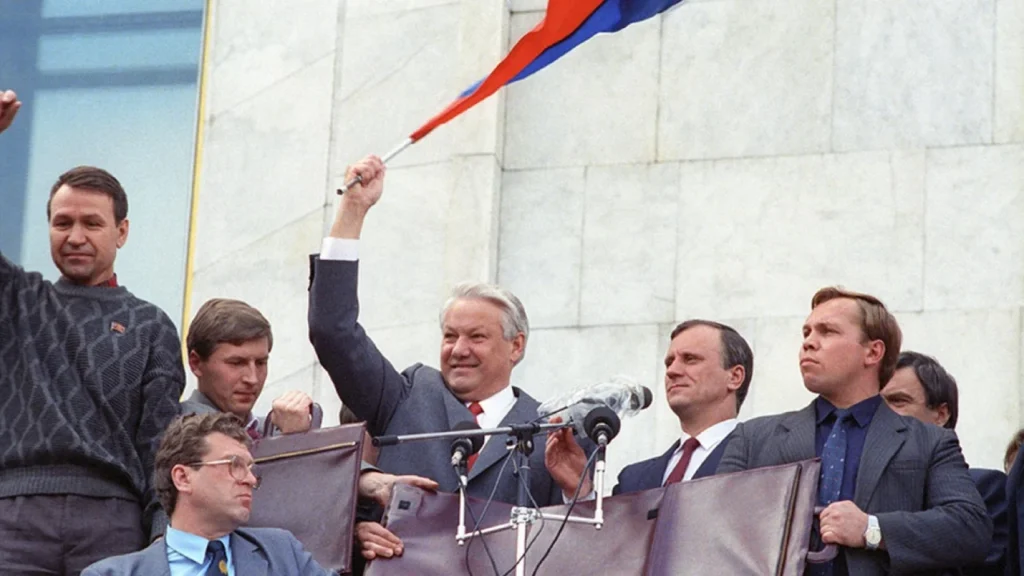
In March 1991, about seven in ten voters in Soviet Ukraine backed a proposal to keep a reworked Soviet federation. In December, nine in ten participants in Ukraine’s referendum backed independence. The difference makes sense once you read the questions and see what happened between the two votes.
The Soviet Union collapsed as economic decline undermined its central government and republics claimed more control over their own affairs. A failed August 1991 coup weakened Mikhail Gorbachev and disrupted his plan for a looser federation. Ukraine’s December vote for independence took a key republic out of that plan, and agreements among republic leaders ended the union.
How to use this article: Compare the three ballot questions, see why talks continued after the coup, or follow the final December agreements.
1. Why the Old Soviet System Was Already Weak
The USSR was one country, but it contained 15 union republics. Its central government had long exercised power through the Communist Party and a planned economy. The republics, however, had their own legislatures and institutions. As Moscow lost the ability to settle disputes and keep goods moving, those institutions gave leaders a place to make and enforce competing decisions.
Gorbachev’s perestroika, or restructuring, was meant to revive a sluggish economy. Instead of a smooth shift from central planning, the late Soviet economy endured falling output, shortages and growing disputes over prices and supply. A factory could depend on a supplier in another republic; when planning and deliveries broke down, announcing a new economic policy did not restore those connections.
Glasnost, or greater openness, widened public debate and gave organized opposition more room. Independence campaigns became especially prominent in the Baltic republics. In Russia itself, Boris Yeltsin’s rise created a different problem for Gorbachev: the government of the largest Soviet republic could openly challenge the union government, even though both operated from Moscow.
Economic crisis made the old arrangement harder to defend, but it did not dictate a single outcome. Some republic leaders wanted a shared economic space while insisting on more control at home. The crucial question in 1991 was what, if anything, they would still authorize a union government to do.
2. What the March and December Votes Actually Asked
A renewed federation was not the old status quo
The March all-Union referendum asked whether to preserve the USSR as a “renewed federation of equal sovereign republics,” with guaranteed rights and freedoms. It did not ask voters to choose between the existing system and an independent country. Six republic governments, in Armenia, Estonia, Georgia, Latvia, Lithuania and Moldova, declined to organize the vote. Some local polling occurred in republics whose governments did not take part. Kazakhstan used its own wording about a union of equal sovereign states, and the central commission included its results in the all-Union count.
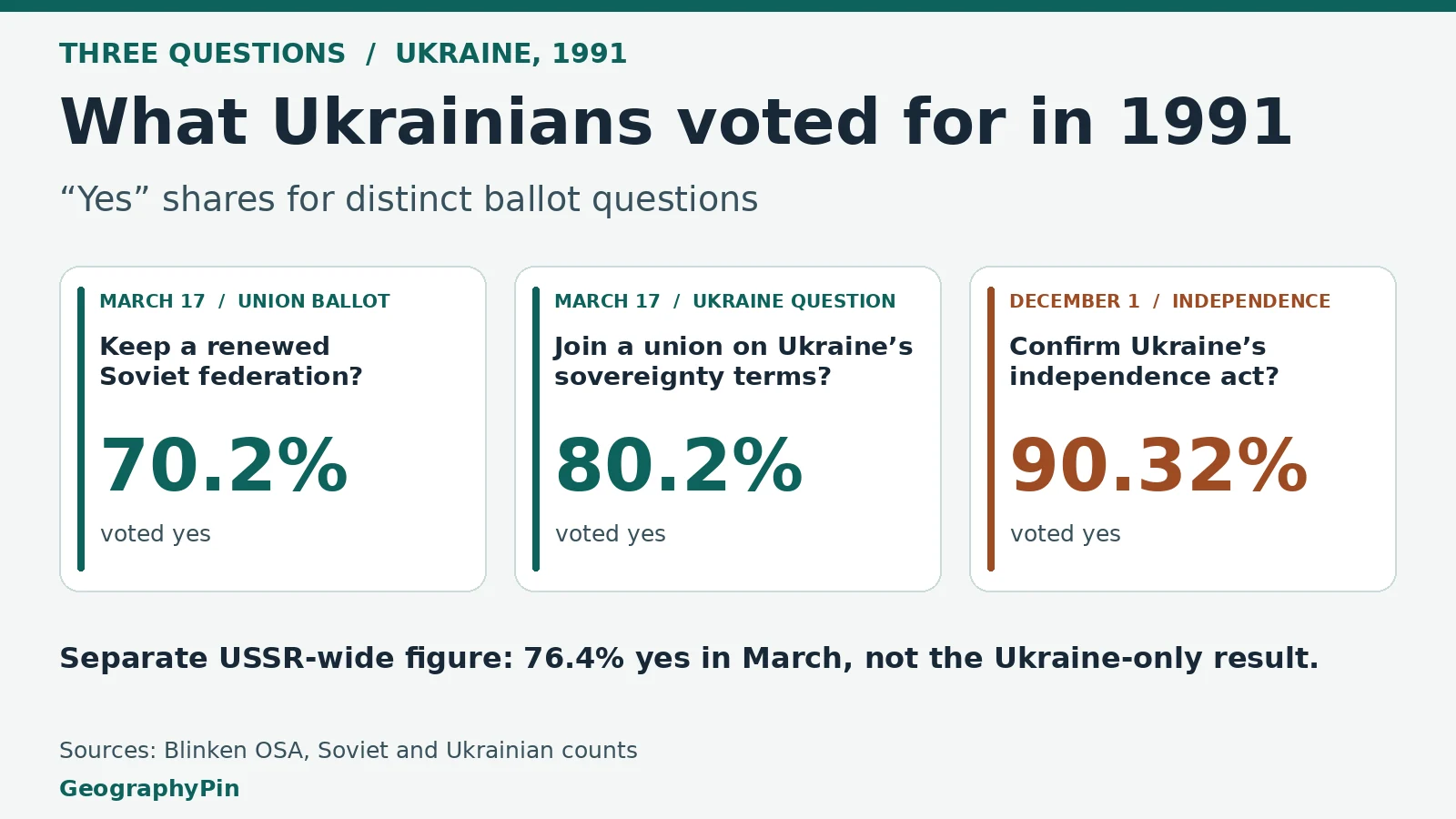
Soviet Ukraine added its own question on the same day. It asked about joining a union of sovereign Soviet states on the terms of Ukraine’s declaration of state sovereignty. More voters backed that wording than backed the all-Union proposal in Ukraine. Neither March question asked whether to confirm an act of independence. That act did not yet exist.

| Date | Jurisdiction | Eligible places | Question, abridged | Participation | Yes |
|---|---|---|---|---|---|
| March 17 | All-Union ballot | Organized by nine republic governments; some local polls elsewhere | Preserve a renewed federation of equal sovereign republics? | 148.6 million ballots cast; 80.0% of listed voters | 76.4% overall; 70.2% in Soviet Ukraine |
| March 17 | Supplementary Ukraine question | Ukrainian SSR | Join a union on the terms of Ukraine’s sovereignty declaration? | Held alongside the all-Union vote in Ukraine | 80.2% in Soviet Ukraine |
| December 1 | Ukraine independence referendum | All 27 administrative regions at the time | Confirm Ukraine’s August 24 Act of Declaration of Independence? | 31,891,742 participants; 84.18% of eligible voters | 90.32% of participants |
In December, 28,804,071 participants voted yes, and the proposal won a majority in every region, including Crimea and Sevastopol. The figures establish the outcome of each ballot. They cannot show which individual voters changed their minds or why they did so.
3. How the August Coup Changed the Negotiations
Gorbachev treated the March vote as a mandate to negotiate a new treaty. The idea was to preserve union-level institutions while giving the republics greater autonomy. A signing was due to begin on August 20. Instead, hardliners moved against Gorbachev on August 19 and held him at his holiday residence in Crimea. Yeltsin opposed the coup from the seat of the Russian republic’s government in Moscow.
The coup collapsed within three days. Gorbachev returned, but the intervention had discredited institutions on which he depended and strengthened leaders who stood against it. On August 24 Ukraine’s legislature adopted its independence act and put it to a December referendum. The move was both a break with the center and a decision to ask voters to confirm that break.
The union did not end when the coup failed
Talks continued into the autumn. October State Council minutes show republican leaders discussing a revised treaty and a common economic space. They could agree on the need to restore trade more readily than they could agree on which government should control prices or exercise shared powers. The revised union treaty was never signed. Ukraine’s December result then made it untenable for Kyiv to agree to join a renewed Soviet federation.
4. How the Soviet Union Ended in December
Four steps from the Belavezha agreement to dissolution
- December 8: Leaders of Belarus, Russia and Ukraine signed the Belavezha agreement, declaring that the USSR no longer existed and establishing the Commonwealth of Independent States (CIS).
- December 21: At Alma-Ata, now Almaty, 11 republics in all joined the arrangements. The declaration distinguished the commonwealth from a state or a government above its members.
- December 25: Mikhail Gorbachev resigned as president of the USSR.
- December 26: The Soviet of the Republics, a chamber of the USSR Supreme Soviet, issued Declaration 142-N acknowledging that the USSR had ceased to exist.
The December dates mark different actions. December 8 was an agreement among three republics, December 21 broadened the arrangement, and December 26 was the formal acknowledgment by a Soviet institution. The map and list of the former Soviet republics show how the breakup reshaped the international map.
Frequently Asked Questions
Did every Soviet republic participate in the March referendum?
No. Nine republic governments organized it; six did not. The final Soviet totals also included some votes cast at local polling sites on territory where a republic government had refused to organize the referendum. The 76.4% figure is a share of ballots cast, not a share of the entire Soviet population.
Was the Commonwealth of Independent States a new Soviet Union?
No. The Alma-Ata Declaration called the CIS neither a state nor a supranational entity. Its members could coordinate on common concerns but did not form a new single country with Moscow as its capital.
What Did We Learn Today?
A March vote for some form of renewed union did not settle what that union would be. The coup weakened the institutions trying to preserve it, and Ukraine’s later vote gave its leaders a clear mandate for independence. The republics’ December agreements, followed by Gorbachev’s resignation and the formal declaration, ended the Soviet state.
Sources & Data Notes
Original ballots, counts, diplomatic records and photo credit
Ballot questions in the table are abridged English translations or paraphrases of the original wording. The March USSR-wide and Ukraine-only figures use different electorates. Ukraine’s December yes percentage uses all participants as its denominator, including invalid ballots. Crimea and Sevastopol refer to the 1991 administrative units and the December 1991 vote.
- January 16 Supreme Soviet decree, English translation of the all-Union ballot; Soviet Central Referendum Commission final announcement, Russian text transcription.
- Blinken Open Society Archives: Winning Freedom, for the additional question and both March figures in Ukraine; Ukrainian Institute of National Memory and Constitutional Court of Ukraine collected decisions, for the December question and count.
- US International Trade Commission report on trade with former Soviet republics, for the economic context; National Security Archive: The End of the Soviet Union, 1991, for treaty talks and primary meeting records.
- Belavezha documents circulated at the United Nations (A/46/771); Alma-Ata documents circulated at the United Nations (A/47/60); George H.W. Bush Presidential Library chronology; Kazakhstan’s national history portal on Declaration 142-N, for the December 26 session and declaration.
- Cover: Boris Yeltsin raises a Russian flag at a Moscow rally after the failed coup, August 22, 1991. ITAR-TASS via Kremlin.ru and Wikimedia Commons, CC BY 4.0; resized and re-encoded.