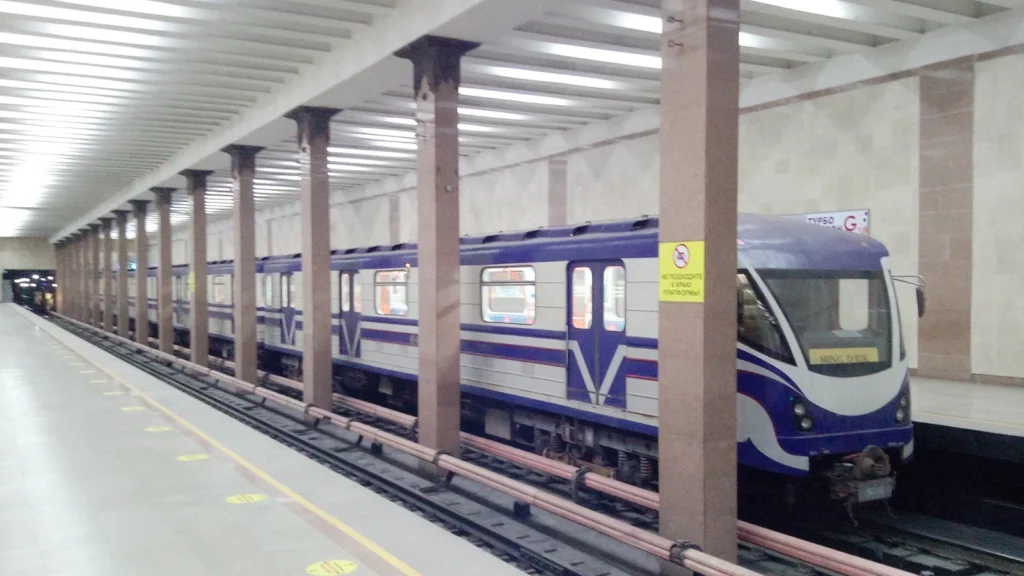
One Tashkent Metro platform uses blue domes and ceramic panels to tell stories from literature. Another makes the walls look like a night sky. You can compare them on a central circuit rather than riding to the ends of the network.
For two contrasting interiors, walk the passage between Alisher Navoiy (blue domes) and Paxtakor (cotton mosaics). For the longer route, start at Chorsu, visit Kosmonavtlar, then change at Oybek. Ride one stop on the Yunusobod line, change to the Chilonzor line and finish at Paxtakor. At each change, the connecting platform has a different station name.
Practical information checked: November 2026
How to use this article: Follow the station order, compare what to look at on the platforms, or check old names and return options.
Start at Chorsu and finish at Paxtakor
Read the three lines in riding order
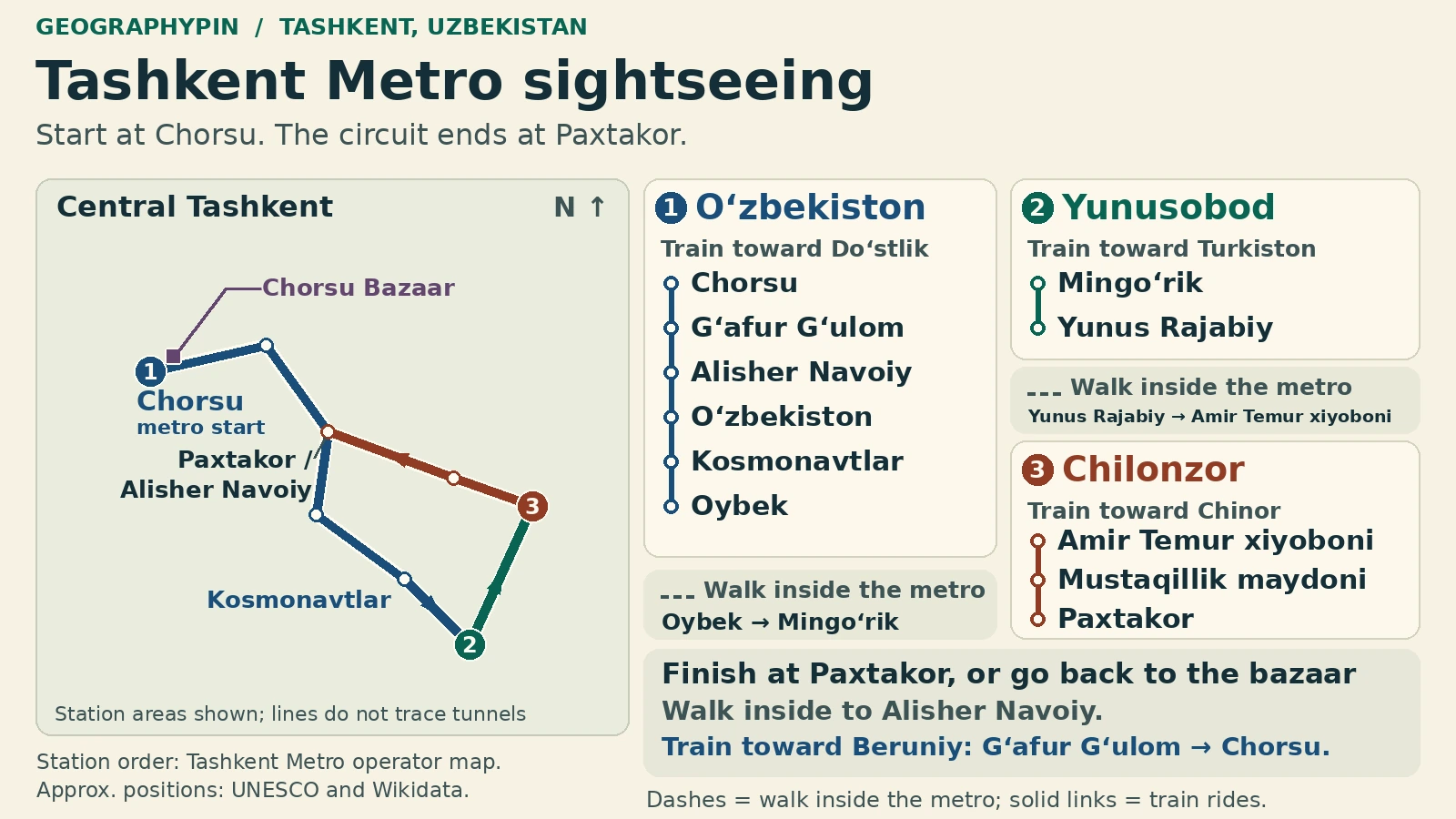
Start at Chorsu by Chorsu Bazaar. The main market dome is your street landmark before going underground; ask for Chorsu Bozori if you need directions from the metro exit to the dome. The map covers the central route only. Use its north-up overview to see where the trip goes, then follow the three lists to board the right way.
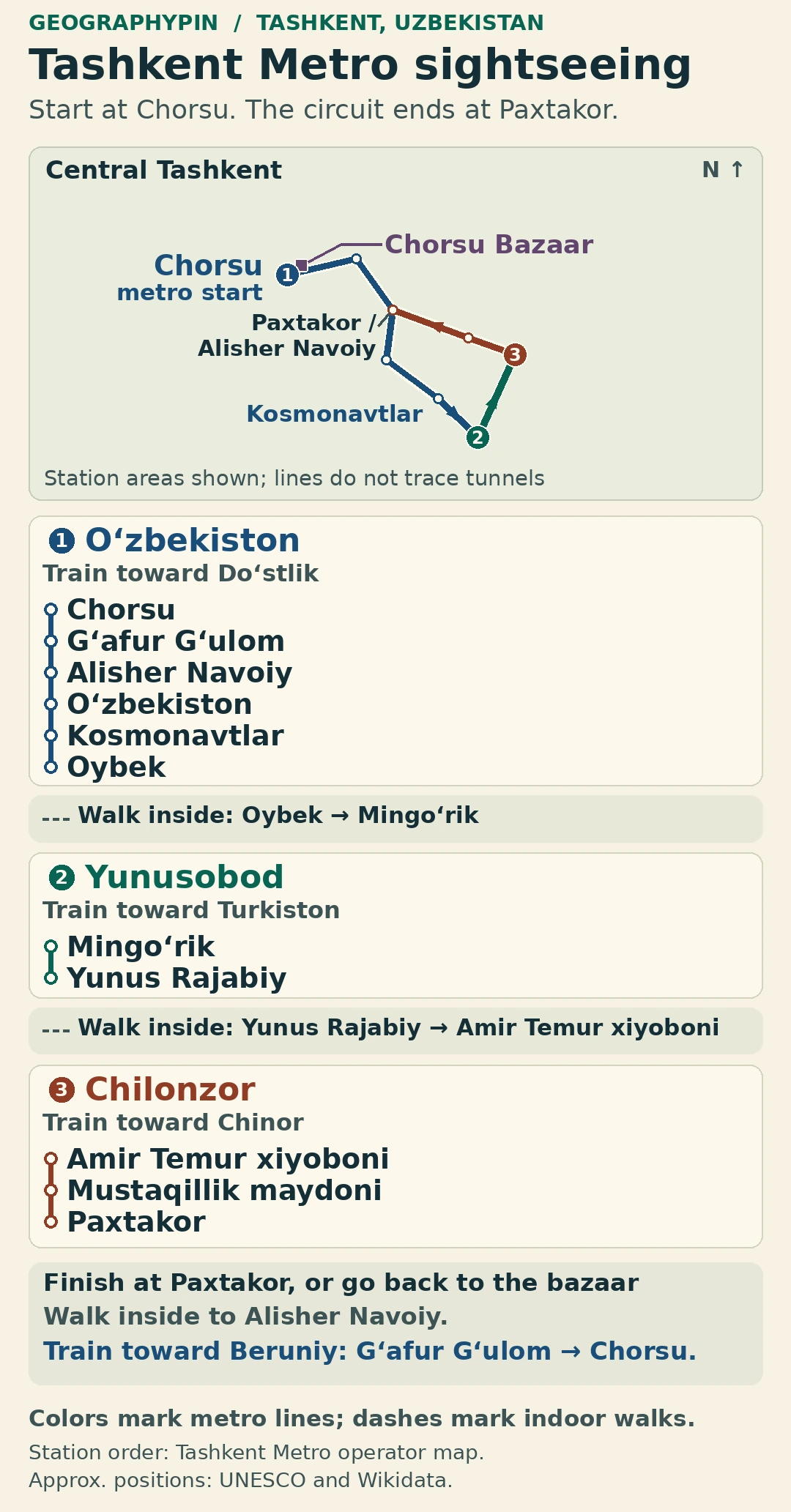
- Oʻzbekiston line, toward Doʻstlik: Chorsu → Gʻafur Gʻulom → Alisher Navoiy → Oʻzbekiston → Kosmonavtlar → Oybek. Oʻzbekiston is both the line name and a distinct station between Alisher Navoiy and Kosmonavtlar.
- Yunusobod line, toward Turkiston: from Oybek, follow the transfer to Mingoʻrik. Ride one stop to Yunus Rajabiy, then follow the signs to Amir Temur xiyoboni on the other line.
- Chilonzor line, toward Chinor: Amir Temur xiyoboni → Mustaqillik maydoni → Paxtakor. Exit at Paxtakor to finish. To return to Chorsu Bazaar, stay inside, take the passage to Alisher Navoiy and board toward Beruniy. Pass Gʻafur Gʻulom and get off at the second stop, Chorsu. Walking the last passage alone won’t get you back to the bazaar.
Set aside part of a morning if you want to look around the bazaar and linger over the station art. Leave the through-path clear while you look. For a trip beyond the capital, see what Tashkent, Samarkand, Bukhara and Khiva each add to an Uzbekistan itinerary.
What to look for at four stations
Use the Paxtakor interchange for the shortest visit
| Station and line | What to look for |
|---|---|
| Alisher Navoiy Oʻzbekiston | Look up at the blue domed ceilings, then look for narrative panels inspired by the poet’s work. |
| Kosmonavtlar Oʻzbekiston | Compare the space-themed portraits and darkening blue wall palette with the decorative blue at Alisher Navoiy. |
| Mustaqillik maydoni Chilonzor | Look for marble columns and chandeliers rather than a wall narrative. |
| Paxtakor Chilonzor | Look for the repeated cotton motif in the mosaics. |
If you have time for just one interchange, use Alisher Navoiy and Paxtakor. At Alisher Navoiy, four panels illustrate poems from Navoiy’s Khamsa, including the story of Layli and Majnun; the other four are decorative. The titles alongside the scenes are in Chagatai, written in Cyrillic. The gallery in the passage toward Paxtakor includes a portrait of the poet. At Paxtakor, the name means “cotton grower”; look for the repeated cotton motif instead of another narrative scene.
If you want one more stop for art, make it Kosmonavtlar. It’s two stops from Alisher Navoiy toward Doʻstlik, with Oʻzbekiston in between. Alongside the space theme, look for the portrait of the fifteenth-century astronomer Ulugbek. That portrait explains why the station’s story begins long before anyone flew into orbit. To resume the full circuit, continue in the same direction to Oybek.
Recognize older names and plan your return
Use the current Uzbek station names
Look for Mustaqillik maydoni (Independence Square), formerly V. Lenin station. Some older sources call Amir Temur xiyoboni October Revolution. Pakhtakor is another spelling of Paxtakor, not an extra stop. The labels here use current Uzbek Latin-script station names, with English explanations where useful.
Since October 1, 2026, the single metro fare is 2,500 Uzbek soum (UZS) when paid electronically, or 3,000 UZS in cash for a QR-code ticket. ATTO lists transport cards, bank cards and mobile payments; carry enough local cash for a ticket if your card isn’t accepted. You can use the marked indoor passages without paying at a new entrance. If you leave to visit a square or market and then come back in, pay another fare. The city’s 60-minute transfer rules do not make a second metro entry free.
For a late visit, check the operator’s notices and the last departure in each direction you’ll need. A line’s published closing time doesn’t tell you when the last train leaves your platform. If you need step-free access, verify each entrance, platform and transfer with station staff; an indoor passage can still have stairs.
Frequently Asked Questions
Can I photograph the Tashkent Metro stations?
Yes, for personal photos or videos in public station areas. Uzbekistan’s metro rules forbid photography in technical rooms and other restricted facilities, and professional photography or filming requires written permission from metro management. Stay clear of stairs and walkways while you take pictures.
Which places on this route are part of Tashkent’s UNESCO World Heritage listing?
Kosmonavtlar Metro Station and Chorsu Bazaar are separate parts of the Tashkent Modernist Architecture property inscribed in 2026. The listing covers the market above ground, not Chorsu Metro Station, and it does not designate the whole subway.
What Did We Learn Today?
The most useful comparison is between neighboring interiors, not between the ends of the lines. A passage takes you from Alisher Navoiy’s stories to Paxtakor’s cotton mosaics; two stops from Navoiy, Kosmonavtlar uses portraits to connect astronomy with spaceflight. If you turn that short visit into a circuit, keep the difference between a transfer passage and a train ride in mind, especially when going back to the bazaar.
Sources & Data Notes
The map uses approximate position facts from UNESCO and Wikidata to place station areas and the bazaar; the routes simply connect those points, and do not represent tracks, particular entrances or the whole network. Fare and service notices checked November 23, 2026.
View sources and map notes
- Tashkent Metro operator’s interactive network map for the named platforms, their line order and transfer pairs; operator’s line and terminus descriptions and operator service notices. GeographyPin drew the schematic independently.
- Gazeta.uz interview with the architect of Alisher Navoiy station, Uzbekistan Travel’s Chorsu Bazaar guide and UNESCO’s list of the inscribed architectural sites and published points. Approximate station positions include public geographic data from Wikidata (CC0).
- AramcoWorld’s reporting and local interviews for former station names, station interiors and the portrait of Ulugbek; Ministry of Transport October 2026 fare and transfer rules, confirmed by ATTO’s fare notice. Cabinet passenger regulation no. 535, paragraphs 10, 12 and 16, provides photo and video rules.
- Featured photograph: Tashkent Metro train at Shahriston, Sick Spiny, August 15, 2020, CC BY-SA 4.0. Cropped and re-encoded under the same license. Shahriston is on the Yunusobod line but outside the illustrated loop.