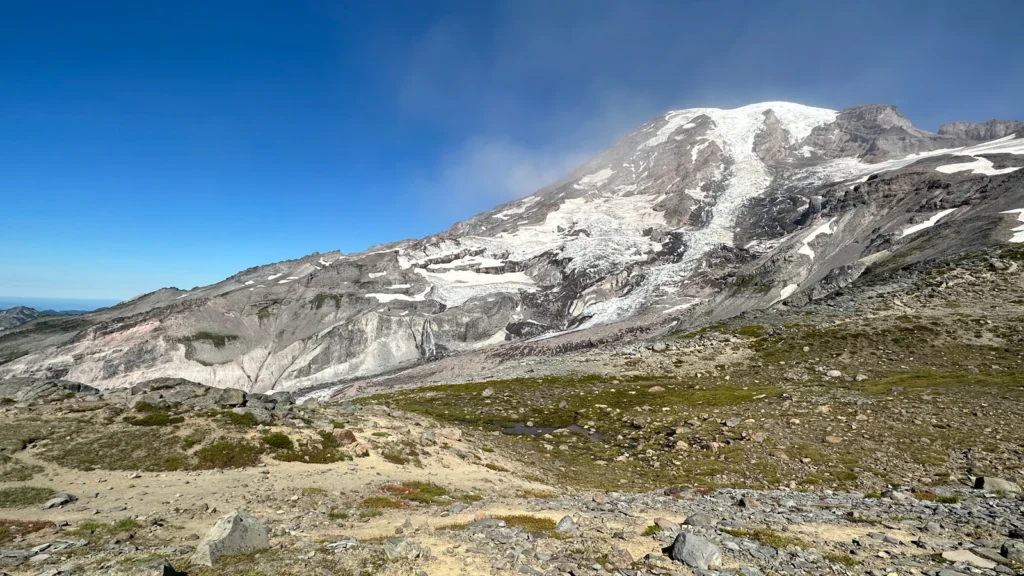
Paradise and Sunrise look at different sides of the same mountain. Paradise sits above the Nisqually Valley; Sunrise looks toward the ice and ridges above the White River. The road you can actually use matters as much as the view.
Practical information checked: November 2026
Choose Paradise if you want a short Nisqually Glacier walk, or are visiting outside the brief Sunrise driving season. In winter the road beyond Longmire depends on a daily gate decision. Choose Sunrise when its road is open if you want the higher trailhead and a short walk to look across the White River Valley toward Emmons Glacier.
How to use this article: check the winter gate at Longmire, find the Nisqually Vista trailhead, or walk to the Emmons Vista Overlooks.
Locate the two mountain faces
Paradise is on Mount Rainier’s south side at about 5,400 feet (1,646 m). Sunrise is on high ground northeast of the summit at 6,400 feet (1,951 m), about 1,000 feet (305 m) higher. There is no road straight across the mountain between them. When open, Stevens Canyon Road, State Route 123 and State Route 410 connect the approaches around the east side; that connection is seasonal too.
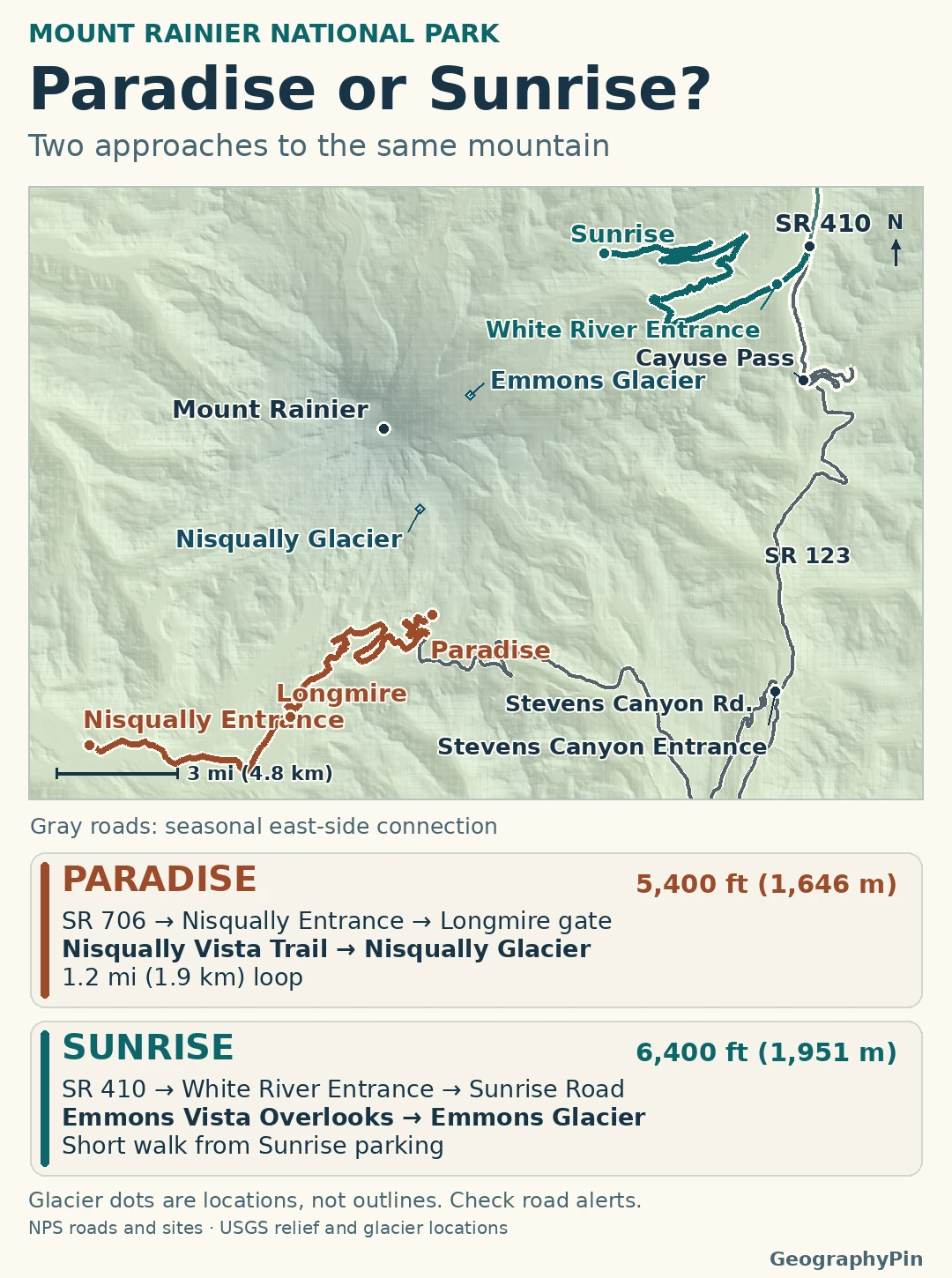
Enlarge map: Phone layout · Wide layout
Compare the two approaches
| Area | Approach | Seasonal constraint |
|---|---|---|
| Paradise | State Route 706 to Nisqually Entrance, then Longmire. NPS lists 12 miles (19 km) from Longmire to Paradise. | Nisqually Entrance to Longmire is normally available in winter. Past Longmire, the gate closes nightly in winter and may stay closed. |
| Sunrise | State Route 410 to the White River turnoff and entrance, then Sunrise Road. NPS lists 13 miles (21 km) from White River Entrance to Sunrise. | Sunrise Road usually opens in late June or early July and closes in late September or early October. Check the year’s actual dates. |
Check the winter gate before driving
The National Park Service’s November 18, 2026 road table listed Sunrise Road and Stevens Canyon Road as closed for the season. It listed Longmire to Paradise as open subject to the daily gate alert and regular nightly winter closures. Those were the park’s published road-table statuses, not a guarantee that the Longmire gate opens on any particular day. Washington State announced that Cayuse and Chinook passes would close for the season on November 18. Check park road status and the park’s current alerts before driving. NPS requires vehicles to carry tire chains from November 1 to May 1, including all-wheel-drive and four-wheel-drive vehicles.
In winter, the park’s usual weather-dependent schedule closes the uphill gate at 3 p.m. and the downhill gate at 4 p.m. NPS advises leaving Paradise by 3:30 p.m. to allow time to reach Longmire. Check the day’s gate notice before driving uphill; it can close earlier or stay shut. The park posts an expected status after 4 p.m. the day before and advises checking again after 7 a.m. on the day you go.
Choose a short glacier-view walk
Find the Nisqually Vista trailhead
Paradise: Start the Nisqually Vista Trail at the west end of the lower Paradise parking lot. The 1.2-mile (1.9 km) loop looks into the Nisqually Glacier valley. NPS lists about 200 ft (61 m) of gain and stairs at the start; the paved route is not wheelchair accessible. In winter the trail is covered in snow and is usually marked for snowshoeing once enough snow has accumulated. Check the day’s trail conditions rather than counting on markers.
Find the two Emmons Vista Overlooks
Sunrise: Take the marked path downhill from the south side of the parking lot. Continue from the first Emmons Vista Overlook to the second and turn back rather than following the full Silver Forest Trail. On a clear day, both overlooks face Emmons Glacier across the White River Valley.
The park’s trailhead guide lists a 0.5-mile (0.8 km) round trip with 70 feet (21 m) of gain. Its Sunrise activity guide gives 1 mile (1.6 km) with 100 feet (30 m) of gain for the two overlooks. The two guides do not explain the difference, so allow for the longer estimate. A short walk is not a guarantee of step-free access; check trail conditions, especially when snow remains.
Frequently Asked Questions
Do I need a timed reservation as well as a park pass?
NPS did not require a timed-entry reservation anywhere in the park in 2026. That was separate from the entrance fee or pass, and it does not establish the rule for a future year. Check the park’s fees page for the season you are planning.
What should I enter for the southwest entrance?
Use Nisqually Entrance instead. The headquarters address leads to an office in Ashford, outside the park. NPS lists the entrance at 39000 State Route 706 E, Ashford, Washington.
What Did We Learn Today?
The road between Paradise and Sunrise goes around the east side of Mount Rainier, not over it, and that connection is seasonal. Check access before trying to fit both into one day. If you choose just one side, Paradise looks into the Nisqually Glacier valley, while Sunrise looks across the White River Valley toward Emmons Glacier.
Sources & Data Notes
Heights refer to the visitor areas, not the summit. The relief map shows selected approach roads. The glacier diamonds are interior reference points from the federal hydrography dataset, not current ice boundaries. Neither road colors nor terrain shading shows current access. The two road distances have different named starting points and are not total journeys from the same town.
Maps, road alerts and park information
- National Park Service: park map and elevations, Sunrise, and directions and distances.
- NPS road status, winter travel, fees and timed entry; WSDOT seasonal pass closure, November 2026.
- NPS Nisqually Vista walk, Nisqually Vista winter markers and trailhead, Emmons Vista trailhead, Sunrise activity guide, and trail conditions.
- NPS public road centerlines and public visitor locations; NPS Paradise Road linework in The National Map; USGS 3DEP relief, National Hydrography Dataset, and USGS geographic names.
- Cover photograph: Jeff Hollett / Wikimedia Commons, CC0 1.0; cropped and resized.
