Norway’s oil wealth and public services make it a frequent example in debates about socialism. But a government owning company shares, investing national savings and providing social insurance is doing three different things. Understanding how these institutions fit together gives a clearer answer than a one-word label.
Norway is a market economy with extensive welfare institutions and substantial state ownership, not an economy organized around general social ownership. Its elected parliament, private businesses and public investment fund perform different roles. The oil fund holds investments abroad; it does not mean that the Norwegian government owns all domestic production.
How to use this article: Compare public and private institutions, distinguish the oil fund from domestic ownership, or clarify what the fiscal rule means.
1. Parliamentary government is not an economic ownership label
The Storting’s explanation of Norway’s Constitution separates legislative, executive and judicial power. Parliament grants public funding, imposes taxes and supervises government; political leadership is exercised by the Cabinet. These institutions describe how public power is organized, not a requirement that every enterprise be state-owned.
The Storting’s election guide, updated in January 2026, describes voters choosing among different parties’ candidate lists through proportional representation. A social-democratic policy program must therefore be distinguished from permanent rule by a single socialist party. Party competition and arguments over ownership can take place within the same constitutional framework.
Social democracy commonly refers to pursuing social protection and reform through democratic politics while retaining markets. In Norway’s case, the more informative description adds its substantial public ownership. Calling it either an entirely private economy or a system without private enterprise would miss important institutions.
2. Private enterprise and state ownership coexist
Norway’s Brønnøysund Register Centre provides the framework for establishing and registering limited companies. The OECD’s 2026 economic survey examines young firms, competition, investment and business restructuring. These are features of an economy in which enterprise decisions and market activity matter, not merely administrative allocations by the state.
Different institutions, different kinds of evidence
| Institution or example | What the evidence shows | What it does not show |
|---|---|---|
| Private enterprises | Company formation and competitive business activity operate within public rules. | That every business is privately owned. |
| Equinor | The government’s company overview lists a 67% state stake. | That the state owns 67% of Norway’s economy. |
| DNB Bank | The same overview lists a 34% state stake. | That public participation always means complete ownership. |
| Government Pension Fund Global | Public savings invested in an overseas portfolio. | Government ownership of all Norwegian companies. |
| National Insurance Scheme | A social-insurance institution with membership and contribution rules. | A measure of productive asset ownership. |
The company stakes come from the government’s state-ownership overview, updated July 1, 2026. They are concrete ownership interests, not scores on a capitalism-to-socialism scale. A majority stake and a minority stake also create different governance positions.
The same overview distinguishes enterprises where the state seeks long-term financial returns from those serving public-policy goals. Public ownership is therefore not one uniform activity. Its purpose, extent and governance need to be identified company by company.
3. The oil fund invests public savings abroad
A global portfolio is not a domestic nationalization program
The oil fund’s formal name is the Government Pension Fund Global, or GPFG. Norges Bank Investment Management’s explanation traces its establishment to legislation in 1990 and its first deposit to 1996. Its purpose includes saving petroleum wealth for future generations and cushioning the economy against fluctuations in oil revenue.
The fund’s half-year report for 2026 states that the entire portfolio is invested outside Norway. Norges Bank manages it on behalf of the Ministry of Finance, with day-to-day management delegated to NBIM. The portfolio includes company shares, bonds, property and renewable-energy infrastructure.
This is public ownership of financial wealth operating through international investment markets. It is not the same as the ministries’ direct stakes in Norwegian businesses. Both belong in the description of Norway’s model, but adding their values together would not produce a meaningful “percentage socialist.”
Nor is the fund simply a stored pile of oil-tax receipts. Investment returns and changes in asset and currency values affect its size. Its 2026 report separates investment results, inflows and currency movements, which is why a rising krone value cannot automatically be read as new petroleum revenue.
4. The fiscal rule governs spending over time
Three percent is an expected return, not a guaranteed payout
The Finance Ministry’s fiscal-policy framework says transfers to the budget should follow the fund’s expected real return over time. The return assumption was reduced from 4% to 3% in 2017. The framework also allows fiscal policy to respond to economic fluctuations and smooths large changes over several years.
That makes 3% a long-term policy benchmark, not a promise that investments earn exactly that amount each year. It is not a rigid instruction to withdraw precisely 3% every year, and it is not 3% of Norwegian GDP.
Norges Bank’s description of petroleum-revenue transactions separates the flows: state petroleum revenue is transferred to the fund for accounting purposes, while a transfer back finances the non-oil budget deficit. The budget connection is real, but it does not imply that every public service is paid for solely by oil.
5. Welfare institutions do not remove private ownership
Norway’s National Insurance Scheme guidance, updated in 2026 explains that membership can be based on residence or employment and connects membership to rights and contribution obligations. This is a system of social protection with specific rules, not simply a claim that every person receives every service without conditions.
Taxes and contributions concern how public activities and social insurance are financed. Ownership concerns who holds assets and directs enterprises. The two interact, but neither a high tax rate nor a particular benefit determines the ownership of a private business.
Public services and state investment can therefore coexist with markets. Norway’s distinctive combination deserves examination on its own terms rather than being treated as proof that either socialism or capitalism has one universal form. The institutions, their purposes and their actual operation tell us more than the label.
Frequently Asked Questions
Is the Government Pension Fund Norway the same as the oil fund?
No. The Finance Ministry distinguishes the Government Pension Fund Global, which continues the former Petroleum Fund, from the Government Pension Fund Norway, formerly the National Insurance Scheme Fund. Similar names should not be used interchangeably when discussing their investments or management.
Does “mixed economy” mean half public and half private?
No. It describes coexistence, not a 50–50 formula. Any numerical comparison must specify the assets, companies or activity measured. A company ownership stake, a fund balance and public expenditure are different measures.
What Did We Learn Today?
Norway combines private enterprise, direct state shareholdings, social insurance and overseas public investment. Those institutions perform different jobs. The oil fund’s public ownership does not turn its foreign portfolio into ownership of Norway’s entire economy, while the fiscal rule manages spending rather than classifying an ideology.
Sources & Data Notes
Company percentages describe named state shareholdings in the dated government overview, not ownership of the economy. Fund reporting refers to the first half of 2026, not a live valuation. The fiscal rule concerns expected real returns over time; actual annual returns vary. Welfare references explain institutions, not personal eligibility or tax advice. The public/private table is an editorial comparison, not an official ideological ranking.
For the separate question of political and constitutional country labels, see GeographyPin’s Socialist Countries guide.
- Storting, The Constitution — parliamentary responsibilities
- Storting, Parliamentary Elections in Norway — January 28, 2026
- Brønnøysund Register Centre, Establish a limited company — May 26, 2026
- OECD Economic Surveys: Norway 2026 — business dynamism chapter
- Government of Norway, What the State owns — July 1, 2026 overview
- Norges Bank Investment Management, About the fund — origins and purpose
- NBIM, Half-year report 2026 — Note 1 and investment results
- Ministry of Finance, The Norwegian Fiscal Policy Framework
- Norges Bank, Foreign exchange transactions on behalf of the government
- Nav, Membership of the National Insurance Scheme — 2026 update
- Ministry of Finance, The Government Pension Fund — distinction between its two parts
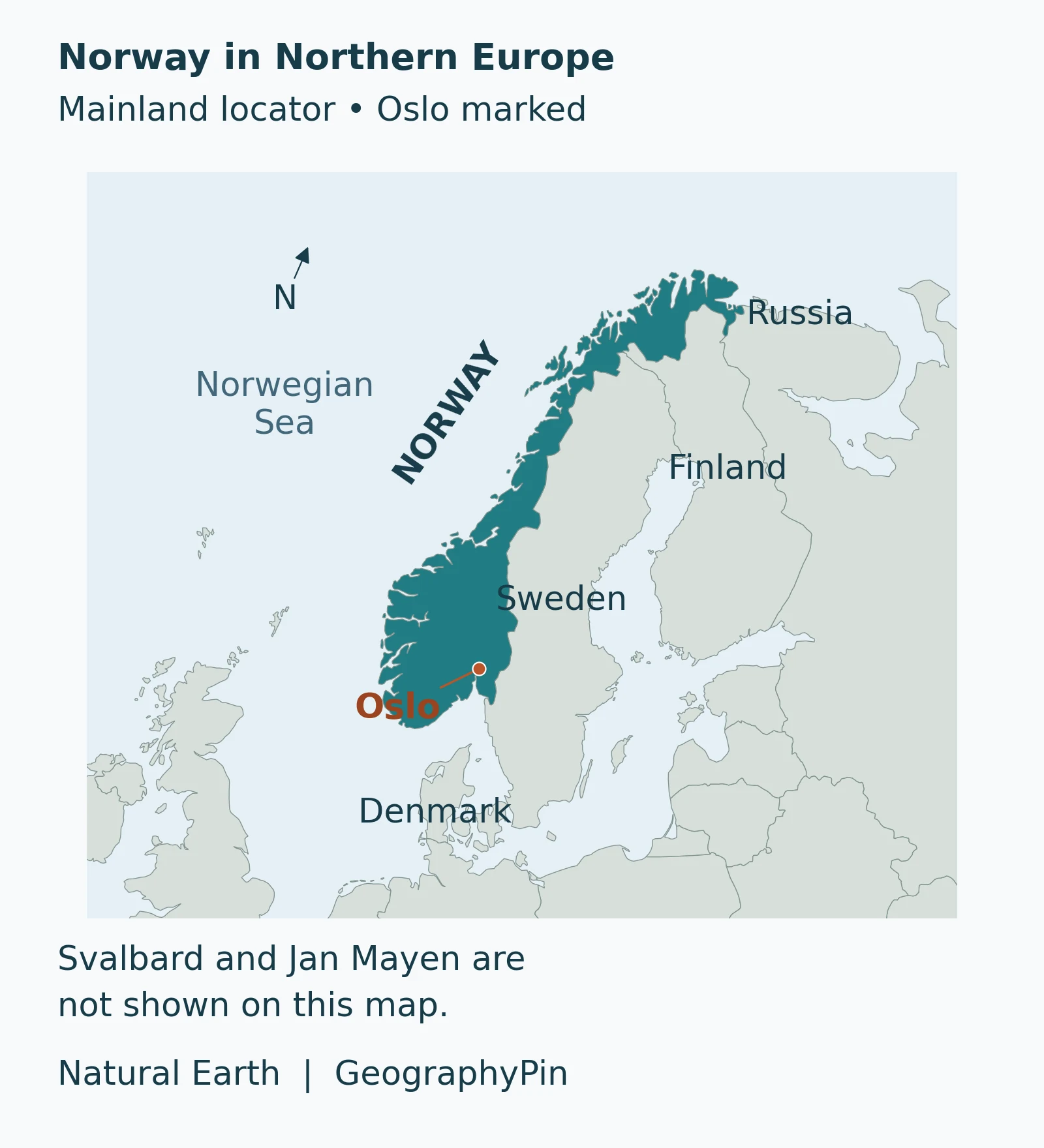
Locator methodology: generalized country outlines and the Oslo city point from Natural Earth country data and populated places, used under its public-domain terms. Lambert azimuthal equal-area projection. The map is a mainland locator, not a complete territorial or economic-ownership map.
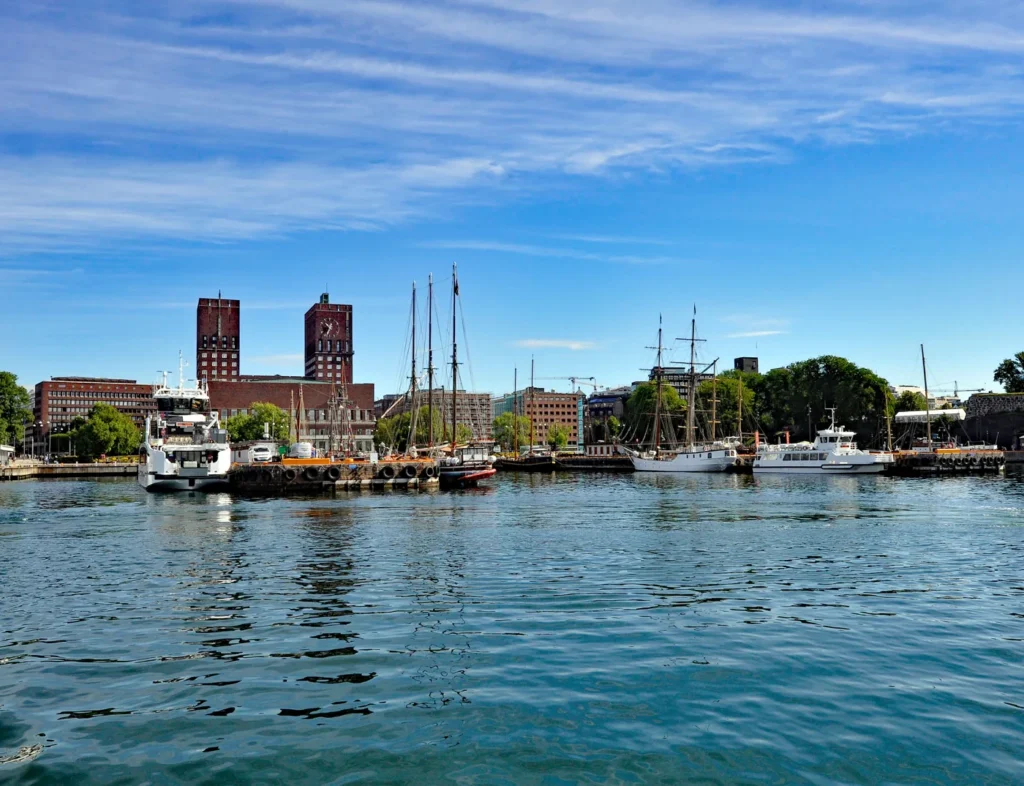
Featured photo: © 2022 P. Hughes / Wikimedia Commons, CC BY 4.0; resized and converted to WebP. Oslo’s waterfront and City Hall, photographed in 2022.