National flag guide
Flag of Turkmenistan: Meaning, Symbols and History
Turkmenistan introduced its green national flag in 1992 after independence from the Soviet Union.
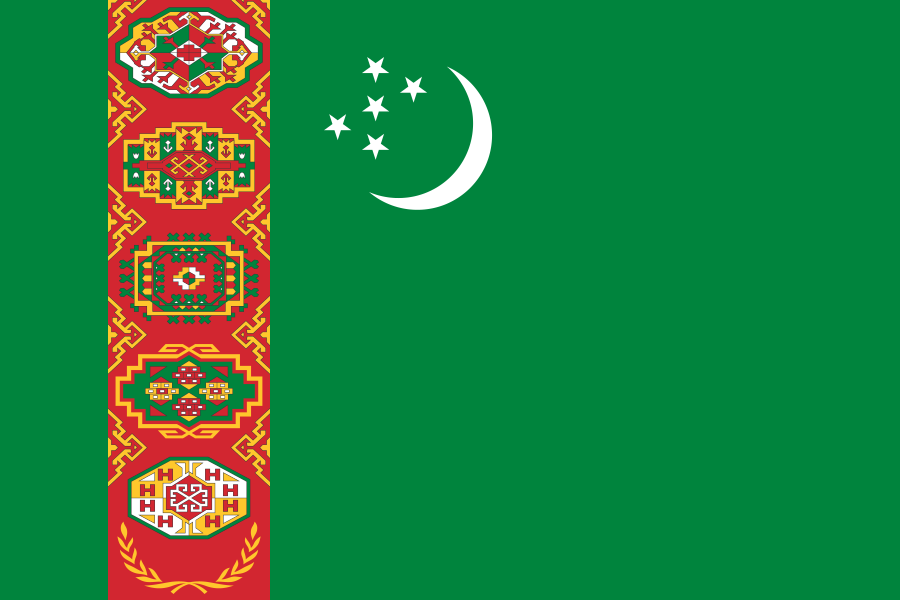
Green field with a vertical red stripe near the left side; the stripe has five tribal guls (designs used in producing carpets) stacked above two crossed olive branches; five five-pointed white stars and a white crescent moon appear in the upper left corner of the main field.
The design and its details
Green field with a vertical red stripe near the left side; the stripe has five tribal guls (designs used in producing carpets) stacked above two crossed olive branches; five five-pointed white stars and a white crescent moon appear in the upper left corner of the main field.
| Flag | Turkmenistan |
|---|---|
| Collection | Country flags |
| Adoption or specification | 1992; present proportions and design from 2001 |
| Browsing region | Asia · Central Asia |
| Illustrated proportions (height:width) | 2:3 |
What the flag means
Five carpet guls represent major traditional tribal groups, while five stars are associated with the country’s regions. Carpet patterns are specific cultural motifs, not five interchangeable decorative rectangles.
| Element | Meaning or historical connection |
|---|---|
| Green field and crescent | Islamic and national traditions. |
| Five white stars | The country’s five regional components in the national explanation. |
| Five carpet guls | Traditional patterns associated with major Turkmen tribal groups. |
| Olive branches | Peace and the country’s policy of neutrality. |
| Vertical carpet panel | A cultural identifying device, not a scale map or simply a decorative border. |
How the flag developed
Turkmenistan introduced its green national flag in 1992 after independence from the Soviet Union. The vertical carpet strip created an unusually detailed national design grounded in traditional textile motifs.
Olive branches were added during the 1990s in connection with the country’s neutrality, and a 2001 revision adjusted the modern design and proportions. The flag’s chronology should distinguish the first post-independence design from those later additions.
The main changes over time
1992 — National carpet flag
The independent state introduced the green flag and carpet motifs.
1990s — Neutrality branches
Olive branches were added below the guls.
2001 — Modern form
The design and proportions were revised.
How to recognise this flag
The red patterned hoist strip is the key cue. A white crescent and five white stars sit on green beside it; the main field contains no central coat of arms.
Earlier designs and other uses
Early post-independence flags lack later olive-branch details or use different proportions. They should be dated as specific versions.
Questions about this flag
When was the flag adopted?
1992; present proportions and design from 2001. An adoption date can refer to a design, its restoration or a later legal specification; the timeline above separates those stages.
What should I check before identifying an older example?
Early post-independence flags lack later olive-branch details or use different proportions. They should be dated as specific versions.
What Did We Learn Today?
The red patterned hoist strip is the key cue. A white crescent and five white stars sit on green beside it; the main field contains no central coat of arms. Its adoption and later changes reflect the national history described in the timeline, while older or specialist flags need their own labels.
Sources & Data Notes
This guide distinguishes first use, national adoption, restoration and later construction standards. Traditional or commonly reported interpretations are identified where they differ from a formal specification. It is a dated reference, not a live record of every change in official flag use.
- Archived World Factbook country record — background flag description and symbolic interpretations; later changes are explained above.
- Flagpedia: Turkmenistan — flag artwork and comparison reference.
- Flag history reference and bibliography — chronology and links to underlying sources.
The main illustration preserves the selected flag artwork’s proportions; these are a reproduction guide, not a substitute for a legal construction drawing. Color names group shades for browsing.
Current flag artwork is supplied with the original flag collection; the package’s artwork register contains provenance and license details.