National flag guide
Flag of Sri Lanka: Meaning, Symbols and History
Sri Lanka’s lion flag draws on the royal banner tradition of the Kingdom of Kandy.
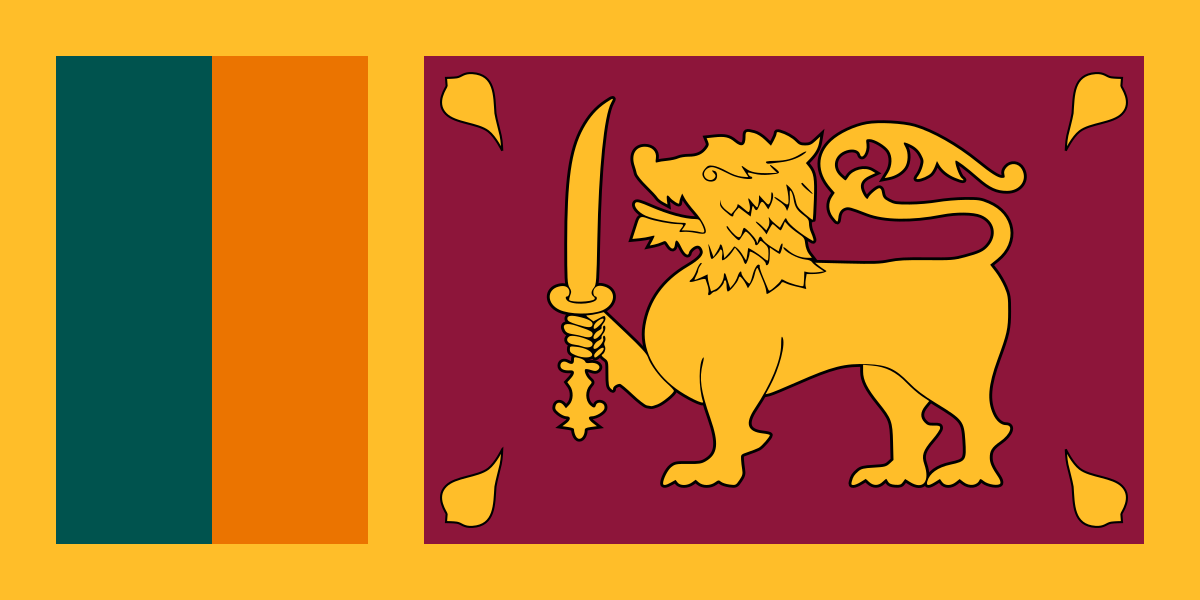
Yellow with two panels; the smaller panel on the left has two equal vertical bands of green (left side) and orange; the larger panel has a yellow lion holding a sword on a maroon field, with a yellow bo leaf in each corner. The lion is associated with Sinhalese identity, the sword with sovereignty, and the bo leaves with Buddhism and virtues including loving-kindness and compassion.
The design and its details
Yellow with two panels; the smaller panel on the left has two equal vertical bands of green (left side) and orange; the larger panel has a yellow lion holding a sword on a maroon field, with a yellow bo leaf in each corner.
| Flag | Sri Lanka |
|---|---|
| Collection | Country flags |
| Adoption or specification | 22 May 1972 for the present bo-leaf design |
| Browsing region | Asia · Southern Asia |
| Illustrated proportions (height:width) | 1:2 |
What the flag means
The lion is associated with Sinhalese identity, the sword with sovereignty, and the bo leaves with Buddhism and virtues including loving-kindness and compassion. The orange and green bands are commonly associated with Tamil and Muslim communities.
| Element | Meaning or historical connection |
|---|---|
| Lion and sword | The Sinhalese national tradition, courage and sovereignty. |
| Maroon field | Associated with the Sinhalese community. |
| Orange and green panels | The Tamil and Muslim communities respectively in the national explanation. |
| Four bo leaves | Buddhism and the virtues of loving-kindness, compassion, sympathetic joy and equanimity. |
| Gold border | Unity and inclusion, framing the different elements in one national design. |
How the flag developed
Sri Lanka’s lion flag draws on the royal banner tradition of the Kingdom of Kandy. The lion-and-sword emblem returned as an important symbol when Ceylon gained independence in 1948.
Green and orange vertical bands were added in 1951 to represent communities beyond the Sinhalese majority. In 1972, when the republic took the name Sri Lanka, bo leaves replaced earlier corner finials in the maroon panel. The modern flag thus combines a royal heraldic inheritance with later efforts to represent the island’s communities and Buddhist tradition.
The main changes over time
1948 — Independence lion flag
The Kandyan lion tradition became a national state symbol.
1951 — Community bands added
Green and orange bands broadened the design’s representation.
1972 — Bo leaves introduced
The present corner devices accompanied the republican era.
How to recognise this flag
A gold lion holding a sword occupies the maroon panel, while narrow green and orange bands stand near the hoist. Four gold bo leaves sit in the maroon corners.
Earlier designs and other uses
The earlier Kandyan royal flag and the 1948–1951 national design differ from the present multi-panel flag.
Questions about this flag
When was the flag adopted?
22 May 1972 for the present bo-leaf design. An adoption date can refer to a design, its restoration or a later legal specification; the timeline above separates those stages.
What should I check before identifying an older example?
The earlier Kandyan royal flag and the 1948–1951 national design differ from the present multi-panel flag.
What Did We Learn Today?
A gold lion holding a sword occupies the maroon panel, while narrow green and orange bands stand near the hoist. Four gold bo leaves sit in the maroon corners. Its adoption and later changes reflect the national history described in the timeline, while older or specialist flags need their own labels.
Sources & Data Notes
This guide distinguishes first use, national adoption, restoration and later construction standards. Traditional or commonly reported interpretations are identified where they differ from a formal specification. It is a dated reference, not a live record of every change in official flag use.
- Archived World Factbook country record — background flag description and symbolic interpretations; later changes are explained above.
- Flagpedia: Sri Lanka — flag artwork and comparison reference.
- Flag history reference and bibliography — chronology and links to underlying sources.
The main illustration preserves the selected flag artwork’s proportions; these are a reproduction guide, not a substitute for a legal construction drawing. Color names group shades for browsing.
Current flag artwork is supplied with the original flag collection; the package’s artwork register contains provenance and license details.