National flag guide
Flag of South Korea: Meaning, Symbols and History
The Taegeukgi developed in the late nineteenth century as Korea entered new diplomatic relationships.
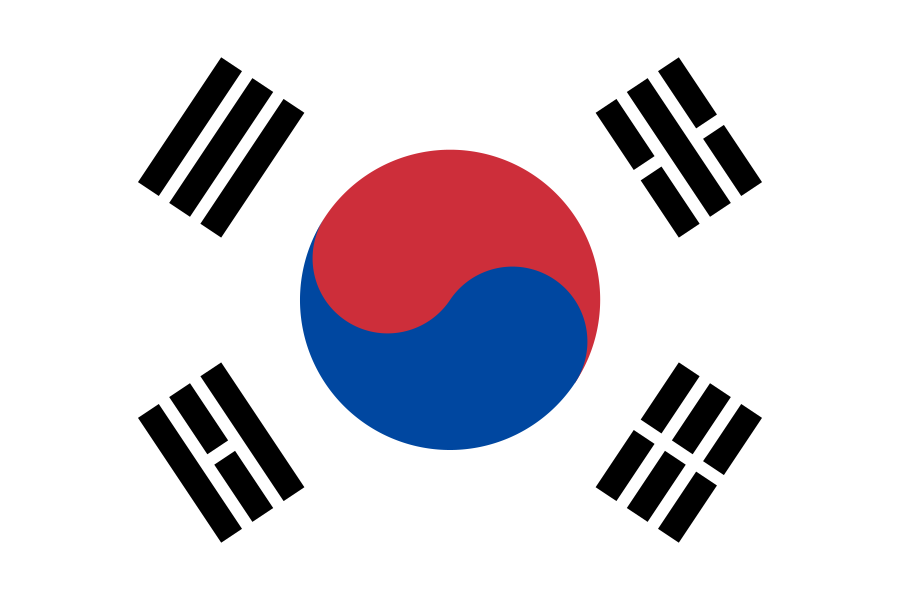
White with a red-and-blue yin-yang symbol in the center; a black trigram ( kwae ) from the ancient I Ching (Book of Changes) is in each corner of the white field. The red-and-blue taegeuk expresses complementary forces, and the four trigrams refer to heaven, earth, water and fire.
The design and its details
White with a red-and-blue yin-yang symbol in the center; a black trigram ( kwae ) from the ancient I Ching (Book of Changes) is in each corner of the white field.
| Flag | South Korea |
|---|---|
| Collection | Country flags |
| Adoption or specification | 1948 for the Republic of Korea; geometry specified in 1949 |
| Browsing region | Asia · Eastern Asia |
| Illustrated proportions (height:width) | 2:3 |
What the flag means
The red-and-blue taegeuk expresses complementary forces, and the four trigrams refer to heaven, earth, water and fire. Their positions and patterns are deliberate; swapping the corners produces an incorrect flag.
| Element | Meaning or historical connection |
|---|---|
| White field | A traditional Korean color associated with peace and purity. |
| Red-and-blue taegeuk | The complementary cosmic forces conventionally described as yang and yin, expressing balance and interaction. |
| Four black trigrams | Heaven, earth, water and fire in the adopted arrangement. |
| Combined composition | A philosophical account of harmony and change; the four trigrams are not four provinces or political parties. |
How the flag developed
The Taegeukgi developed in the late nineteenth century as Korea entered new diplomatic relationships. Earlier versions varied in the central taegeuk and in the arrangement of trigrams.
Korean independence movements and the government in exile used related flags during Japanese colonial rule. The Republic of Korea adopted the Taegeukgi in 1948, followed by modern construction rules in 1949 and later color standards. The flag’s longer Korean history should therefore be distinguished from its adoption by the modern South Korean state.
The main changes over time
1880s — Diplomatic national flag
The Taegeukgi developed as a Korean state symbol.
1910–1945 — Independence movement
Related designs continued in exile and independence symbolism.
1948–1949 — Republican adoption and construction
The new republic adopted and specified the modern flag.
Historical flags in pictures

How to recognise this flag
A red-over-blue taegeuk sits on white with four different black trigrams around it. The upper hoist trigram has three unbroken bars.
Earlier designs and other uses
Historical Taegeukgi drawings can differ in their trigrams and central symbol. Modern construction requires the correct arrangement.
Questions about this flag
When was the flag adopted?
1948 for the Republic of Korea; geometry specified in 1949. An adoption date can refer to a design, its restoration or a later legal specification; the timeline above separates those stages.
What should I check before identifying an older example?
Historical Taegeukgi drawings can differ in their trigrams and central symbol. Modern construction requires the correct arrangement.
What Did We Learn Today?
A red-over-blue taegeuk sits on white with four different black trigrams around it. The upper hoist trigram has three unbroken bars. Its adoption and later changes reflect the national history described in the timeline, while older or specialist flags need their own labels.
Sources & Data Notes
This guide distinguishes first use, national adoption, restoration and later construction standards. Traditional or commonly reported interpretations are identified where they differ from a formal specification. It is a dated reference, not a live record of every change in official flag use.
- Ministry of the Interior and Safety: Taegeukgi.
- Archived World Factbook country record — background flag description and symbolic interpretations; later changes are explained above.
- Flagpedia: South Korea — flag artwork and comparison reference.
- Flag history reference and bibliography — chronology and links to underlying sources.
The main illustration preserves the selected flag artwork’s proportions; these are a reproduction guide, not a substitute for a legal construction drawing. Color names group shades for browsing.
Illustration credits
- Flag of Korea (1882–1910).svg — Daniil Ivanov; Public domain.
