National flag guide
Flag of Saudi Arabia: Meaning, Symbols and History
Saudi Arabia’s flag developed from green banners associated with the Al Saud state tradition and the shahada.
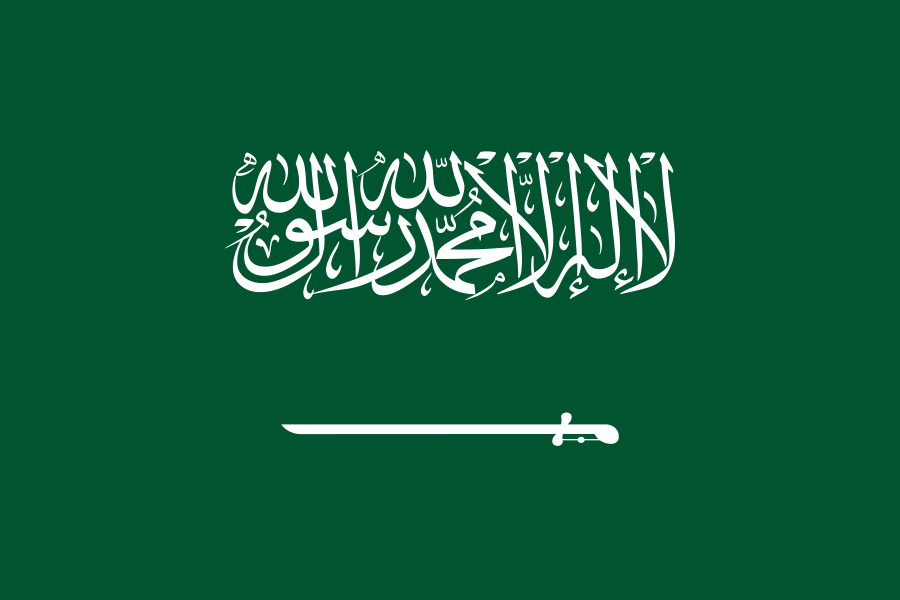
Green (traditional Islamic color) with the Shahada, or Muslim creed, in large white Arabic script that translates as, "There is no god but God; Muhammad is the messenger of God;" the text is above a white horizontal saber pointing to the left. The white writing is the shahada, the Islamic declaration of faith.
The design and its details
Green (traditional Islamic color) with the Shahada, or Muslim creed, in large white Arabic script that translates as, "There is no god but God; Muhammad is the messenger of God;" the text is above a white horizontal saber pointing to the left.
| Flag | Saudi Arabia |
|---|---|
| Collection | Country flags |
| Adoption or specification | 15 March 1973 for the present standard design |
| Browsing region | Asia · Western Asia |
| Illustrated proportions (height:width) | 2:3 |
What the flag means
The white writing is the shahada, the Islamic declaration of faith. The sword is a separate element below it. Because the inscription is sacred, the national flag has particular display traditions, including not being flown at half-mast.
| Element | Meaning or historical connection |
|---|---|
| Green | An established Islamic and Saudi dynastic color association. |
| White inscription | The shahada, the Islamic declaration of faith. |
| Sword | The authority and founding history of the Saudi state. |
| Legibility on both sides | The lettering is not simply mirrored on the reverse. The religious inscription also explains why normal flag practices such as half-masting require special treatment. |
How the flag developed
Saudi Arabia’s flag developed from green banners associated with the Al Saud state tradition and the shahada. Earlier flags varied in the arrangement of writing and swords as the state expanded and the kingdom was established in 1932.
The present standard form dates from 1973. Its inscription has to remain readable on both sides, so a physical flag cannot be treated as one ordinary image mirrored through the cloth. The central meaning lies in the Islamic declaration of faith and the state’s historical authority, rather than in a decorative calligraphic pattern.
The main changes over time
Early twentieth century — Al Saud banners
Green banners with the declaration of faith developed in the state tradition.
1932 — Kingdom established
The national design continued through the formation of Saudi Arabia.
1973 — Present standard form
The modern arrangement was standardised.
How to recognise this flag
A white Arabic declaration and horizontal sword appear on green. Afghanistan’s de facto-authority flag has black writing on white and no sword.
Earlier designs and other uses
The inscription must be readable on both sides. Royal and military standards have separate devices and should not be substituted for the national flag.
Questions about this flag
When was the flag adopted?
15 March 1973 for the present standard design. An adoption date can refer to a design, its restoration or a later legal specification; the timeline above separates those stages.
What should I check before identifying an older example?
The inscription must be readable on both sides. Royal and military standards have separate devices and should not be substituted for the national flag.
What Did We Learn Today?
A white Arabic declaration and horizontal sword appear on green. Afghanistan’s de facto-authority flag has black writing on white and no sword. Its adoption and later changes reflect the national history described in the timeline, while older or specialist flags need their own labels.
Sources & Data Notes
This guide distinguishes first use, national adoption, restoration and later construction standards. Traditional or commonly reported interpretations are identified where they differ from a formal specification. It is a dated reference, not a live record of every change in official flag use.
- Archived World Factbook country record — background flag description and symbolic interpretations; later changes are explained above.
- Flagpedia: Saudi Arabia — flag artwork and comparison reference.
- Flag history reference and bibliography — chronology and links to underlying sources.
The main illustration preserves the selected flag artwork’s proportions; these are a reproduction guide, not a substitute for a legal construction drawing. Color names group shades for browsing.
Current flag artwork is supplied with the original flag collection; the package’s artwork register contains provenance and license details.