National flag guide
Flag of Niger: Meaning, Symbols and History
Niger adopted its orange-white-green flag during the transition to independence from France, which followed in 1960.
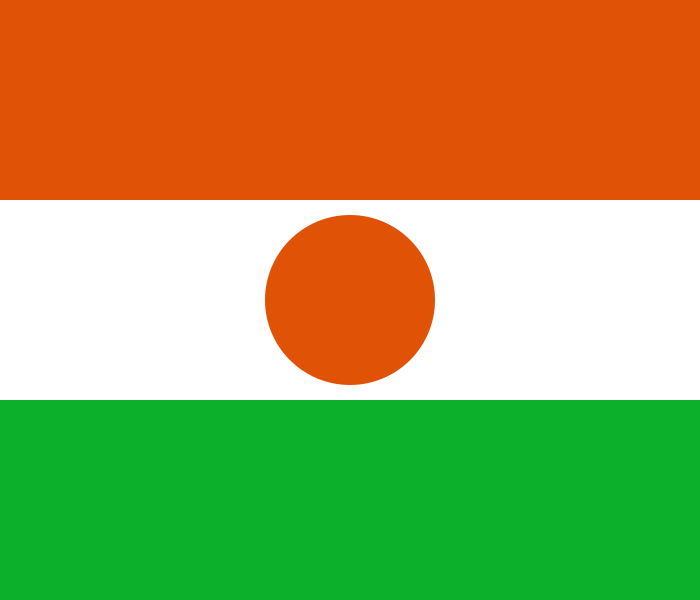
Three equal horizontal bands of orange (top), white, and green, with an orange disk centered on the white band. Orange is associated with the Sahara, green with fertile areas and hope, and the disc with the sun. The white band is commonly associated with peace and purity.
The design and its details
Three equal horizontal bands of orange (top), white, and green, with an orange disk centered on the white band.
| Flag | Niger |
|---|---|
| Collection | Country flags |
| Adoption or specification | 23 November 1959 |
| Browsing region | Africa · Western Africa |
| Illustrated proportions (height:width) | 6:7 |
What the flag means
Orange is associated with the Sahara, green with fertile areas and hope, and the disc with the sun. The white band is commonly associated with peace and purity.
| Element | Meaning or historical connection |
|---|---|
| Orange band | The northern desert and the Sahara. |
| White band | Peace and purity in common explanations. |
| Green band | The fertile southern areas and hope. |
| Orange disc | The sun and national sacrifice. It is a central disc, unlike the wheel on India’s flag. |
How the flag developed
Niger adopted its orange-white-green flag during the transition to independence from France, which followed in 1960. Its bands were tied to the country’s contrasting dry northern and more productive southern landscapes.
An orange disc placed in the white stripe gave the design a distinctive center. Its resemblance to India’s color arrangement is superficial: India has a blue spoked wheel, different proportions and its own national history. Niger’s flag has continued through later political and constitutional changes without acquiring a central coat of arms.
The main changes over time
1959 — National flag adopted
The orange-disc design was established.
1960 — Independence
The existing national flag continued.
How to recognise this flag
Orange above white above green, with a solid orange disc in the middle. India has a blue wheel, not a solid orange sun.
Earlier designs and other uses
Different reproductions use slightly different proportions; the orange center disc remains essential.
Questions about this flag
When was the flag adopted?
23 November 1959. An adoption date can refer to a design, its restoration or a later legal specification; the timeline above separates those stages.
What should I check before identifying an older example?
Different reproductions use slightly different proportions; the orange center disc remains essential.
What Did We Learn Today?
Orange above white above green, with a solid orange disc in the middle. India has a blue wheel, not a solid orange sun. Its adoption and later changes reflect the national history described in the timeline, while older or specialist flags need their own labels.
Sources & Data Notes
This guide distinguishes first use, national adoption, restoration and later construction standards. Traditional or commonly reported interpretations are identified where they differ from a formal specification. It is a dated reference, not a live record of every change in official flag use.
- Archived World Factbook country record — background flag description and symbolic interpretations; later changes are explained above.
- Flagpedia: Niger — flag artwork and comparison reference.
- Flag history reference and bibliography — chronology and links to underlying sources.
The main illustration preserves the selected flag artwork’s proportions; these are a reproduction guide, not a substitute for a legal construction drawing. Color names group shades for browsing.
Current flag artwork is supplied with the original flag collection; the package’s artwork register contains provenance and license details.