National flag guide
Flag of Kiribati: Meaning, Symbols and History
Kiribati’s national flag turns an earlier colonial badge into a full-field armorial banner.
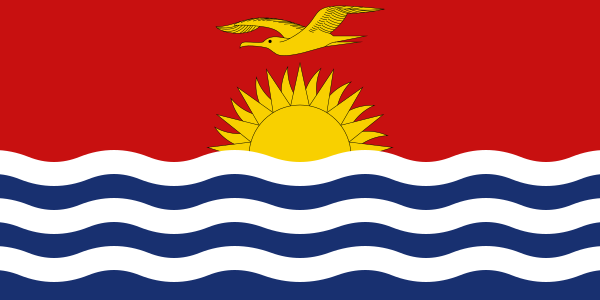
The upper half is red with a yellow frigatebird flying over a yellow rising sun, and the lower half is blue with three wavy horizontal white stripes to represent the Pacific Ocean. The frigatebird represents freedom and maritime skill. The sun has seventeen rays associated with the Gilbert Islands and Banaba, while the waves relate to the ocean and the principal island groups.
The design and its details
The upper half is red with a yellow frigatebird flying over a yellow rising sun, and the lower half is blue with three wavy horizontal white stripes to represent the Pacific Ocean.
| Flag | Kiribati |
|---|---|
| Collection | Country flags |
| Adoption or specification | 12 July 1979 |
| Browsing region | Oceania · Micronesia |
| Illustrated proportions (height:width) | 1:2 |
What the flag means
The frigatebird represents freedom and maritime skill. The sun has seventeen rays associated with the Gilbert Islands and Banaba, while the waves relate to the ocean and the principal island groups.
| Element | Meaning or historical connection |
|---|---|
| Blue and white waves | The Pacific Ocean and the country’s principal island groups. |
| Rising gold sun | The equatorial setting and a new national day. |
| Seventeen rays | Conventionally connected with the sixteen Gilbert Islands and Banaba; this is not the total island count of modern Kiribati. |
| Frigatebird | Freedom, authority and the ability to range across the ocean. |
| Red upper field | Part of the inherited national arms composition rather than a separate map of an island group. |
How the flag developed
Kiribati’s national flag turns an earlier colonial badge into a full-field armorial banner. The frigatebird, rising sun and sea appeared in the arms granted to the Gilbert and Ellice Islands colony in 1937.
At independence in 1979, Kiribati adopted that imagery as its national flag rather than retaining the British blue-ensign format. The waves and sun connect the state with its equatorial Pacific setting. The transition illustrates how an inherited badge can be retained while the overall flag becomes a distinct independent national design.
The main changes over time
1937 — Colonial arms granted
The bird, sun and wave device appeared in the colonial badge.
1979 — Independent national banner
The imagery filled the new national flag.
How to recognise this flag
A gold frigatebird flies above a rising gold sun on red, with blue-and-white waves below.
Earlier designs and other uses
The earlier colonial ensign carried the device as a badge on blue; it was not the present full-field banner.
Questions about this flag
When was the flag adopted?
12 July 1979. An adoption date can refer to a design, its restoration or a later legal specification; the timeline above separates those stages.
What should I check before identifying an older example?
The earlier colonial ensign carried the device as a badge on blue; it was not the present full-field banner.
What Did We Learn Today?
A gold frigatebird flies above a rising gold sun on red, with blue-and-white waves below. Its adoption and later changes reflect the national history described in the timeline, while older or specialist flags need their own labels.
Sources & Data Notes
This guide distinguishes first use, national adoption, restoration and later construction standards. Traditional or commonly reported interpretations are identified where they differ from a formal specification. It is a dated reference, not a live record of every change in official flag use.
- Archived World Factbook country record — background flag description and symbolic interpretations; later changes are explained above.
- Flagpedia: Kiribati — flag artwork and comparison reference.
- Flag history reference and bibliography — chronology and links to underlying sources.
The main illustration preserves the selected flag artwork’s proportions; these are a reproduction guide, not a substitute for a legal construction drawing. Color names group shades for browsing.
Current flag artwork is supplied with the original flag collection; the package’s artwork register contains provenance and license details.