National flag guide
Flag of Guyana: Meaning, Symbols and History
Guyana adopted the Golden Arrowhead at independence from the United Kingdom in 1966.
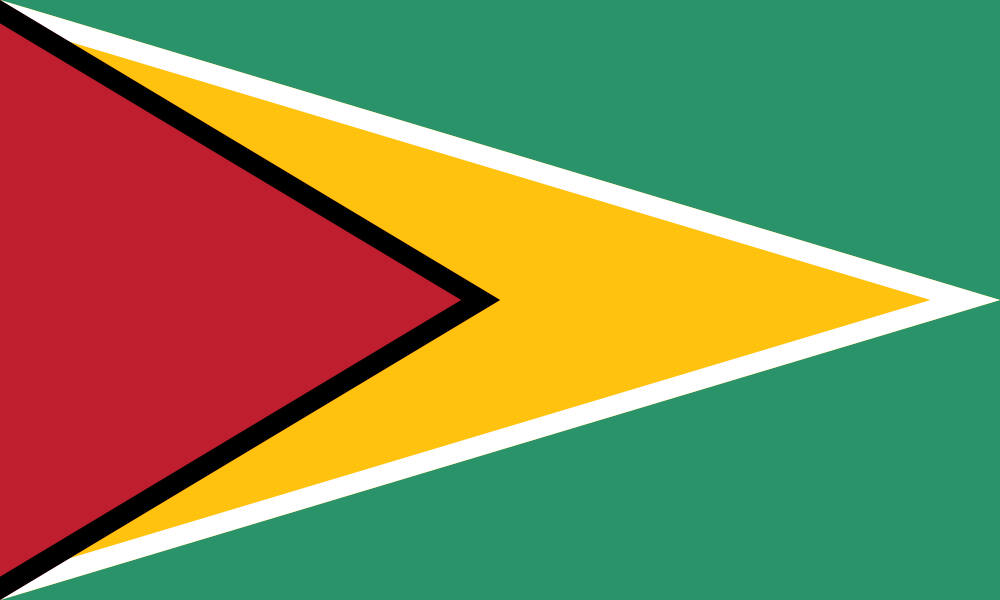
Green with a red isosceles triangle (based on the left side) on top of a long yellow arrowhead shape that extends to the opposite side of the flag; a narrow black border sits between the red and yellow, and a narrow white border between the yellow and green.
The design and its details
Green with a red isosceles triangle (based on the left side) on top of a long yellow arrowhead shape that extends to the opposite side of the flag; a narrow black border sits between the red and yellow, and a narrow white border between the yellow and green.
| Flag | Guyana |
|---|---|
| Collection | Country flags |
| Adoption or specification | 26 May 1966 |
| Browsing region | South America · South America |
| Illustrated proportions (height:width) | 3:5 |
What the flag means
Green is associated with vegetation, gold with mineral resources, white with waters, red with energy and sacrifice, and black with endurance. The black and white are narrow borders, not extra full-width stripes.
| Element | Meaning or historical connection |
|---|---|
| Green | Forests and vegetation. |
| Gold arrowhead | Mineral resources and the national future. |
| White border | Rivers and waters. |
| Red triangle | Energy, sacrifice and determination. |
| Black border | Perseverance and endurance. |
How the flag developed
Guyana adopted the Golden Arrowhead at independence from the United Kingdom in 1966. Vexillologist Whitney Smith proposed the main design, and black-and-white edging was added during its development.
The arrowhead replaced the colonial blue ensign and its sailing-ship badge with an emblem that combined the country’s forests, rivers and mineral wealth in a bold geometric design. The present national flag is distinct from the longer civil-air ensign and the presidential standard, even though those flags draw on related national symbolism.
The main changes over time
Colonial period — British Guiana ensigns
A blue ensign with a colonial badge preceded independence.
1966 — Golden Arrowhead
The independent country adopted the new national design.
How to recognise this flag
A long golden arrowhead points toward the fly, with a smaller red triangle at the hoist. The two triangles have different outlines and lengths.
Earlier designs and other uses
The national flag’s proportions differ from some special-purpose ensigns. Preserve the long arrowhead when displaying or cropping the flag.
Questions about this flag
When was the flag adopted?
26 May 1966. An adoption date can refer to a design, its restoration or a later legal specification; the timeline above separates those stages.
What should I check before identifying an older example?
The national flag’s proportions differ from some special-purpose ensigns. Preserve the long arrowhead when displaying or cropping the flag.
What Did We Learn Today?
A long golden arrowhead points toward the fly, with a smaller red triangle at the hoist. The two triangles have different outlines and lengths. Its adoption and later changes reflect the national history described in the timeline, while older or specialist flags need their own labels.
Sources & Data Notes
This guide distinguishes first use, national adoption, restoration and later construction standards. Traditional or commonly reported interpretations are identified where they differ from a formal specification. It is a dated reference, not a live record of every change in official flag use.
- Archived World Factbook country record — background flag description and symbolic interpretations; later changes are explained above.
- Flagpedia: Guyana — flag artwork and comparison reference.
- Flag history reference and bibliography — chronology and links to underlying sources.
The main illustration preserves the selected flag artwork’s proportions; these are a reproduction guide, not a substitute for a legal construction drawing. Color names group shades for browsing.
Current flag artwork is supplied with the original flag collection; the package’s artwork register contains provenance and license details.