National flag guide
Flag of Guatemala: Meaning, Symbols and History
Guatemala inherited the blue-white-blue color family of the Central American federation.
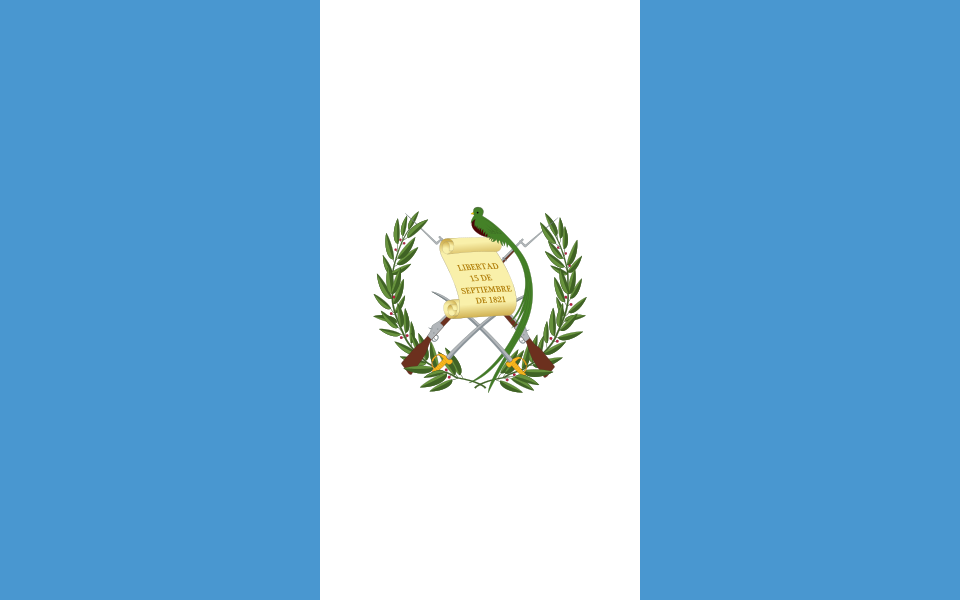
Three equal vertical bands of light blue (left side), white, and light blue, with the coat of arms centered in the white band; the coat of arms includes a green-and-red quetzal (the national bird), a scroll with the inscription Libertad 15 DE Septiembre DE 1821 (the original date of independence from Spain), a pair of crossed rifles, and a pair of crossed swords; a laurel wreath frames the objects.
The design and its details
Three equal vertical bands of light blue (left side), white, and light blue, with the coat of arms centered in the white band; the coat of arms includes a green-and-red quetzal (the national bird), a scroll with the inscription Libertad 15 DE Septiembre DE 1821 (the original date of independence from Spain), a pair of crossed rifles, and a pair of crossed swords; a laurel wreath frames the objects.
| Flag | Guatemala |
|---|---|
| Collection | Country flags |
| Adoption or specification | 17 August 1871 |
| Browsing region | North America · Central America |
| Illustrated proportions (height:width) | 5:8 |
What the flag means
The quetzal is a national symbol of liberty. The scroll, crossed weapons and laurel branches combine independence, defence and victory; their details identify the Guatemalan emblem.
| Element | Meaning or historical connection |
|---|---|
| Blue | Associated with the Pacific and Caribbean sides of Central America. |
| White | Peace and purity in national explanations. |
| Quetzal | Liberty, using a distinctive regional bird. |
| Scroll | The independence date, 15 September 1821. |
| Rifles, swords and laurel | Readiness to defend the country, honor and victory. |
How the flag developed
Guatemala inherited the blue-white-blue color family of the Central American federation. Its national designs changed after the federation’s collapse, including a period with additional red and yellow colors.
The liberal revolution of 1871 brought the vertical blue-white-blue design and a new national emblem. The vertical bands distinguished Guatemala from the horizontal federal-style flags used by neighboring countries. The arms place the 1821 date of Central American independence inside a design adopted half a century later, so the date printed on the flag is not its adoption date.
The main changes over time
1820s–1830s — Federal color family
Guatemala used flags connected with the Central American federation.
1850s–1871 — Expanded color designs
Intervening flags included red and yellow elements.
1871 — Vertical national flag
The present arrangement followed the liberal revolution.
How to recognise this flag
Guatemala’s blue-white-blue bands are vertical. El Salvador, Honduras and Nicaragua arrange related colors horizontally.
Earlier designs and other uses
The civil flag can omit the arms. The state flag includes the quetzal and the independence-date scroll.
Questions about this flag
When was the flag adopted?
17 August 1871. An adoption date can refer to a design, its restoration or a later legal specification; the timeline above separates those stages.
What should I check before identifying an older example?
The civil flag can omit the arms. The state flag includes the quetzal and the independence-date scroll.
What Did We Learn Today?
Guatemala’s blue-white-blue bands are vertical. El Salvador, Honduras and Nicaragua arrange related colors horizontally. Its adoption and later changes reflect the national history described in the timeline, while older or specialist flags need their own labels.
Sources & Data Notes
This guide distinguishes first use, national adoption, restoration and later construction standards. Traditional or commonly reported interpretations are identified where they differ from a formal specification. It is a dated reference, not a live record of every change in official flag use.
- Archived World Factbook country record — background flag description and symbolic interpretations; later changes are explained above.
- Flagpedia: Guatemala — flag artwork and comparison reference.
- Flag history reference and bibliography — chronology and links to underlying sources.
The main illustration preserves the selected flag artwork’s proportions; these are a reproduction guide, not a substitute for a legal construction drawing. Color names group shades for browsing.
Current flag artwork is supplied with the original flag collection; the package’s artwork register contains provenance and license details.