National flag guide
Flag of Dominican Republic: Meaning, Symbols and History
The Dominican flag grew from the movement for independence from Haiti in 1844.
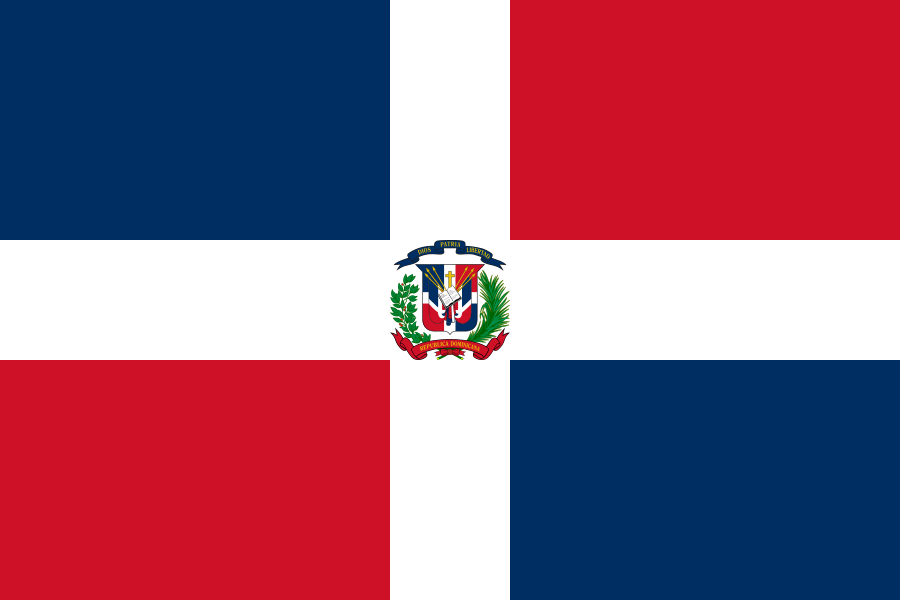
The flag of the Dominican Republic is divided into alternating blue and red quarters by a white cross reaching all four edges. The state coat of arms sits at the center, with an open Bible and cross, branches, national flags and ribbons bearing the country’s name and God, Fatherland, Liberty motto.
The design and its details
The flag of the Dominican Republic is divided into alternating blue and red quarters by a white cross reaching all four edges. The state coat of arms sits at the center, with an open Bible and cross, branches, national flags and ribbons bearing the country’s name and God, Fatherland, Liberty motto.
| Flag | Dominican Republic |
|---|---|
| Collection | Country flags |
| Adoption or specification | Independence tradition from 1844; restored in 1863 |
| Browsing region | North America · Caribbean |
| Illustrated proportions (height:width) | 2:3 |
What the flag means
The arms include a Bible and cross, with the motto Dios, Patria, Libertad: God, Fatherland, Liberty. These are specific elements of the Dominican emblem, not a generic coat of arms placed on a quartered flag.
| Element | Meaning or historical connection |
|---|---|
| Blue | Commonly associated with liberty. |
| Red | The sacrifice of national heroes. |
| White cross | Faith, peace and salvation in national interpretations. |
| Central arms | The Bible and cross identify the Christian symbolism of the state emblem; its motto expresses God, Fatherland and Liberty. |
How the flag developed
The Dominican flag grew from the movement for independence from Haiti in 1844. A white cross divided blue and red areas, creating an explicitly distinct design from the Haitian bicolour. Juan Pablo Duarte and the Trinitarian independence movement are central to its history.
Spanish reannexation interrupted Dominican statehood between 1861 and 1865, while the restoration movement brought the national flag back into use in 1863. The current arrangement therefore reflects both the original independence struggle and the restoration of the republic. The central arms developed as a further identifying feature, while a plain civil form also exists.
The main changes over time
1844 — Independence flag
The cross design distinguished the new republic from Haiti.
1861–1865 — Spanish reannexation
The restoration struggle interrupted and then restored national statehood.
1863 — Flag restored
The national flag returned with the restoration movement.
How to recognise this flag
The white cross reaches all four edges. Blue occupies the upper hoist and lower fly quarters, with red in the other two; the arms sit at the crossing.
Earlier designs and other uses
The civil flag can omit the coat of arms. The state design illustrated here includes it.
Questions about this flag
When was the flag adopted?
Independence tradition from 1844; restored in 1863. An adoption date can refer to a design, its restoration or a later legal specification; the timeline above separates those stages.
What should I check before identifying an older example?
The civil flag can omit the coat of arms. The state design illustrated here includes it.
What Did We Learn Today?
The white cross reaches all four edges. Blue occupies the upper hoist and lower fly quarters, with red in the other two; the arms sit at the crossing. Its adoption and later changes reflect the national history described in the timeline, while older or specialist flags need their own labels.
Sources & Data Notes
This guide distinguishes first use, national adoption, restoration and later construction standards. Traditional or commonly reported interpretations are identified where they differ from a formal specification. It is a dated reference, not a live record of every change in official flag use.
- Archived World Factbook country record — background flag description and symbolic interpretations; later changes are explained above.
- Flagpedia: Dominican Republic — flag artwork and comparison reference.
- Flag history reference and bibliography — chronology and links to underlying sources.
The main illustration preserves the selected flag artwork’s proportions; these are a reproduction guide, not a substitute for a legal construction drawing. Color names group shades for browsing.
Current flag artwork is supplied with the original flag collection; the package’s artwork register contains provenance and license details.