Flag Explorer
Chile’s Flag and the Meaning of the Lone Star
Chile’s flag has a white star in a blue square at the upper hoist. The rest of the upper band is white, and the lower band is red.

How is Chile’s lone star different from the Texas flag?
Chile’s blue canton occupies only the upper band. The red lower band runs all the way to the pole. On Texas’s flag, the blue forms a full-height vertical panel. Look at the lower hoist corner even if the star itself is hidden.
The design and its details
Two equal horizontal bands of white (top) and red; a blue square sits in the top left corner of the flag, the same height as the white band; the square has a five-pointed white star in the center.
| Collection | Country flags |
|---|---|
| Adoption or design date | 18 October 1817 |
| Geographic region | South America |
| Illustrated proportions (height to width) | 2:3 |
Look closer · Chile’s upper hoist
What the flag means
White is commonly linked with Andean snow, blue with the sky and red with sacrifice in the independence struggle. The star is associated with guidance, unity and national aspiration; it does not stand for one particular modern province.
| Element | Meaning or historical connection |
|---|---|
| Blue | Commonly associated with the sky. |
| White | The snow of the Andes. |
| Red | Sacrifice in the independence struggle. |
| Single white star | A guiding national symbol, often connected with progress and honor; it is not a count of Chilean regions. |
Compare the flags of Chile and Cuba
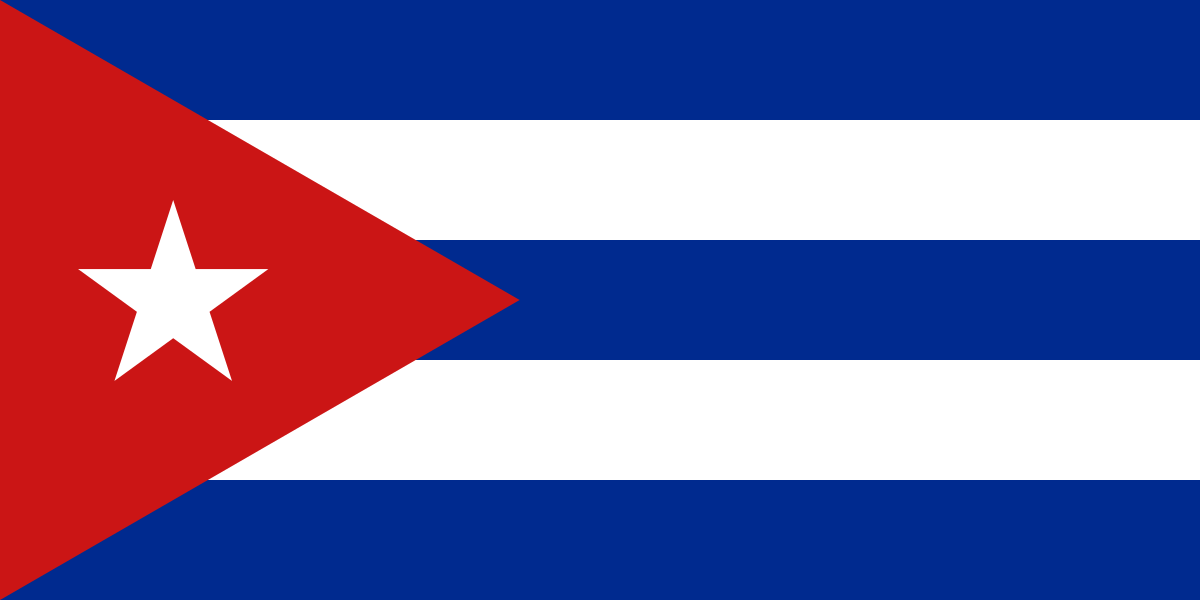
Where does the single white star sit in relation to the stripes? In both drawings, the flagpole side is on the left.
Reveal the flag names and clues
A · Cuba — The star lies in a red triangle stretching the full height at the pole. Blue and white stripes start alongside the triangle.
B · Chile — A blue square containing the star occupies only the upper corner. The broad red lower half passes beneath it.
How the flag developed
Chile’s independence movement first used the blue-white-yellow Patria Vieja flag, followed by a transitional blue-white-red tricolour. The present Lone Star design was adopted in 1817, before the formal declaration of independence in 1818.
The single star and blue canton distinguished Chile’s new flag from other revolutionary tricolours. Later laws clarified construction and use, but the central arrangement remained. The flag’s similarity to the much later Texas state flag makes proportion and canton height useful identification details.
The main changes over time
1812–1814 — Patria Vieja
The early independence flag used blue, white and yellow.
1817 — Transitional tricolour
A short-lived blue-white-red arrangement preceded the present flag.
1817 — Lone Star adopted
The modern canton-and-star design became the national flag.
Earlier designs and other uses
Early independence flags should be dated by their particular revolutionary period. The present national flag has one star in a square blue canton.
Download the flag

Artwork credit and reuse
Flagpedia vector collection · Public domain. The PNG is a raster export of the credited SVG.
What Did We Learn Today?
Chile’s blue canton occupies only the upper half of the flag. In the Texas flag, the blue hoist section extends from top to bottom.
Sources & Data Notes
View references and illustration credits
The dates distinguish adoption of the flag from later revisions to its artwork. The comparison uses the two illustrations at the same height, with the hoist on the left.
- Chilean Air Force, regulations on national emblems — The specifications for the national flag describe the blue square at the hoist of the upper band and the five-pointed white star at its center.
- Archived World Factbook country record — background flag description and symbolic interpretations; later changes are explained above.
- Flagpedia: Chile — flag artwork and comparison reference.
- Flag history reference and bibliography — chronology and links to underlying sources.
The flag downloads include the artwork credit and reuse terms for the SVG and PNG.