Historical flag guide
Austria-Hungary Flag: Meaning and History
The 1867 Compromise created the dual monarchy of Austria-Hungary.
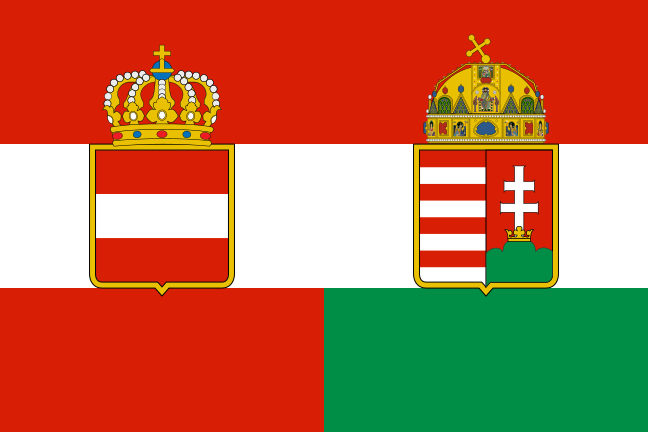
A combined red-white-red and red-white-green civil ensign with Austrian and Hungarian shields. This is a common civil ensign used at sea. Austria-Hungary did not have one simple, universally used national flag for the whole dual monarchy. Calling this design the empire’s single national flag erases important distinctions between civil shipping, the navy, the dynasty and the two state halves.
The design and its details
A combined red-white-red and red-white-green civil ensign with Austrian and Hungarian shields.
| Flag | Austria-Hungary |
|---|---|
| Collection | Historical flags |
| Adoption or specification | 1869 for the illustrated common civil ensign |
| Browsing region | Europe · Former multinational states |
| Illustrated period | 1869–1918 civil ensign |
What the flag means
This is a common civil ensign used at sea. Austria-Hungary did not have one simple, universally used national flag for the whole dual monarchy. Calling this design the empire’s single national flag erases important distinctions between civil shipping, the navy, the dynasty and the two state halves.
| Element | Meaning or historical connection |
|---|---|
| Austrian red-white-red | The Austrian half of the common civil maritime arrangement. |
| Hungarian red-white-green | The Hungarian half, joined to the Austrian colors in the ensign. |
| Paired crowned shields | The heraldic identities of the two state halves under the shared monarchy. |
| Joined composition | Expresses common civil shipping. Its meaning depends on that specific function; it was not one universal flag for every imperial institution. |
How the flag developed
The 1867 Compromise created the dual monarchy of Austria-Hungary. Austria and Hungary shared a monarch and certain common institutions while maintaining distinct constitutional structures. Their symbols consequently did not collapse into one universal national flag.
The combined civil ensign introduced in 1869 joined Austrian red-white-red with Hungarian red-white-green and two shields. It is widely reproduced in modern historical flag lists, but its original role was to identify civil shipping connected with the monarchy.
The navy used a different red-white-red war ensign with a crowned shield, while dynastic and territorial flags served other purposes. A historical atlas should preserve those functions rather than treating every rectangular emblem as a national flag.
The monarchy broke apart at the end of the First World War in 1918. Austria, Hungary and other successor states developed separate national symbols. The joined civil ensign is useful evidence of the former common state, provided its maritime role remains explicit.
The main changes over time
1867 — Dual monarchy established
The Compromise reorganised the Habsburg state.
1869 — Common civil ensign
The joined Austrian-Hungarian maritime design was introduced.
1918 — Monarchy dissolved
The common state ended after the First World War.
How to recognise this flag
The paired Austrian and Hungarian shields sit over joined color arrangements. The design’s purpose—civil maritime use—is essential to its identification.
Compare the relevant designs in these guides:
Earlier designs and other uses
The Habsburg black-yellow colors, naval ensign and combined civil ensign had different functions.
Questions about this flag
Which period does this historical flag represent?
1869–1918 civil ensign. The monarchy broke apart at the end of the First World War in 1918. Austria, Hungary and other successor states developed separate national symbols. The joined civil ensign is useful evidence of the former common state, provided its maritime role remains explicit.
What should I check before identifying an older example?
The Habsburg black-yellow colors, naval ensign and combined civil ensign had different functions.
What Did We Learn Today?
The paired Austrian and Hungarian shields sit over joined color arrangements. The design’s purpose—civil maritime use—is essential to its identification. The historical label identifies a particular state or version; related modern flags have their own national histories.
Sources & Data Notes
This guide distinguishes first use, national adoption, restoration and later construction standards. Traditional or commonly reported interpretations are identified where they differ from a formal specification. It is a dated reference, not a live record of every change in official flag use.
- Željko Heimer, International Congress of Vexillology: Austro-Hungarian naval and merchant flags.
- Austria-Hungary flag: history and source bibliography.
Illustration credits
- Civil ensign of Austria-Hungary (1869-1918).svg — This vector image includes elements that have been taken or adapted from this file:; CC BY-SA 3.0.
