National flag guide
Flag of Armenia: Meaning, Symbols and History
Armenia’s red-blue-orange was used by the First Republic of 1918–1920.
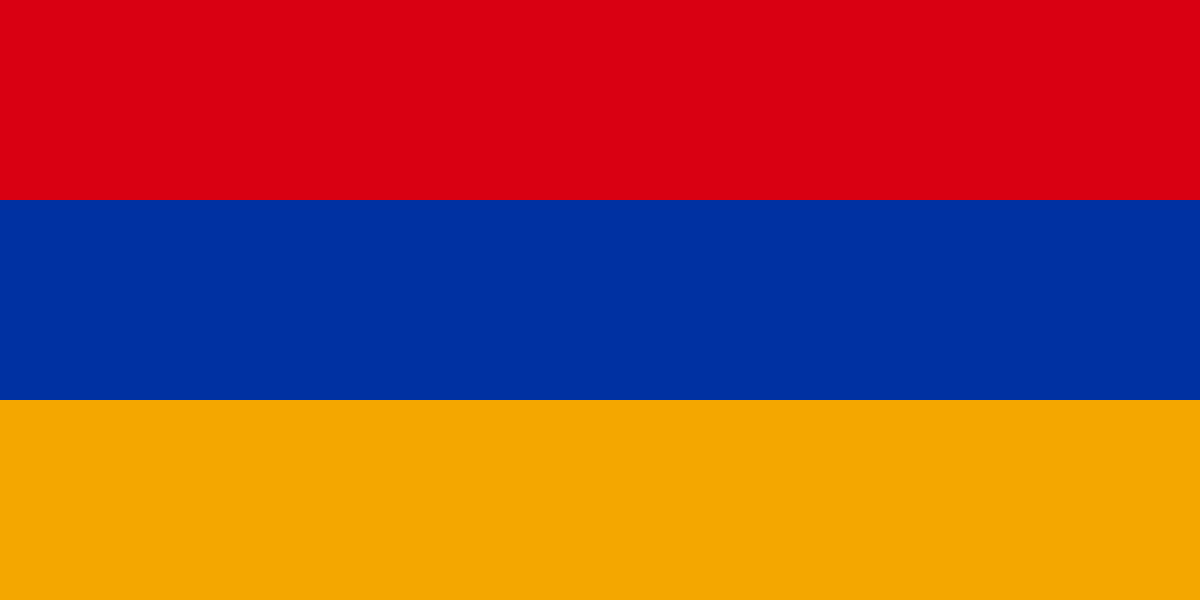
Three equal horizontal bands of red (top), blue, and orange. The official explanation connects red with the Armenian Highland, survival, the Christian faith and independence; blue with the people’s will to live under peaceful skies; and orange with creative talent and hard work. A simple “blood, sky, wheat” formula omits that fuller official account.
The design and its details
Three equal horizontal bands of red (top), blue, and orange.
| Flag | Armenia |
|---|---|
| Collection | Country flags |
| Adoption or specification | 24 August 1990; color meanings specified in the 2006 law |
| Browsing region | Asia · Western Asia |
| Illustrated proportions (height:width) | 1:2 |
What the flag means
The official explanation connects red with the Armenian Highland, survival, the Christian faith and independence; blue with the people’s will to live under peaceful skies; and orange with creative talent and hard work. A simple “blood, sky, wheat” formula omits that fuller official account.
| Element | Meaning or historical connection |
|---|---|
| Red | The Armenian Highland, the struggle for survival, Christian heritage, independence and freedom in the legal national explanation. |
| Blue | The desire to live beneath peaceful skies. |
| Orange | The people’s creative talent and diligence. Reducing it to a generic sunset misses the statutory explanation. |
How the flag developed
Armenia’s red-blue-orange was used by the First Republic of 1918–1920. Soviet rule replaced it with republican Soviet flags, including a later red flag with a horizontal blue band.
The tricolour was restored in August 1990, before the independent republic was established in 1991. The 2006 flag law supplied an official explanation of the colors. It is therefore useful to separate the first republic’s adoption, the modern restoration and the later legal statement of meaning.
The main changes over time
1918–1920 — First Republic tricolour
Red-blue-orange represented the first modern independent republic.
Soviet period — Republican Soviet designs
Red flags and communist devices replaced the national tricolour in official use.
1990–1991 — Restoration and independence
The tricolour returned before the new republic’s independence.
How to recognise this flag
Armenia has red-blue-orange horizontal bands and no central device. Azerbaijan uses blue-red-green and adds a crescent and star.
Earlier designs and other uses
The flag of the former Armenian Soviet republic is historical. The present national flag is the plain tricolour.
Questions about this flag
When was the flag adopted?
24 August 1990; color meanings specified in the 2006 law. An adoption date can refer to a design, its restoration or a later legal specification; the timeline above separates those stages.
What should I check before identifying an older example?
The flag of the former Armenian Soviet republic is historical. The present national flag is the plain tricolour.
What Did We Learn Today?
Armenia has red-blue-orange horizontal bands and no central device. Azerbaijan uses blue-red-green and adds a crescent and star. Its adoption and later changes reflect the national history described in the timeline, while older or specialist flags need their own labels.
Sources & Data Notes
This guide distinguishes first use, national adoption, restoration and later construction standards. Traditional or commonly reported interpretations are identified where they differ from a formal specification. It is a dated reference, not a live record of every change in official flag use.
- President of Armenia — State Symbols.
- Flagpedia: Armenia — flag artwork and comparison reference.
- Flag history reference and bibliography — chronology and links to underlying sources.
The main illustration preserves the selected flag artwork’s proportions; these are a reproduction guide, not a substitute for a legal construction drawing. Color names group shades for browsing.
Current flag artwork is supplied with the original flag collection; the package’s artwork register contains provenance and license details.