Two villages sit almost opposite each other across a river. On a straight-line map, residents of both seem close enough to use the same clinic. Put the only bridge upstream and one village drops out of the clinic’s market.
Central place theory explains why smaller settlements tend to offer everyday services, while larger centers can support services that draw customers from farther away. A service needs enough demand to meet its threshold. Its range is how far people are willing or able to travel for it. A bridge can change that catchment without moving any settlement.
How to use this article: See the settlement and service assumptions, work through the straight-line range test, or check the road-network result.
The settlements, households and road inputs
Put two services in settlement A
Walter Christaller’s 1933 study of southern Germany asked how settlements that provide goods and services are spaced. In a simplified hierarchy, a small center may have a shop for frequent purchases; a higher-order center provides a wider mix of services, including ones people travel farther to use. A place can play different roles for different services, so size alone does not tell you where residents go.
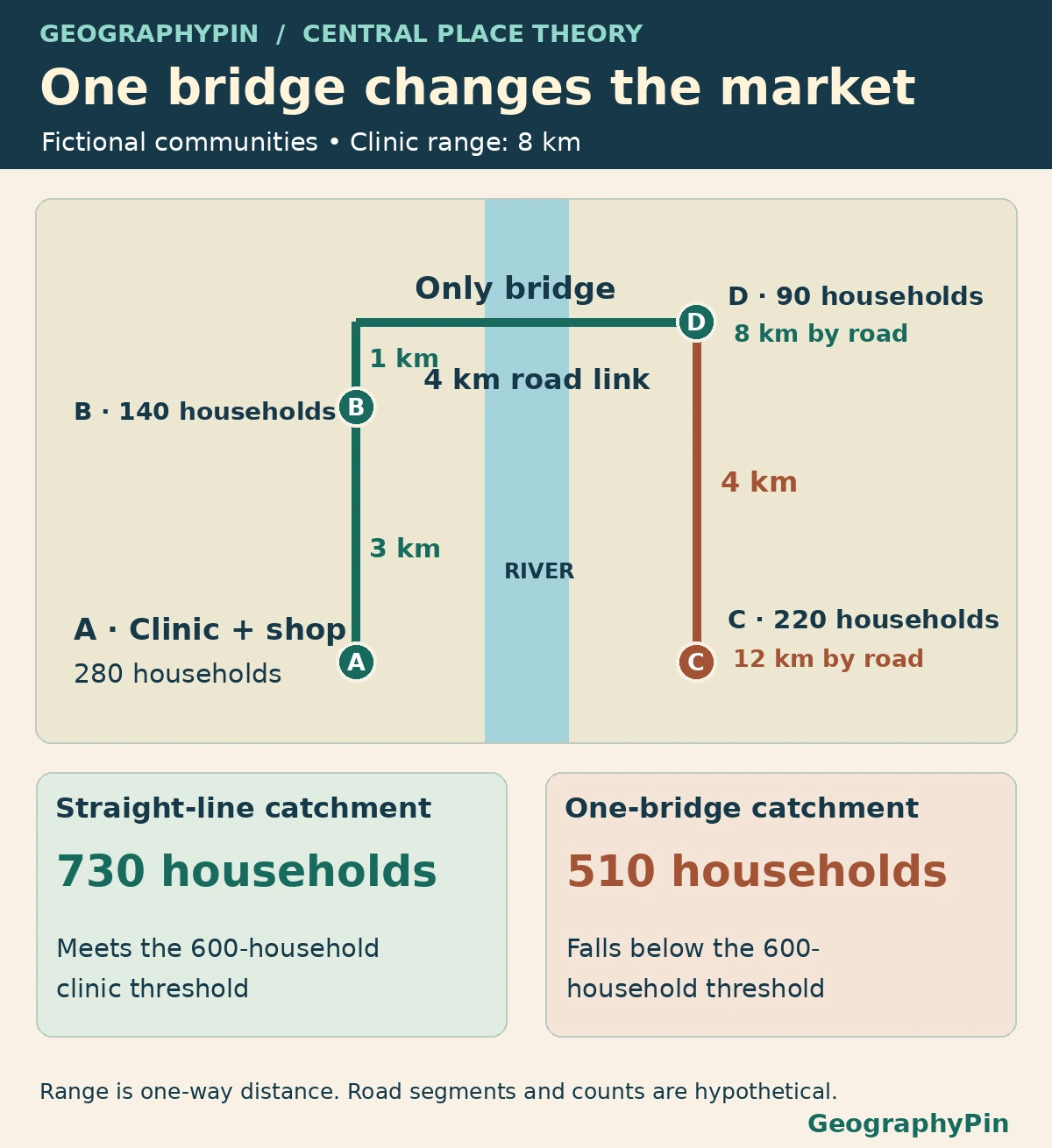
Put both a shop and a proposed clinic in fictional settlement A. A has 280 households, B 140, C 220 and D 90. Assume a household contributes one equal unit of potential demand, there is no competing provider, and trips at the exact range limit count as reachable. The shop’s range is 3 km (1.86 mi) and the clinic’s is 8 km (4.97 mi). Their illustrative thresholds are 250 and 600 households respectively, not actual retail or healthcare planning standards.
Compare range with threshold
First measure straight-line distance
Threshold asks whether there is enough demand. Range asks how far that demand can come from. Treat the diagram as a flat plane with A and C opposite one another, 4 km apart. B is 3 km directly upstream of A. D is 4 km upstream of C. By the right-triangle rule, A to D is the square root of 4² + 4², about 5.66 km (3.52 mi).
Under the straight-line assumption, all four settlements fall within the clinic’s 8 km limit. Their total is 280 + 140 + 220 + 90 = 730 households, 130 above the threshold. The everyday shop reaches only A and B. Together they have 420 households, which exceeds the shop’s lower threshold of 250. The same place is central to different groups depending on which service you ask about.
Why a single bridge changes the market area
Make road distance the measure of access
Now keep the household counts, the thresholds and both ranges fixed, but measure travel along roads. From A, travel 3 km to B and 1 km farther upstream. The next 4 km road link crosses the only bridge and ends at D. That makes D exactly 8 km away. C is another 4 km back downstream, putting it 12 km away by road, beyond clinic range.
In the ideal marketing model, hexagons are a way to tile space without gaps when similar centers, demand and travel conditions are regularly spaced. Our exercise is not a full hexagon model. It tests one assumption behind a symmetric market area. With one crossing, a nearby point across the river can be less accessible than a more distant point reached directly. The catchment follows the links rather than the shape of a circle or hexagon.
Check the changed result
Add the reachable households again
Only A, B and D now count for the clinic: 280 + 140 + 90 = 510 households, 90 short of the threshold. Check by subtracting C’s 220 from the straight-line total of 730. Both methods return 510. The shop still reaches 420 households: neither east-bank settlement was within its 3 km range even before the road rule changed.
| Settlement | Households | Straight-line distance | Road distance | Within 8 km by road? |
|---|---|---|---|---|
| A | 280 | 0 km | 0 km | Yes |
| B | 140 | 3 km | 3 km | Yes |
| C | 220 | 4 km | 12 km | No |
| D | 90 | 5.66 km | 8 km | Yes |
Reaching the threshold in a model does not guarantee that a service succeeds. In a real survey, check who is likely to use the service, competing destinations and travel times for several modes. A bus that crosses the bridge infrequently may make an 8 km trip less practical than the distance suggests.
Frequently Asked Questions
Why do some services need a larger market area?
Specialist services can have higher costs and less frequent visits, so a small local customer base may not support them. People may also travel farther for specialist care than for everyday purchases. Threshold and range are separate conditions, not interchangeable words.
Would a second bridge automatically make the clinic viable?
Not necessarily. In this example it would bring C into the catchment only if it cut the shortest route to 8 km or less. The clinic would then reach its modeled threshold, but demand and operating costs could still differ from the assumptions.
Can market areas overlap?
Yes. Different providers, services and transport modes can produce overlapping catchments. The simplified one-provider model avoids assigning shared demand, which would need its own evidence in real work.
What Did We Learn Today?
Range decides which households can be counted. Threshold decides whether the reachable set is large enough in the model. Changing the route, without changing the population, can change the threshold result.
Sources & Data Notes
The landscape, network and counts are hypothetical. The calculation uses Euclidean distance for the flat baseline and shortest-path distance for the connected roads; exact range endpoints count. Kilometer-to-mile equivalents are rounded. The hero is an idealized tiling, not a real settlement map.