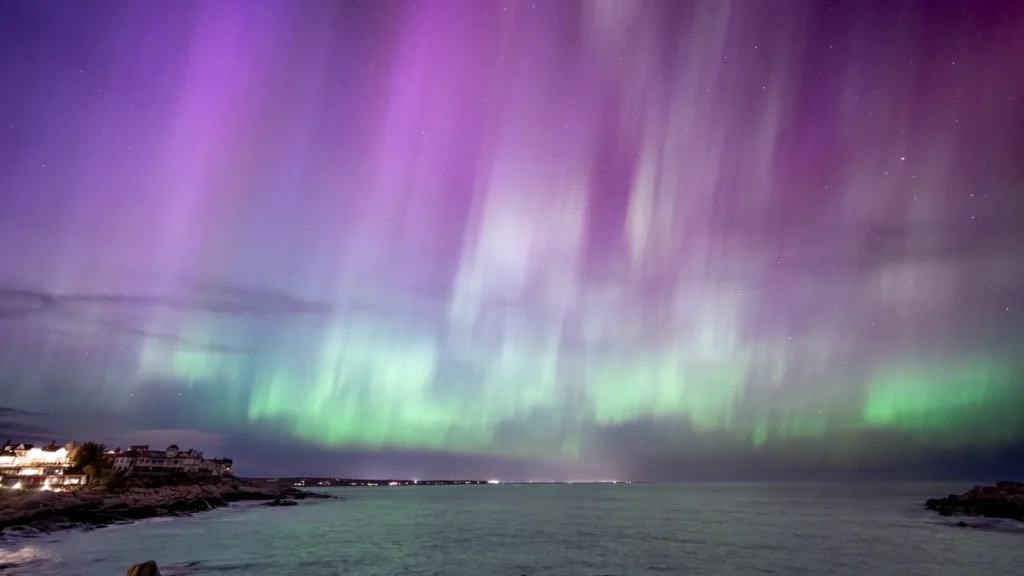
On May 10, 2024, a camera in Farmington, Connecticut, recorded a red-pink glow and a patch of pale green. The photographer found the colors harder to distinguish in person. Both views were real: a photo can bring out light that your eyes barely register.
The northern lights, or aurora borealis, are light emitted by gases high in Earth’s atmosphere after fast-moving particles collide with them. Oxygen produces much of the green and red; nitrogen can add purple or pink. The glow usually forms near the magnetic pole, but strong storms can bring it much farther south.
How to use this article: Start with the two colors on the Connecticut photo, compare the overlapping height bands, or see why the glow can reach farther south.
1. What Makes the Atmosphere Glow?
The Sun continually sends out a stream of charged particles called the solar wind. When it interacts with Earth’s magnetic environment, energy can accelerate electrons already there. Many of those electrons follow magnetic field lines into the upper atmosphere near the poles. They collide with oxygen atoms and nitrogen molecules and give them extra energy. When those gases lose some of that energy, they release light.
It works a little like the gas in a glowing sign: different gases and different energy changes produce different colors. The same basic process makes the southern lights, Aurora Australis, in the Southern Hemisphere.
2. Why Are the Northern Lights Different Colors?
Read the colors in one Connecticut photo

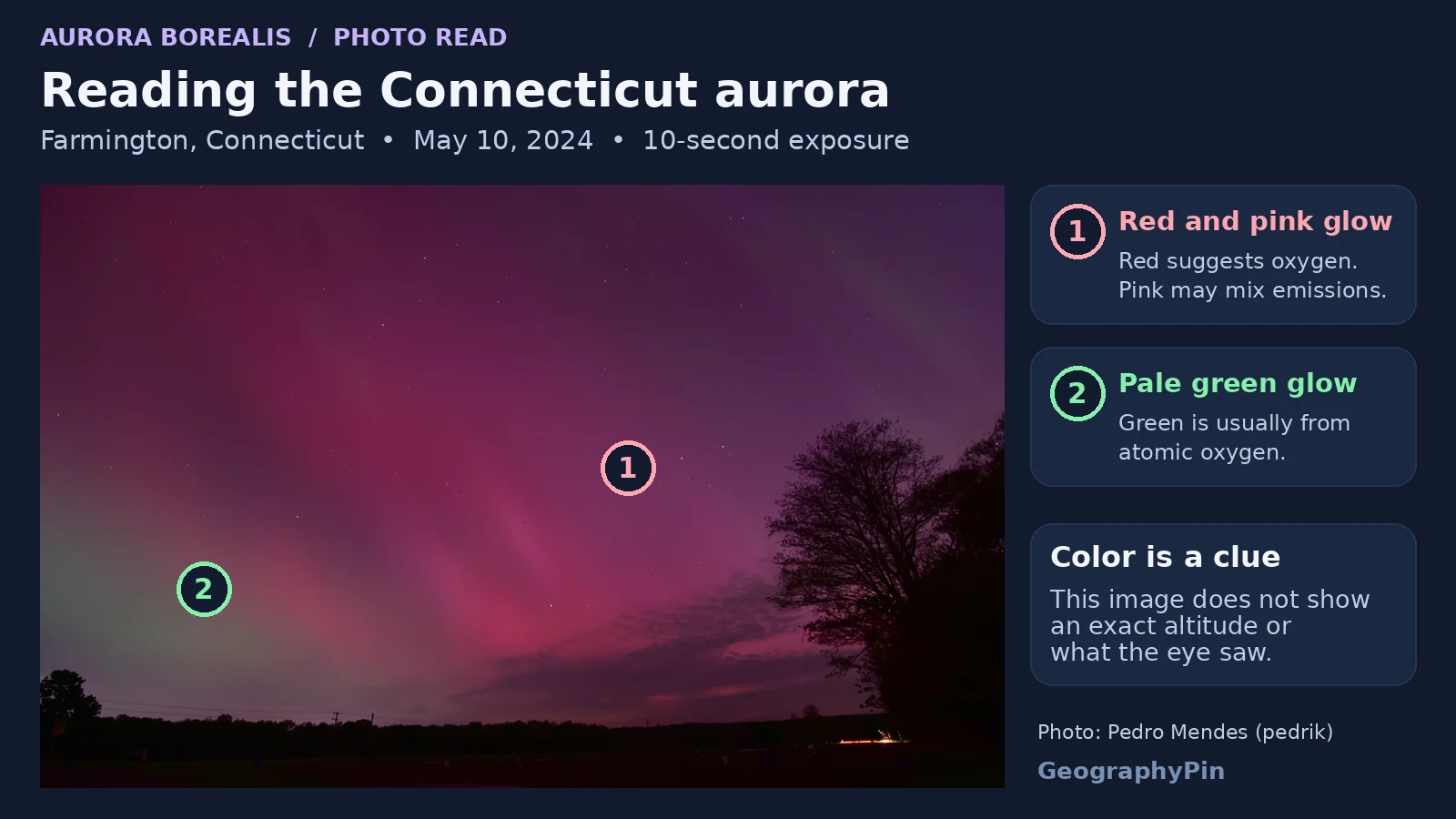
Start with the red-pink area at marker 1. A red oxygen emission is one possible contributor, but pink can combine several emissions. The picture alone does not separate them. At marker 2, the pale green is consistent with the most common auroral color, which comes from atomic oxygen. Neither marker gives a measured height.
A camera can gather light for several seconds. Its exposure, sensitivity and white balance can change how bright or saturated the result looks. At low light levels, your eyes rely more on cells that detect brightness than on those that distinguish colors. A dim band may therefore look grayish or white in person, even if a camera records green.
The color bands are not separate layers
- Green from oxygen: NOAA’s tutorial puts the common green emission roughly 75–250 miles (120–400 km) above the surface.
- Deep red from oxygen: The tutorial places this emission mainly high in thinner air, roughly 185 miles (300 km) and higher. Lower down, collisions can interrupt the oxygen atom before it emits that slower red light.
- Purple along a lower edge: Nitrogen can emit light quickly in denser air. NOAA’s example band for that lower purple border is roughly 75–125 miles (120–200 km). It does not describe every purple or pink feature.
3. Why the Glow Can Reach Farther South
The auroral oval can expand beyond its usual range

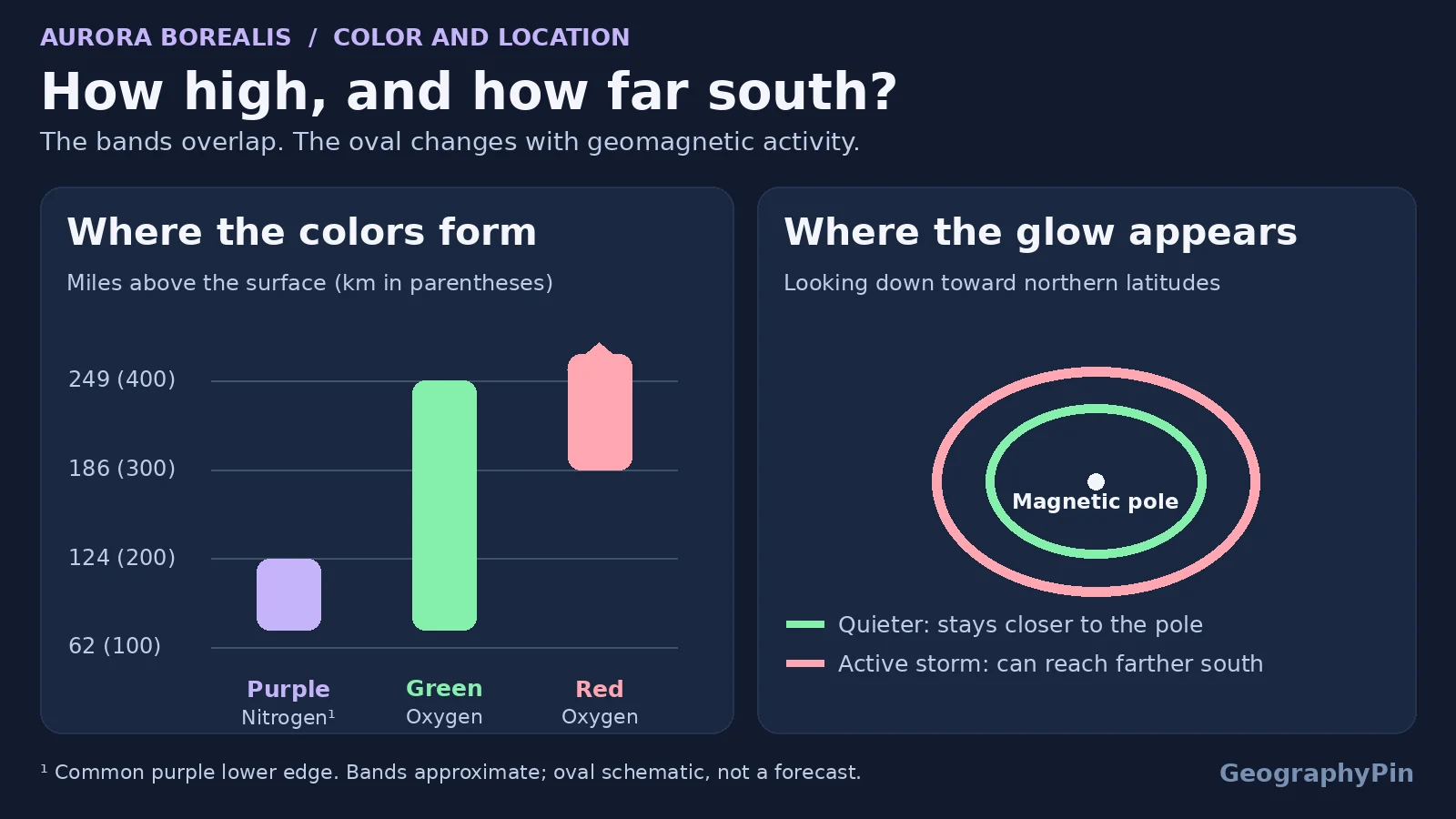
Seen from above, the glow often forms an uneven ring around Earth’s magnetic pole. The ring is called the auroral oval. During stronger geomagnetic activity, its edge can move toward the equator. An observer may also see a bright aurora on the northern horizon even if it is not directly overhead. Both effects help explain sightings at lower latitudes during the extreme May 2024 storm.
A wider oval does not promise a visible display. You need a sufficiently dark, clear sky and a view in the right direction. Long winter nights increase your chances of being outside in darkness; they do not cause the aurora. The comparison of polar night and midnight sun explains how that darkness changes with latitude. If you’re planning a trip, our guide to the best time to see the northern lights in Iceland compares dark hours in Reykjavík and shows how to read the cloud forecast. For current activity, use NOAA’s short-term aurora forecast alongside a local cloud forecast.
Frequently Asked Questions
Can the camera show northern lights I can’t see?
Yes. A longer exposure can reveal a weak glow or more distinct color than you can see unaided. A single bright photo does not establish what everyone nearby saw, and colors can change with camera settings. Compare the image with what you see in the same part of the sky.
Why does an aurora’s color sometimes change as it moves?
The incoming particles can excite different gases at different heights. The emissions also last for different amounts of time. A fast-moving curtain can therefore show a different color at its leading or lower edge than in the light behind it.
Why might someone farther south see red but not green?
High red emissions can be visible over a distant horizon even when lower parts of the same display are below it or obscured. That is one possible reason, not a way to determine the storm’s strength or the exact source of a glow from one photo.
What Did We Learn Today?
The northern lights are emissions from gases energized high in the atmosphere. Colors help identify likely gases, but their heights overlap, a camera sees more color in weak light, and an active oval can carry the display south of its usual range.
Sources & Data Notes
Physics references, diagram conventions and photo credits
- NOAA Space Weather Prediction Center: Aurora Tutorial for electron acceleration, the oval and the approximate ranges plotted. NASA Science: Auroras for additional emission and height examples. Different displays and illustrative bands are not directly interchangeable; the chart uses NOAA’s tutorial convention and rounded conversions.
- USGS record of the May 10, 2024 geomagnetic disturbance and NASA Earth Observatory’s event retrospective.
- Connecticut photo: Pedro Mendes (pedrik), May 10, 2024, CC BY 2.0; resized and annotated by GeographyPin; exposure and naked-eye observation from the photo record.
- Cover photo: Eric Kilby, Cape Neddick, Maine, May 10, 2024, cropped and shared under CC BY-SA 2.0.

