A wall can block a path, but it cannot decide who gets through or warn a fort that trouble is approaching. At Jiayu Pass in western Gansu, a series of gates, walls and separate signal posts shows how the Great Wall did those jobs.
Chinese states and dynasties built sections of the Great Wall to defend their frontiers. Walls and terrain made crossings harder, fortified gates concentrated traffic where officials could control it, and beacon posts carried warnings. It was a system built over centuries, not a single wall built by one emperor.
How to use this article: Trace the sequence through Jiayu Pass, see why the beacon was separate, or compare surviving and reconstructed work.
1. Why the Wall Was Built in Different Periods
Before China’s first emperor, rival states had built their own frontier barriers. After unification in 221 BCE, Qin Shi Huang linked and extended some existing northern defenses. That was one phase, not the construction date of every stretch now called the Great Wall. Later dynasties put up new lines in different places as their frontiers and strategic needs changed.
The Han built western defenses in the broader Gansu corridor. The Ming dynasty (1368–1644) came much later and built a different frontier system that included new and rebuilt fortifications. A recognizable masonry wall near Beijing and a weathered earthwork in Gansu can belong to the same broad history without sharing the same date, builder or material.
2. Why the Ming Fortified Jiayu Pass
The Hexi Corridor is a passage through what is now western Gansu. Routes through the corridor connect the interior with lands farther west; the Qilian Mountains and the terrain around Jiayuguan help explain why a fort there mattered. The China country profile puts Gansu in its wider geographic setting.
Construction of the Ming fortress at Jiayu Pass began in 1372. The site became an important western strongpoint. It did not have to make the entire frontier uncrossable: if the wall and terrain made bypasses less convenient, a staffed gate could supervise movement along the corridor. Wing walls extended the barrier away from the fortress rather than ending at the edge of its courtyard.
From the outer gate to the inner fort
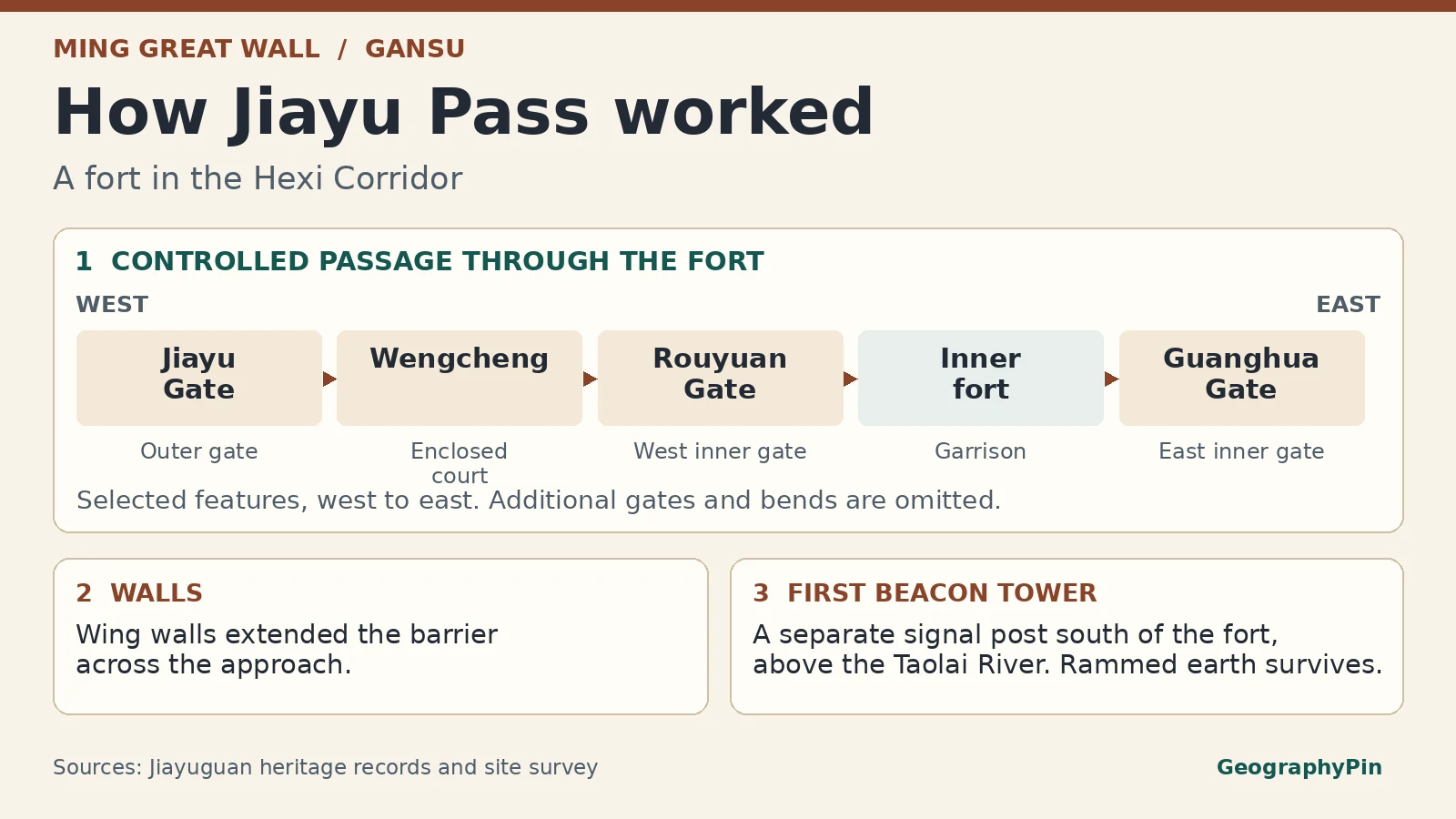
Coming from the west, a traveler could pass through Jiayu Gate and encounter a wengcheng, a walled enclosure protecting the next gateway. Rouyuan Gate led into the inner fort on its west side. Guanghua Gate stood on the east side of the inner fort, with another enclosure there. The diagram traces selected features, not every bend in the route.

3. What the Gate, Wall and Beacon Each Did
The gate controlled entry. A wall could channel movement, but a gate gave officials a place to decide whether to let people pass. Jiayuguan’s heritage interpretation documents the garrison commander’s issuing of passage documents. This helps explain why the same structure could serve trade and travel in peacetime while restricting entry when necessary.
The wall extended the barrier. The fortress did not stand by itself like a castle in an open field. Walls on its flanks extended the defense across the approach. Local earth could be packed in layers into rammed earth. That is why parts of the western system look different from the brick-faced sections familiar from photographs of the Great Wall near Beijing.
A signal post was not the same as a gate tower
The beacon relayed warnings. South of the fort, the surviving First Beacon Tower stands above the Taolai River ravine. Its position matters: an elevated, separate signal post could communicate with others beyond the walls of the fort. Smoke and fire could transmit an alarm within the wider system. The surviving earthwork is not one of the ornate roofed buildings seen above the fortress gates.
4. What Survives at Jiayu Pass Today
Original earthworks and later conservation
Look at three nearby sites separately. The fortress preserves the historical arrangement of gates and enclosures, but the buildings and walls have had conservation work, including a major project launched in 2011. The First Beacon Tower retains a rammed-earth remnant. The Overhanging Great Wall farther north has a different history: a heritage assessment reports that its visible wall was reconstructed on the original foundations between 1985 and 1992.
A newly repaired parapet is therefore not evidence that the entire visible structure is untouched Ming fabric. Nor does a plain earth mound mean that a site was insignificant. At Jiayu Pass, the unadorned beacon helps explain one of the entire frontier system’s most important jobs.
Frequently Asked Questions
Was the entire Great Wall built by one emperor?
No. Qin Shi Huang connected and extended portions of older walls. Other dynasties built different lines, and the Jiayu fortress described here belongs to the Ming period.
What did a frontier gate do when there was no fighting?
It provided a supervised crossing. Travelers could use a permitted route, and officials could control passage. At Jiayuguan, the garrison’s documented duties included issuing passage documents.
What Did We Learn Today?
Jiayu Pass shows why the Great Wall was more than a barrier. Here the wing walls helped channel movement, gates controlled the crossing, and separate beacon posts could relay a warning. The site also shows why it is worth distinguishing surviving earthwork from restored and reconstructed features.
Sources & Data Notes
Heritage records, site survey and photo credit
The graphic is a schematic of selected functions and their relationships. It is not a measured plan or a reconstruction of the buildings’ appearance.
- UNESCO World Heritage Centre: The Great Wall, for the construction periods and nature of the system; UNESCO inventory: Jiayuguan section map.
- Jiayuguan municipal heritage inventory, for the fortress date, layout, wing walls and pass documents; China Culture: Jiayuguan site account, for the gate sequence.
- Gansu cultural heritage assessment, Jiayuguan section, for the First Beacon Tower and the reconstruction of the Overhanging Great Wall; Jiayuguan conservation report, for later conservation work.
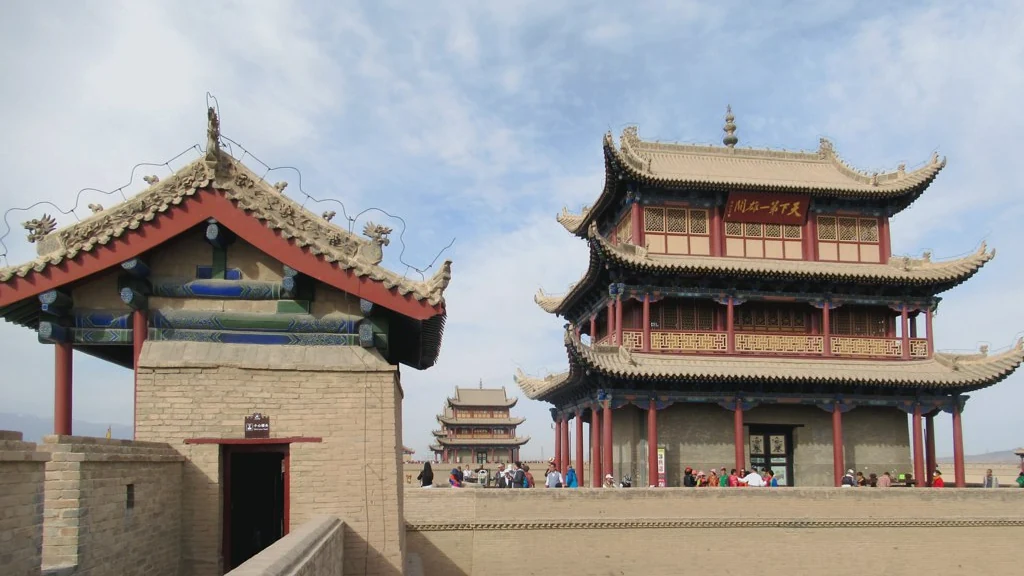
- Cover: David Stanley, Jiayuguan Fortress, September 2017, CC BY 2.0; cropped and re-encoded.