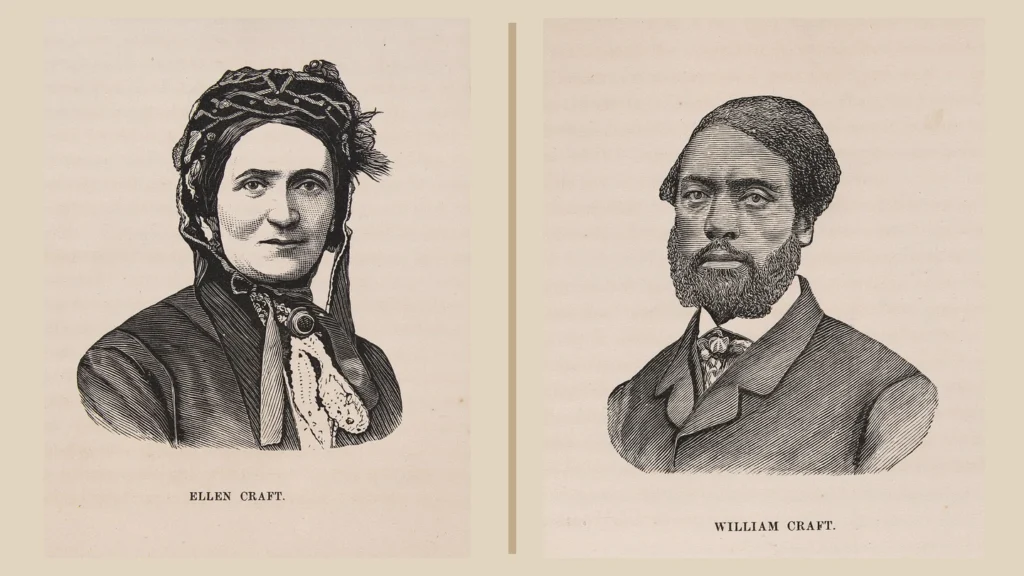
In December 1848, Ellen and William Craft boarded a real train in Macon, Georgia. They bought tickets, rode with other passengers, and later boarded steamers. Those trains and boats were not the Underground Railroad. What the couple did to get aboard, and who helped when they reached Philadelphia, explain the difference.
The Underground Railroad was the effort of enslaved people to escape bondage and the informal networks that helped some reach freedom. Freedom seekers often planned and began their own journeys. People who aided them could provide shelter, information or transportation. Routes varied, and some people traveled without organized help.
How to use this article: Follow the Crafts’ route map, compare what happened at four key stops, or see how Henry Box Brown’s escape differed.
1. Who Made the Underground Railroad Work?
The people taking the greatest risk were the ones escaping enslavement. They decided when to leave and how to travel. Other people sometimes helped them: free Black communities, abolitionists and others could offer a hiding place, contacts for the next leg, or support after arrival. Some aid was spontaneous; some communities organized committees that took on these tasks repeatedly.
Railroad language can make the effort sound more centralized than it was. A “station” could be a home, not a railway building. A “conductor” could guide a person who never boarded a train. A train employee could also appear in the story without being part of the network. What mattered was what a person did, not the name of their job.
Philadelphia and other Northern cities appear in many accounts, but there was no single route or direction. The National Park Service documents journeys toward Canada, Mexico, across waterways and into remote communities. The routes depended on geography, who was watching, and where a person could find safety.
2. From Macon to Philadelphia in December 1848
The Crafts were enslaved in Macon, Georgia. They planned to travel openly, but under a false appearance: Ellen would pass as an ill white man traveling for treatment, and William would pose as the enslaved man accompanying her. The plan relied on the privileges strangers granted a person they thought was a white male enslaver.
The couple had to account for situations in which Ellen might be asked to write. In the memoir William describes how Ellen worked out what to do: an apparent injury, with her right hand in a sling, gave her a reason to ask someone else to sign. The disguise was her work as much as his.
The coast north from Georgia

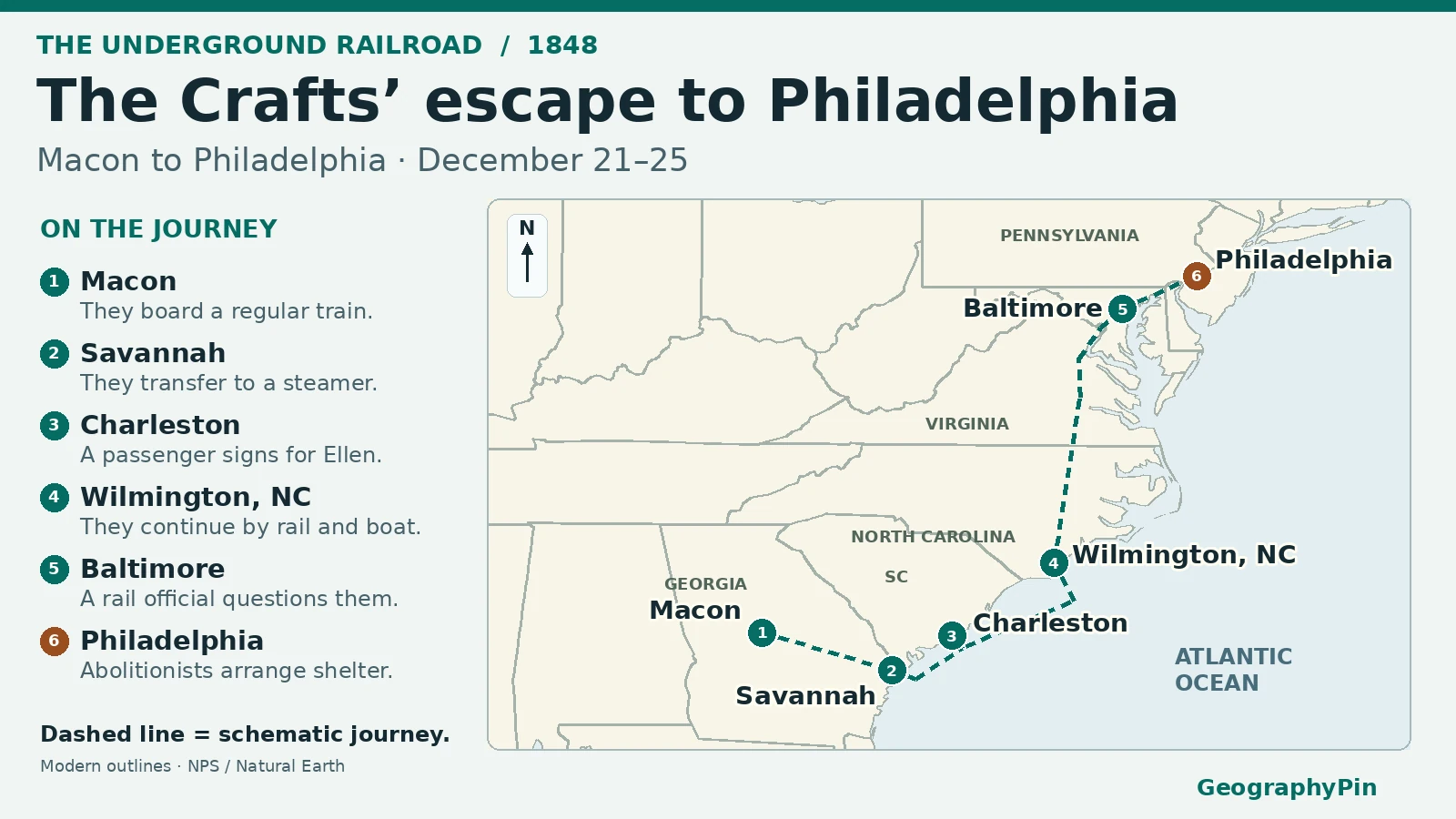
They took a passenger train to Savannah, then a steamer to Charleston. After learning that their intended boat to Philadelphia had already left, they went by way of Wilmington, North Carolina. The Park Service’s reconstruction takes them onward through Richmond, Fredericksburg and Washington, D.C., by rail and steamer, then by train to Baltimore. The map leaves those intermediate stops unlabeled so the main sequence is readable.
Four moments where a decision mattered
| Place and date | Travel | Decision or documented help | The memoir |
|---|---|---|---|
| Macon Dec. 21, 1848 | Passenger train toward Savannah | The Crafts devise and use their disguise. Ellen works out the sling. | Planning and departure, pp. 29–43 |
| Charleston About Dec. 22, 1848 | Arrive by steamer; reroute via Wilmington | Ellen asks the ticket officer to sign. A fellow passenger intervenes; he is not shown to know why Ellen needs help. | Ticket office, pp. 55–58 |
| Baltimore Dec. 24, 1848 | Rail connection toward Philadelphia | The incoming conductor confirms where they boarded; the official allows them to continue. No evidence of organized aid. | Security demand, pp. 68–74 |
| Philadelphia Dec. 25, 1848 | Arrival; later steamer to shelter upriver | Local abolitionists make introductions. The Ivens family knowingly offers lodging. | Arrival and shelter, pp. 78–85 |
At Baltimore the railroad official demanded assurance that the person he thought was an enslaver had a right to take William to Philadelphia. According to the memoir, the conductor of the incoming train confirmed that the pair had come from Washington. That was all he confirmed. The official let them go as the departure bell rang. The book does not give a basis for treating either employee as part of an abolitionist network.
3. Where Organized Help Made a Difference
In Philadelphia, the couple no longer had to rely on the disguise alone. People in the local antislavery community helped them find contacts. The memoir names Robert Purvis, a Black abolitionist, as the person who introduced them to Barkley Ivens, a Quaker who offered them a place to stay. They traveled upriver by steamer and went to his family’s home. His daughters helped the couple learn to read.
That shelter is an example of the network itself. The route from Macon shows the Crafts using public transport on their own terms; the visit to Ivens shows people knowingly providing protection and time to recover. Both parts belong to the history of escape from slavery, but the people involved played different roles.
A different journey to the same city: Henry Box Brown
In 1849, Henry Box Brown reached Philadelphia from Richmond inside a wooden shipping crate. He arranged the escape with Samuel Smith, who helped send the crate by express. The abolitionist William Still was there when the crate was opened and later published an account of the arrival.
Brown also used a commercial service, but unlike the Crafts, he had help arranged at both ends of the trip. The contrast shows why a line on a map cannot tell you how the Underground Railroad worked. You have to ask who planned the escape, who knew what was happening, and what they did.
4. Why Reaching the North Did Not Guarantee Safety
The Crafts eventually settled in Boston. In September 1850, Congress strengthened federal enforcement of the return of people who had escaped slavery. The new Fugitive Slave Act increased the danger of recapture even in states where slavery was illegal. That was a different risk from the railroad’s checks in Baltimore in 1848: the later law had not yet passed when they made the original trip.
When men came to Boston to seize them, the local vigilance network helped resist the attempt. William took shelter at the home of abolitionists Lewis and Harriet Hayden while the couple avoided capture. Ellen also hid at other locations in Boston. They eventually left for England. The change in federal law helps explain why the path to greater safety could extend beyond a Northern city or beyond the United States.
Frequently Asked Questions
Was the Underground Railroad an actual railway?
No. The name describes escape efforts and the people and places that supported them. Some freedom seekers used real trains, as the Crafts did; others went by foot, boat or other means.
Did people who reached the North automatically become safe?
No. Enslavers could still seek their capture, and the 1850 law strengthened federal enforcement. Local help could offer protection, but it did not erase the legal danger. Some people, including the Crafts, chose to leave the United States.
What Did We Learn Today?
The Crafts used real trains and steamers, but the Underground Railroad was not those vehicles. Their planning got them out of Macon, people in Philadelphia offered deliberate help, and the threat of recapture later forced them to move again. Henry Box Brown’s different journey shows how the same city could be reached through a different chain of decisions and assistance.
Sources & Data Notes
Memoir, historical itinerary, law and visual credits
The memoir was published in 1860, twelve years after the escape. Dates follow the Park Service’s reconstruction; the printed weekdays in the memoir do not all match the dates. The map uses modern state outlines for orientation and shows a schematic route, not surveyed 1848 track or harbor alignments.
- William Craft, Running a Thousand Miles for Freedom (1860), Digital Library of Georgia record; digitized original edition, for printed pages in the table.
- National Park Service: What is the Underground Railroad? and The Escape of William and Ellen Craft, for the route reconstruction, terms and Boston account.
- William Still’s account of Henry Box Brown, transcribed by Dickinson College, for the arrival and documented assistance; Fugitive Slave Act of 1850 (9 Stat. 462), for federal enforcement.
- Cover: 1872 engravings of Ellen Craft and William Craft from the National Portrait Gallery, Smithsonian Institution, object S/NPG.2018.89.27, CC0; resized and arranged side by side. Map outlines: Natural Earth, 1:50m admin-1 dataset.