For Kim Hyung-Mi, a haenyeo from Dodu on South Korea’s Jeju Island, finding a shellfish can mean leaving the shallows for a different patch of seabed. Coming ashore does not always end her workday. In a 2023 interview, she described practicing the village’s diving songs after work in the water.
Jeju’s haenyeo are women who harvest seafood by diving without breathing tanks. Their catches include abalone, sea urchins, marine snails and seaweed. Knowing where to look is only part of the job: divers also learn local conditions and follow harvest limits. Fishing groups help organize the work and pass on that knowledge.
How to use this article: follow Kim’s account from Dodu, compare three catches, or see how the divers handle undersized shellfish.
A working day on the Jeju coast
Kim Hyung-Mi’s account from Dodu
In her 2023 UNESCO interview, Kim explained that the target catch changes where she works. She recalled going deeper in the waters near Dodu for a shellfish the interview calls conch. She also described the downside of working close to Jeju’s volcanic coast: waves can push a diver toward sharp basalt. Kim learned in the village from her mother and became secretary of its haenyeo association.
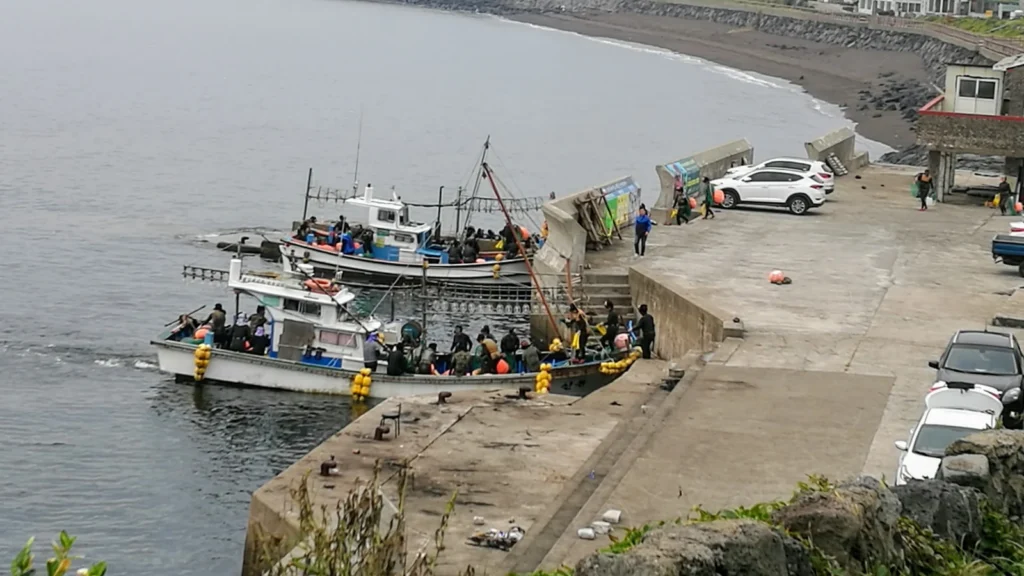
Kim describes singing practice after diving and coast or sea cleanups on some days she does not go out. Those are parts of her routine, not claims about a particular trip or about every village. The opening photograph shows haenyeo preparing to go out by boat at Seongsan Ilchulbong in September 2017, not Kim or the Dodu group. For the lava coast behind this work, see our map of Jeju Island.
What goes in the catch bag
From the seabed to a net hanging under a float
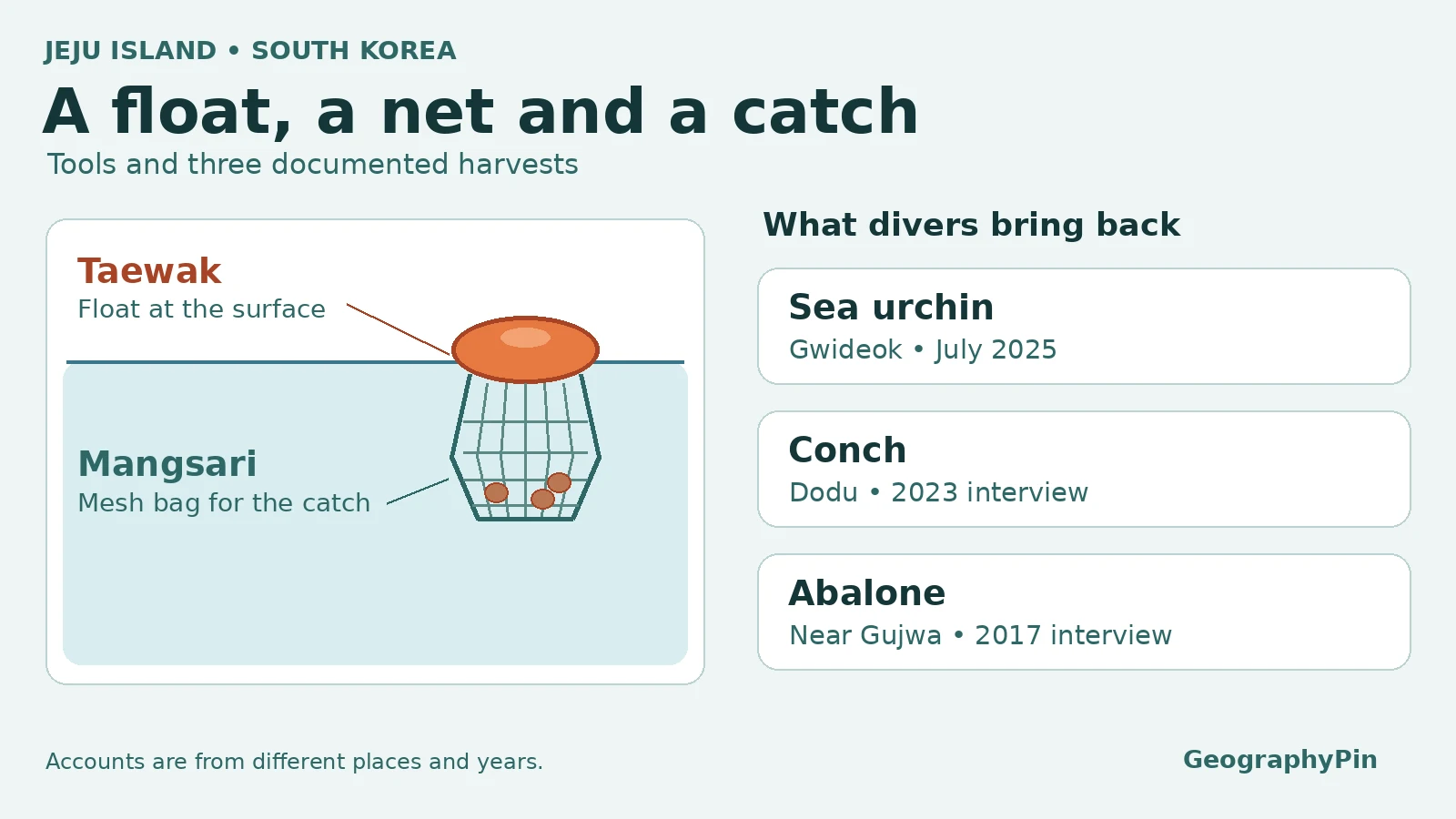
The Jeju Haenyeo Museum describes the taewak as a float a diver can hold at the surface. A mesh bag called a mangsari hangs from it and holds the catch. The float keeps the bag alongside the diver rather than making her tow the whole catch back to shore after every descent.

- Sea urchin, Gwideok, July 2, 2025: FAO documented bags of sea urchins being lifted onto the pier after a harvest in shallow water. The local group used a crane to raise the bags past the rocky steps; FAO notes that most cooperatives do not have one.
- Conch, Dodu, account published in 2023: Kim remembered seeking this marine snail farther down than some of her shallow-water catches. “Conch” is the interview’s English label, not a confirmed species identification here.
- Abalone, interview near Gujwa in 2017: Lee Mae-chun told Korea.net that abalone had once been easier to find and could be a valuable catch, but that she saw fewer by the time of the interview. She was describing a change over her working life, not the yield of a particular dive.
How knowledge and catches are shared
The catch can be sorted before the group comes ashore
In the same UNESCO feature, diver Young-Mi Jang described a rule she follows: if it is hard to judge a shellfish’s size underwater, check it after surfacing and return it if it is undersized. For abalone she gave a minimum of about 2.8 inches (7 cm) in season. That is her account of local practice in 2023, not a current island-wide rule for visitors.
Jang also described pooling catches and sharing earnings in her group even when experienced divers collected more. That example explains one way a group can support newer members; it is not proof that every cooperative divides earnings the same way. Kim’s route into the work was through family teaching. In her interview she also described schools as another way for people to learn.
What Kim notices changing in the sea
Kim told UNESCO she was seeing warmer water, more bleaching and some seafood and seaweed becoming harder to find. Lee’s earlier account near Gujwa similarly describes losing a once dependable catch. These are observations from working divers at particular times. They help explain why a changing seabed affects household income, but they do not measure changes at every site around Jeju.
UNESCO inscribed the culture in 2016. In 2023, the Food and Agriculture Organization recognized the fisheries system. The distinction matters: one recognizes living cultural practices, the other the way a fishing livelihood is organized and maintained.
Frequently Asked Questions
What do haenyeo collect besides abalone?
FAO lists horned turban snails and sea mustard, an edible seaweed, among Jeju catches. The Gwideok example also documents sea urchins. What a diver brings in depends on the fishing ground and season.
How do experienced divers pass along local knowledge?
Kim learned in the water and on shore with her mother. Jang describes senior divers helping less-experienced colleagues rather than expecting them to match a veteran’s catch. Families, colleagues and schools can all be part of learning the work.
What Did We Learn Today?
The haenyeo’s catch depends on the seabed, season and what local rules allow. A float and mesh bag explain how the seafood is carried; the accounts from Dodu, Gwideok and near Gujwa show how experience and cooperation shape each harvest.
Sources & Data Notes
Open the interviews, harvest records and image credit
- UNESCO’s 2023 interviews with Kim Hyung-Mi and Young-Mi Jang. Each diver’s practice and observations are attributed separately. The interview feature also documents the 2016 inscription.
- FAO’s July 2, 2025 Gwideok record and fisheries designation; Korea.net’s February 2017 interview with Lee Mae-chun near Gujwa; Jeju Haenyeo Museum’s float and bag object record. GeographyPin illustrated the equipment; it is not a photograph.
- Cover: Teemeah, boats with haenyeo at Seongsan Ilchulbong, September 19, 2017, CC BY-SA 4.0. Cropped.