At Northern Ireland’s Giant’s Causeway, the Blue Trail takes you down beside the sea. The Red Trail takes you above it. Whichever you choose, think about the way back: a short downhill walk to the basalt stones still leaves a climb to the Visitor Centre.
Take the Blue Trail for the most direct walk to the basalt stones. Choose the Red Trail for clifftop views, then descend the 162 Shepherd’s Steps to connect back toward the stones if the path is open. To avoid those steps, turn back along the cliff or use Blue both ways.
How to use this article: pick Red or Blue, see where the routes meet, or choose a meeting point for your group.
Pick the walk your group wants
Decide which part of the coast you actually want to see
Start near the Giant’s Causeway Visitor Centre and Causeway Hotel. If you want to stand near the columns without doing the clifftop walk, choose Blue. If you want to see the headlands and how the Grand Causeway projects into the sea, choose Red. If you are still working out how to reach the site by road or bus, use our Causeway Coastal Route guide.
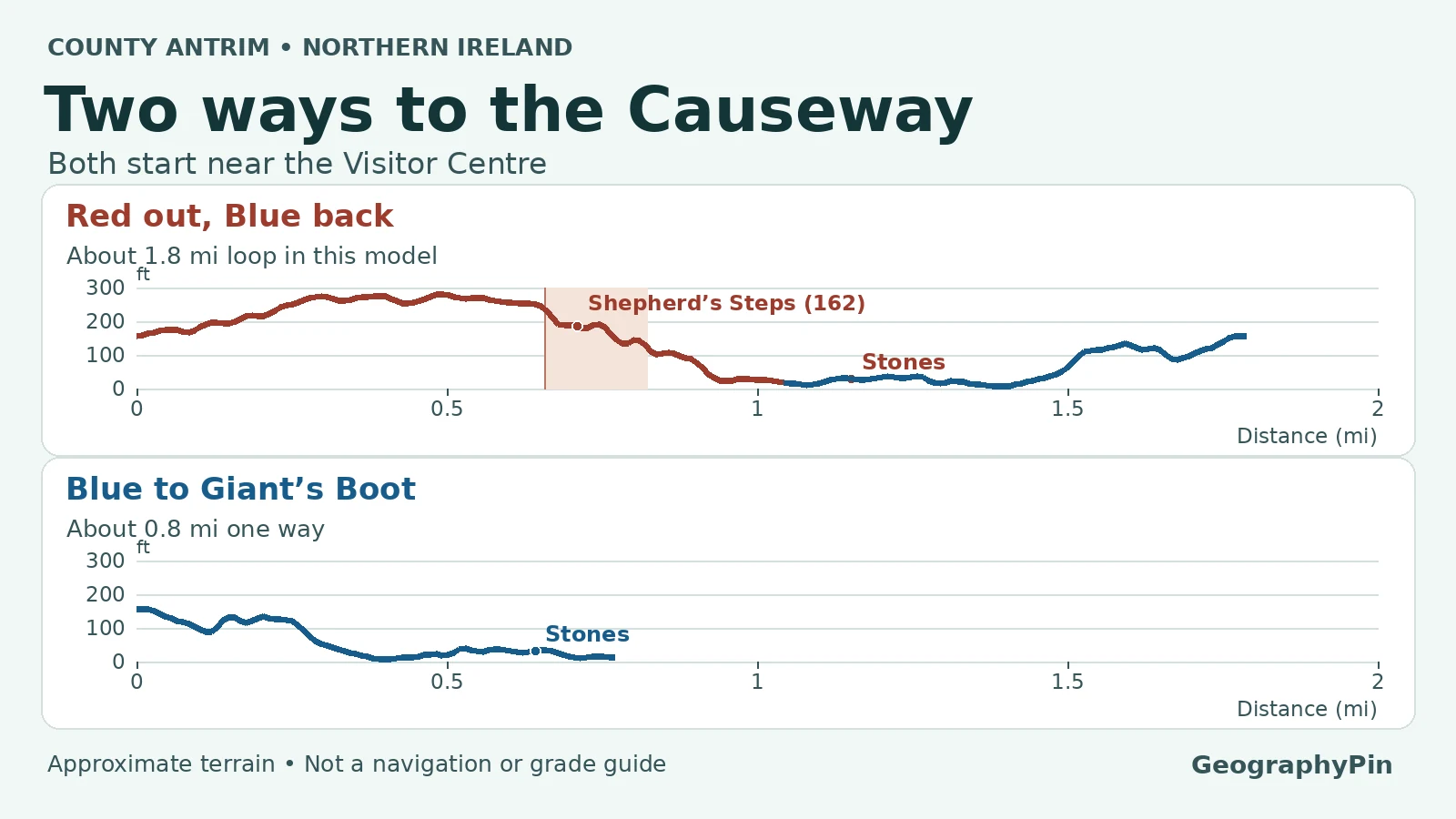
- Blue: The National Trust lists 0.8 mile (1.3 km) one way to Giant’s Boot, beyond the main stones, and about 25 minutes without a long stop. Returning the same way from the Boot makes it about 1.6 miles (2.6 km) round trip. Turning back at the main stones makes it shorter.
- Red: The National Trust lists 2 miles (3.2 km) for its full trail, which starts and ends at Car Park 1. It also lists a shorter option. The exact distance depends on where you turn and whether you detour farther along the coast.
How the two trail profiles compare
Shepherd’s Steps connect the cliff to the lower path
On Red, follow the signed clifftop path past the Weir Snout viewpoint to the top of Shepherd’s Steps. The Yellow Trail continues along the cliffs. If you want to join Blue, descend the steps and turn left from the lower junction toward the Grand Causeway; following the other direction takes you toward the Organ instead.

The shaded section marks the stairs and the short link below them, not the measured drop of each stair. On Blue, the lower stretches are not perfectly level; the climb back to the Visitor Centre is the part you are most likely to notice on the return.
Three walks from the Visitor Centre
- Stones with no Shepherd’s Steps: Follow Blue down and back. Use the tunnel approach beside the Visitor Centre rather than the route over the roof if your goal is to avoid steps. The path descends steeply in places, with kerbs and gravel. It is not a guarantee of wheelchair access, and the basalt is uneven and can be slippery when wet.
- Cliff view without the stair descent: Take Red to Weir Snout and retrace your route. You get views down toward the Grand Causeway without committing to the 162 steps. This is still a clifftop walk with grades and uneven sections.
- Cliff and stones in one loop: Take Red out, descend Shepherd’s Steps, turn toward the stones and return on Blue. If the steps or the lower connector are closed, turn back by the open route rather than trying to find a way around a barrier.
Trail information checked November 26, 2026. The National Trust’s main page listed general coastline hours and no specific Red or Blue closure notice at that check. This does not confirm every path is clear. Check the National Trust’s current site information and follow ranger advice and signs. Avoid the exposed cliffs in strong winds or poor visibility.
Where to meet if you split up
Make the entrance to the Causeway Hotel your rendezvous
Agree on a time at the outside front entrance of the Causeway Hotel, near Car Park 1. The National Trust uses this spot as the Red Trail’s starting reference. It keeps the meeting point above the coastal descent and outside the paid Visitor Centre exhibition. Anyone skipping Red can ask staff about the Green Trail or the shuttle. The access statement identifies the looping section of Green as the accessible trail section, though loose stones can still require help. Check the shuttle setup and whether it meets your group’s needs on the day.
Frequently Asked Questions
Which trail goes directly to the stones?
Blue. The main stones are near the lower shuttle drop-off. You can turn back from there; the official Blue route continues beyond them to Giant’s Boot.
Can I get a cliff view without going down Shepherd’s Steps?
Yes. Walk the Red Trail to the signed Weir Snout viewpoint and return the same way as long as the clifftop is open and conditions are suitable. You do not need to reach the steps for a view.
What Did We Learn Today?
Blue is the direct route to the basalt, with an uphill return. Red gives the view from the cliffs; its stair descent is a choice, not a requirement for enjoying that view. For both in one walk, take Red out and Blue back only when the stairs and connecting paths are open.
Sources & Data Notes
Open the trail sources and elevation method
- National Trust: Red Trail, Blue Trail and Giant’s Causeway Access Statement, pp. 13–16. The Blue round-trip figure doubles the operator’s one-way distance. The modeled loop is not the operator’s full Red Trail listing.
- Profiles by GeographyPin using © OpenStreetMap contributors, route relations 9749721 and 9749722, with the Organ spur omitted. Terrain sampled along the selected lines and smoothed; some coastal samples intersect the water grid and are interpolated. The model is coarse near cliff faces and is not a guide to exact grade or accessibility.
- Profiles produced using Copernicus WorldDEM-30 © DLR e.V. 2010-2014 and © Airbus Defence and Space GmbH 2014-2018 provided under COPERNICUS by the European Union and ESA; all rights reserved.
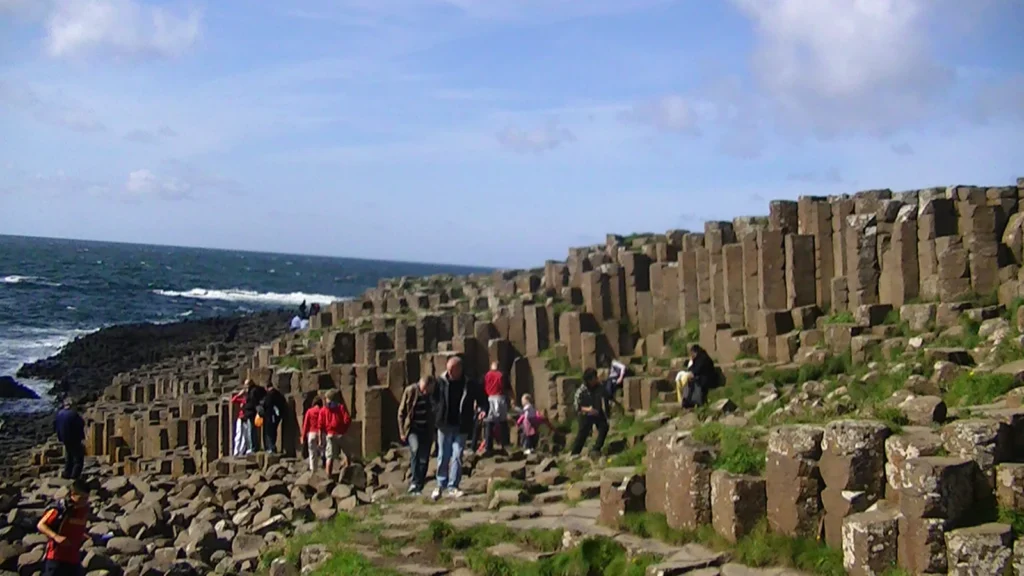
- Cover: Adam Bishop, Giant’s Causeway basalt columns, July 14, 2012, CC BY-SA 3.0. Resized.