The first clue to what Pueblo Bonito was used for is the space its builders left open. In Chaco Canyon, New Mexico, rows of small stone rooms wrap around two plazas. Some rooms show traces of cooking or heating; other spaces were built to bring people together.
Ancestral Pueblo people used Pueblo Bonito for residence, storage and gatherings, including ceremonies. The evidence comes from cooking and heating features, objects kept in rooms, and plazas and kivas designed for groups. The main dispute is how many people lived there full-time and how those uses changed over several centuries.
How to use this article: read the ground plan, follow the evidence from Room 28, or see what Picuris Pueblo chose to share.
What makes Pueblo Bonito a great house?
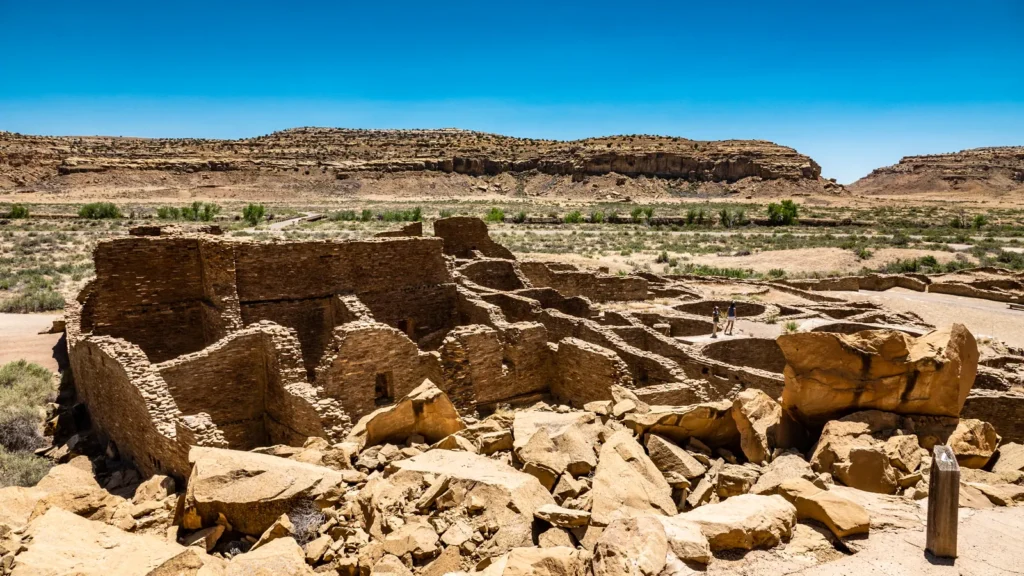
Pueblo Bonito is the largest of the Chacoan great houses in Chaco Canyon. The National Park Service places its major construction roughly between 850 and 1150 CE. Instead of one building project, think of generations adding rooms, raising walls and changing how people moved through the complex. Estimates based on the entire multistory building can run to about 650 rooms; that figure is not a count of the spaces visible at ground level, much less a population count.
A great house is an archaeological name for a large, distinctive complex, not a claim that it housed just one family, or even that most rooms were homes. Smaller houses stood elsewhere in the canyon. Pueblo Bonito was one part of a wider Chacoan system that extended beyond northwest New Mexico into what we now call the Four Corners region.
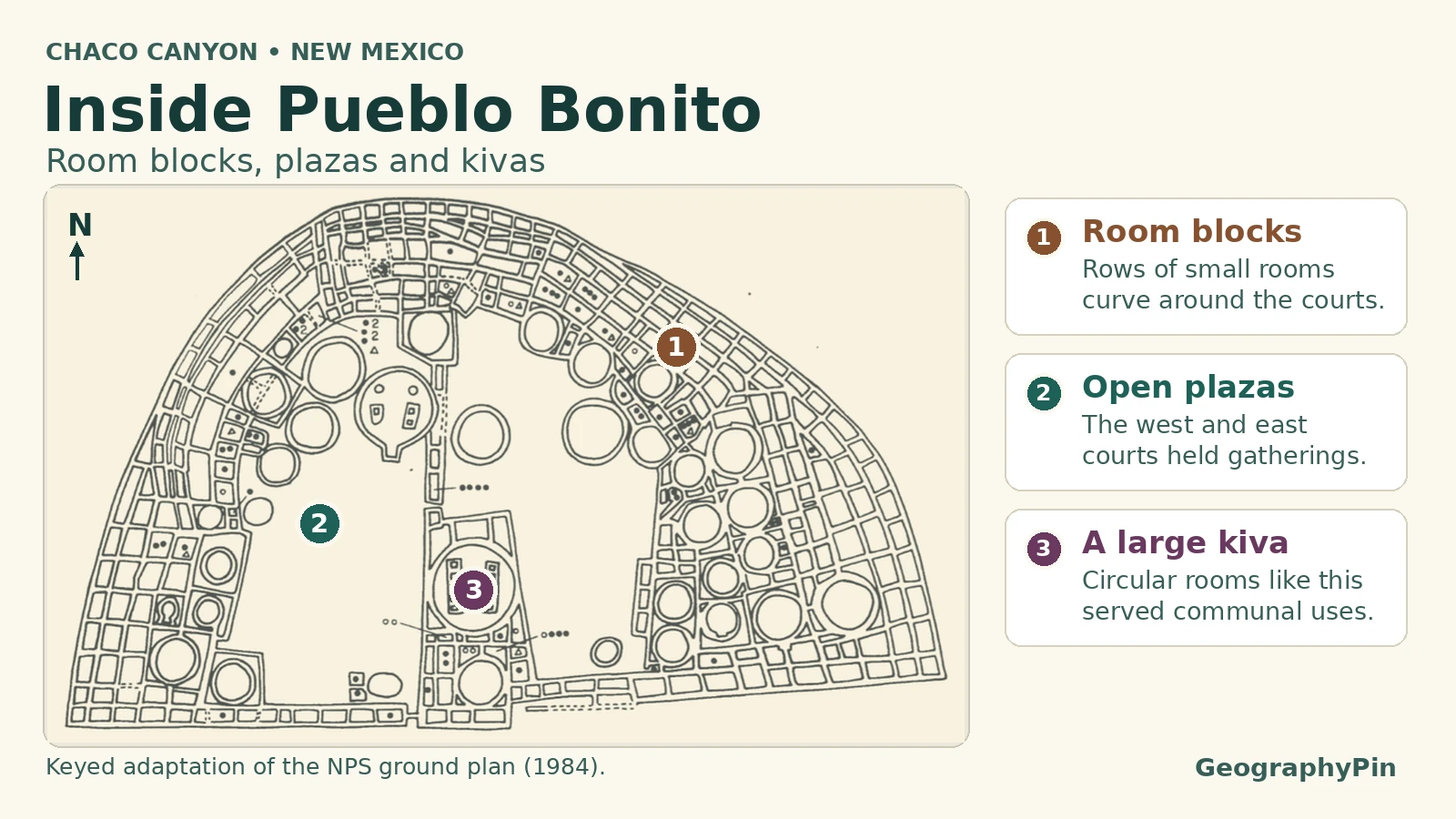
How to read the ground plan
Three spaces you can recognize from above

- Room blocks: The small rectangles along the curve are masonry rooms. Evidence of heating, cooking and storage comes from what was found inside, not from the shapes alone. A room may have served more than one purpose or changed function.
- Plazas: The open courts are divided by a roughly north–south wall. They had space for groups, but the wall and other boundaries shaped who could get in and who could see what happened. A comparative study of Pueblo plazas argues that some gatherings at Chaco great houses may have been more restricted than those at later Pueblo sites.
- Kivas: The circles include partly below-ground rooms. Archaeologists use great kiva for the larger examples, which could accommodate groups under a roof. These spaces are strong evidence for communal use. Round walls alone do not tell us what happened there or who took part.
What the rooms tell us about daily life
Room 28 changed from a domestic space to a place for jars
Excavation found shallow heating pits in an early floor of Room 28. Later, when builders changed the adjoining court and added an upper level, the lower room became a storage space with shelving. Patricia Crown and Wirt Wills report that it eventually held 173 ceramic vessels, including 112 cylinder jars. The same spot thus offers evidence of more than one activity at different times.
A separate chemical study of pottery from Pueblo Bonito detected a cacao marker. That establishes use of cacao and points to long-distance exchange. Together with the jar cache, it supports an interpretation involving special gatherings; it does not mean every jar held cacao, or reveal who drank it or on which occasion.
Some researchers emphasize full-time households, some the role of higher-status residents, and others a regional center where people gathered periodically. These ideas are not mutually exclusive. Hearths and cooking traces indicate domestic activity, but a count of formal hearths can miss less permanent heating features. An open plaza shows room for visitors, not the number of people who came. Early excavations also destroyed or poorly recorded some of the evidence, limiting how closely we can reconstruct particular moments.
Why Chaco still matters to Pueblo communities
Chaco is part of living Pueblo histories
In a 2025 study initiated by Picuris Pueblo, community members and researchers explained how Picuris oral histories relate to Chaco and why the nation chose to investigate connections further. Their account is one publicly shared Pueblo perspective, not a stand-in for every Pueblo nation. The floor plan helps explain the building; it does not speak for descendant communities or disclose knowledge they have not chosen to share.
Frequently Asked Questions
Did people live in Pueblo Bonito year-round?
People did live there at points in its history, but the evidence does not establish how many stayed all year or whether that pattern held through every phase. Occupation inside Pueblo Bonito and around it are separate questions.
Why do archaeologists distinguish a great house from a village?
A village is a settlement; a great house is a type of building complex. Monumental masonry, multiple stories and large shared spaces distinguish Chacoan great houses, which could stand within a broader settlement of smaller structures.
What Did We Learn Today?
Pueblo Bonito’s small rooms, two plazas and circular kivas tell different parts of its story. Together they point to a place where people lived, stored goods and gathered. Because the buildings changed over centuries, the best answer depends on which room and which period we are looking at.
Sources & Data Notes
Open the archaeological sources and image credits
Dates refer to broad construction phases, not a single occupation end date. Room totals for the whole multi-story building are estimates. The plan depicts the ground layout and does not reconstruct the upper floors or assign an original use to every room.
- National Park Service, Pueblo Bonito site overview. GeographyPin plan adapted and labeled from the public-domain National Park Service ground plan, Recent Research on Chaco Prehistory (1984), p. 78. Small survey symbols are retained from the original; the editorial key labels the numbered markers only.
- Patricia L. Crown and W. H. Wills, “The complex history of Pueblo Bonito and its interpretation” (2018), for Room 28 and construction phases; Hannah V. Mattson, lapidary production study, for whole-building counts and the different readings of great house use.
- Comparative plaza research addresses visibility and access, not a calendar of ceremonies. Picuris Pueblo’s 2025 collaboration is cited for publicly shared oral-history context.
- Cover: Brenda Kochevar, Pueblo Bonito Great House and kivas, June 2, 2018, CC BY-SA 4.0. Cropped.