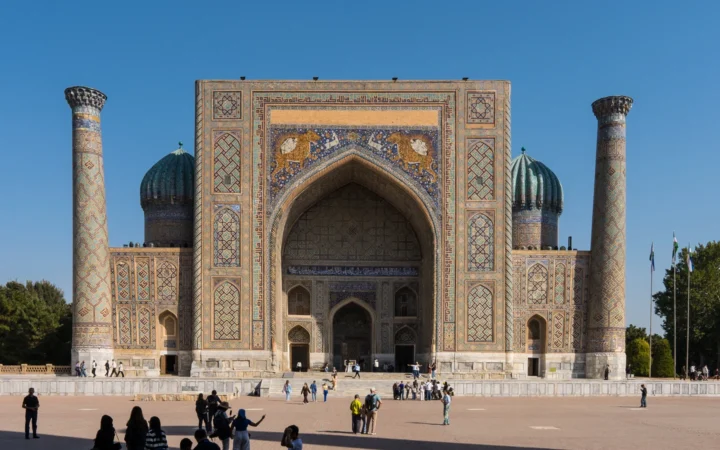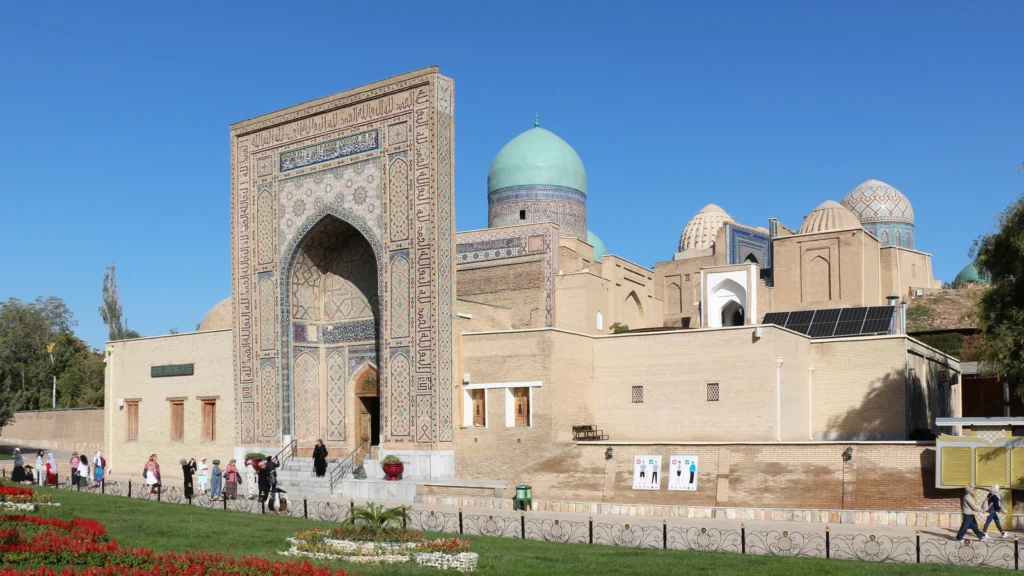
At Shah-i-Zinda in Samarkand, Uzbekistan, the visitor entrance is at the bottom of the hill. Start at the tiled south gateway on Shohi Zinda Street. Then climb the main stair to reach the narrow avenue of mausoleums, where the buildings face one another across the lane.
Visitor information checked: November 23, 2026
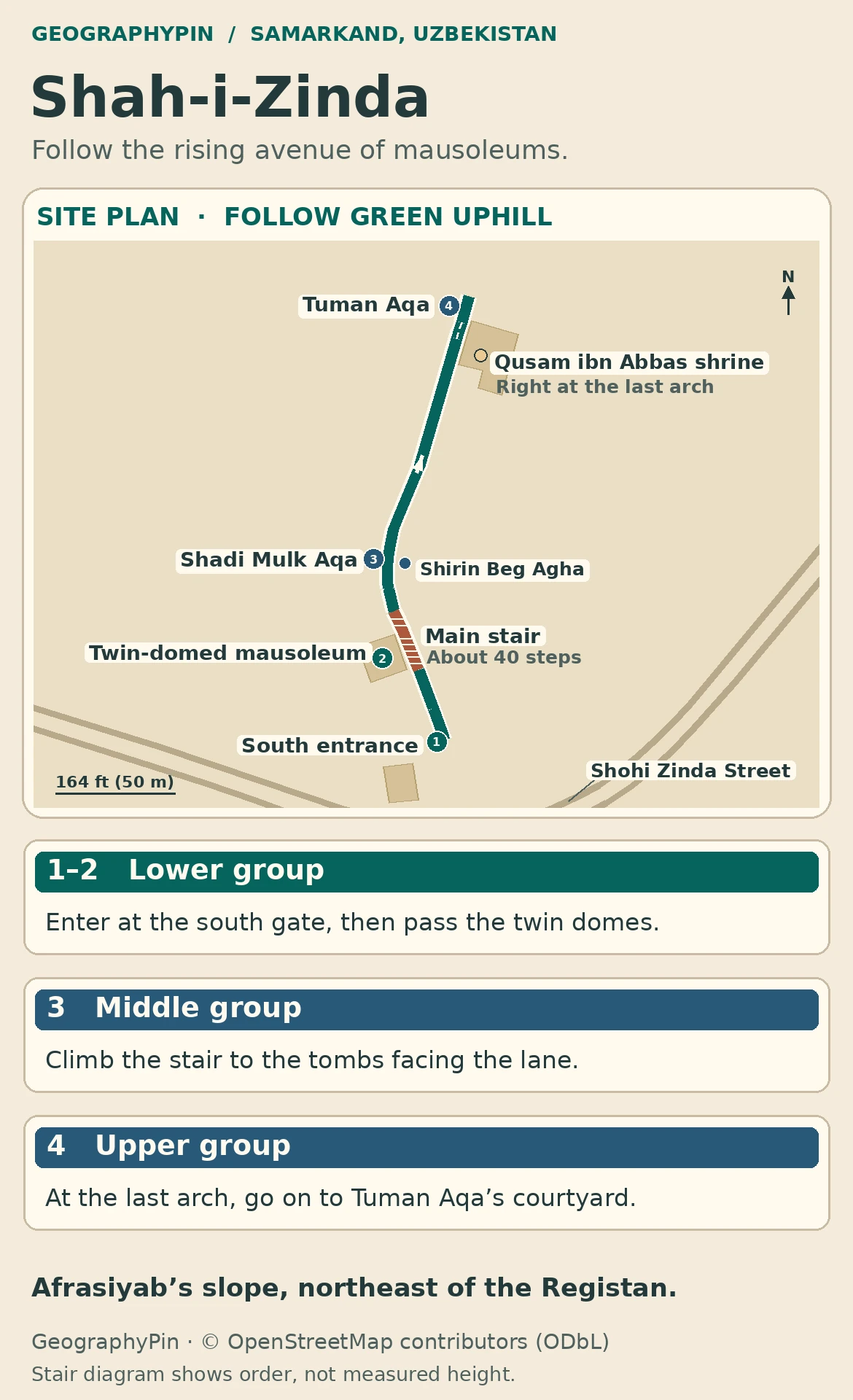
The twin-domed mausoleum marks the lower group beside the steps. Above it, look for Shadi Mulk Aqa on the left and Shirin Beg Agha on the right as you go uphill. At the last domed arch, the door on the right leads toward the shrine of Qusam ibn Abbas. Continue through the arch to reach the upper courtyard and Tuman Aqa’s mausoleum.
How to use this article: Check the main stair before setting off, match the two tombs facing each other or find the shrine turn and upper courtyard.
Find the Visitor Entrance
The walk begins at the south visitor entrance on Shohi Zinda Street and goes uphill to the upper courtyard at Tuman Aqa’s mausoleum. Look for the tall decorated portal at the foot of the slope. The Vaqf Foundation lists 39 Shohi Zinda Street. If your app gives a different street number, use the mapped south entrance (39.66165° N, 66.98798° E), the gateway in the cover photograph.
Enlarge map: Phone version · Desktop version
The main stair comes before the middle group
The route is about 650 feet (200 m) from the gate to the upper courtyard, measured along the lane, not vertically. The main staircase has about 40 steps. The UNESCO and ICOMOS mission described an uneven surface, so distance alone understates the climb. Plan to come back down the same lane unless staff or signs direct you otherwise.
If stairs are a barrier, don’t count on a bypass through the cemetery. A continuous step-free visitor route to the upper courtyard could not be verified. Confirm admission, last entry and access to particular rooms locally before a late visit. Shah-i-Zinda is an active place of pilgrimage: follow posted directions and leave room for people who are praying.
Read the Lower, Middle and Upper Groups
Think of the groups as clusters along one lane, not three separate attractions. Domed crossings divide the route, but the most obvious transition on foot is the main stair. The dates tell a different story from the order of the walk: the entrance you reach first is later than many of the tiled tombs higher up.
Lower group: the twin domes beside the stairs
Beyond the entrance portal of 1434–35, look to the left as you reach the main stairs for the twin-domed mausoleum. Archnet dates it to about 1425 and uses the name Anonymous Mausoleum III. It has long been associated with the astronomer Qazizadeh Rumi, but that attribution is not secure. The two turquoise domes are a better clue to the building than the name on an older guide map.
Middle group: Shadi Mulk Aqa across from Shirin Beg Agha
At the top of the main stair, pass beneath the next domed crossing and enter the tightest part of the lane. The Shadi Mulk Aqa mausoleum, on your left going uphill, stands opposite Shirin Beg Agha. Archnet dates Shadi Mulk’s monument to 1371–83 and Shirin Beg Agha’s to 1385–86. Look up at the latter for the bulbous tiled dome on its high drum.
Upper group: Tuman Aqa’s courtyard and the shrine
At the last domed arch, look for the carved door on your right. It leads toward the shrine associated with Qusam ibn Abbas. The main lane through the arch leads into the small upper courtyard. The Tuman Aqa mausoleum, from around 1405, stands on its west side. The shrine is a different complex reached from the passage, not another name for Tuman Aqa’s tomb.
Place the Complex Beside Afrasiyab
Shah-i-Zinda climbs the southern flank of Afrasiyab, the archaeological mound of ancient Samarkand, northeast of the Registan. That setting helps explain the unusual arrangement: tombs first clustered around the shrine higher on the hill, while later buildings extended down the slope. The grand south gateway came later and gave the older complex a formal entrance from the city below.
The Registan is a separate ensemble centered on a square; Shah-i-Zinda centers on a climb and a line of doorways. Both are part of UNESCO’s Samarkand – Crossroad of Cultures World Heritage property, not one enclosed attraction. The site plan ends at the upper courtyard; it does not show a through-route into the archaeological mound or the cemetery. For the separately entered Afrosiab Museum and other places to visit nearby, see the Samarkand travel guide.
Frequently Asked Questions
What does the name Shah-i-Zinda mean?
It means “the living king.” The name refers to Qusam ibn Abbas. In a local tradition, he escaped an attack in Samarkand and vanished underground rather than dying there.
Whose name is written over the south gate?
The entrance inscription names Abd al-Aziz, son of Ulugh Beg, and dates the gate to 838 in the Islamic calendar, corresponding to 1434–35. That is the date of the gateway, not of the whole cemetery.
What Did We Learn Today?
The order of the walk is not the order in which Shah-i-Zinda was built. Visitors start at a later gateway below the hill, climb past the twin domes to the facing tombs in the narrow lane, and finish near the older shrine that drew burials to the slope in the first place.
Sources & Data Notes
The three groups follow Archnet’s architectural account. The distance follows mapped paths and stairs; the stepped diagram shows order, not measured elevations. The stair count is approximate: Shahzad Bashir describes 40 steps, while the mapped stair records 42. Opening hours and admission figures in older sources are not used as current visitor information.
View sources, map data and photo credit
- Archnet: Aramgah-i Shah-i Zindah identifies the main entry, the three clusters, the named buildings and their dates. Shahzad Bashir, The Grave of a Living King documents the stair and the shrine’s place in local pilgrimage.
- UNESCO: Samarkand – Crossroad of Cultures establishes the wider World Heritage property. The UNESCO and ICOMOS advisory mission discusses the steep terrain and access proposals, not a confirmed alternative route.
- Uzbekistan Travel: Shakhi-Zinda memorial ensemble and the Vaqf Foundation’s Shohi Zinda page document site context and the street address. The World Society for the Study, Preservation and Popularization of the Cultural Legacy of Uzbekistan documents the entrance inscription.
Cartography: GeographyPin. Map linework © OpenStreetMap contributors, ODbL 1.0. Download the visitor-plan linework (GeoJSON ZIP).
Cover photo: Shah-i-Zinda 01, Bernard Gagnon (Bgag), September 30, 2023; cropped and resized, CC0 1.0.