On a map the Diomede Islands are neighbors. On a calendar they can be on different days, but not all the time. Compare the islands at the same UTC hour in January and July and you can see exactly what Alaska’s daylight saving change does.
Russia’s Big Diomede is 21 hours ahead of Alaska’s Little Diomede during Alaska standard time and 20 hours ahead during daylight time. The International Date Line runs between them, but they can still share the same local date. Read both the calendar date and the clock to tell which applies.
How to use this article: Find where the islands are, compare their different UTC offsets, or work through the January and July clocks.
1. Locate Big and Little Diomede
Two islands on opposite sides of the date line
Big Diomede lies to the west and belongs to Russia. Little Diomede lies to the east and is part of Alaska, United States. NASA gives about 2.4 miles (3.8 km) of separation between the islands; that is an approximate shore gap, not the distance between the Asian and North American mainlands.
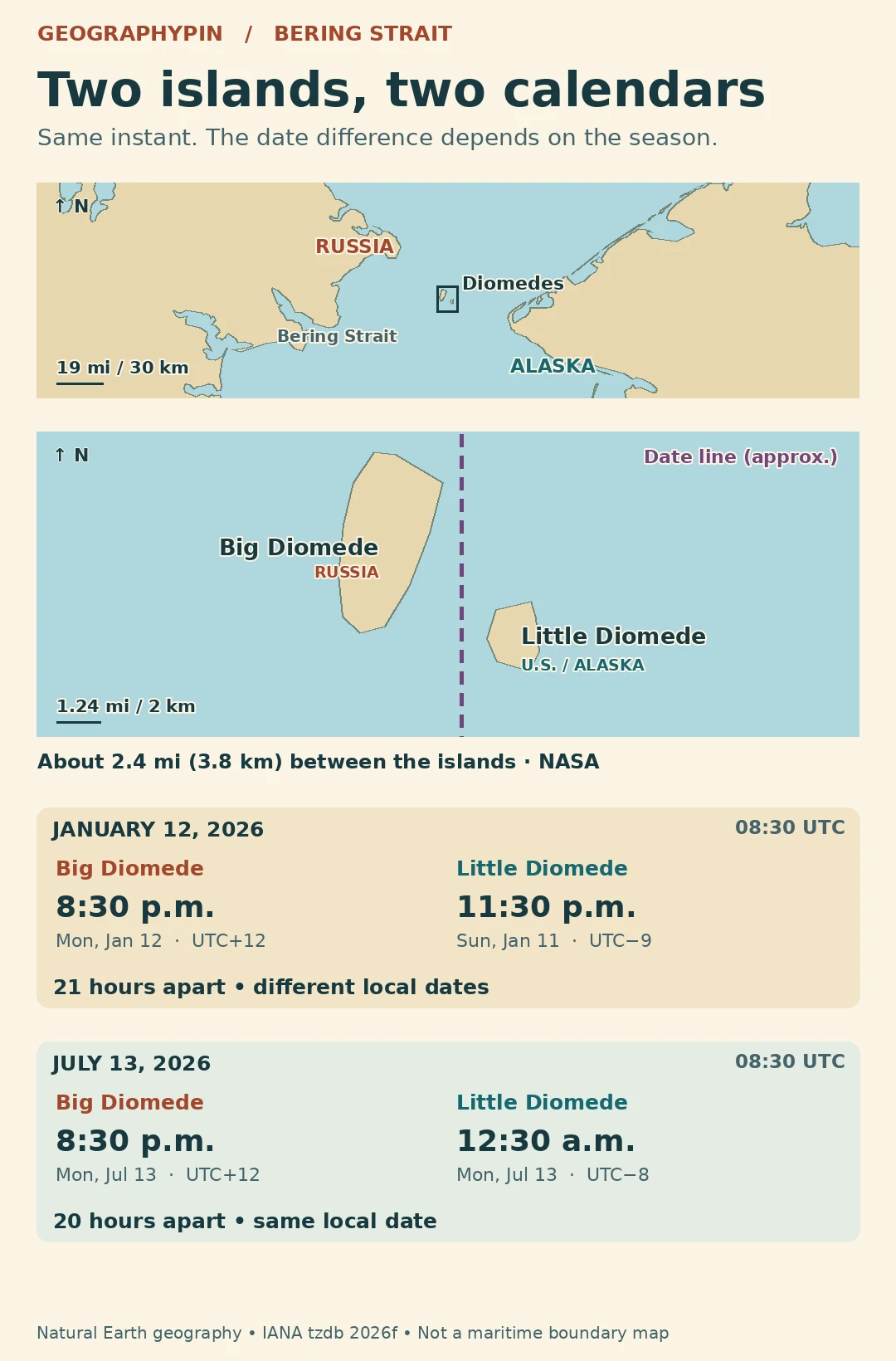
The 1867 Alaska cession treaty described a territorial division passing between the islands. The International Date Line also passes between them, but a date line and a national boundary do different jobs. The date line is a calendar convention; it does not confer jurisdiction or set each island’s clock. Both islands are well east of the 180° meridian on a north-up local map. See the Bering Strait distance maps for the broader setting and how shore gaps are measured.
2. Why the clock difference is not 24 hours
One island changes its clocks
Big Diomede follows Chukotka time, represented by Asia/Anadyr in the IANA database, at UTC+12 year-round. Little Diomede follows Alaska time, represented here by America/Nome: UTC−9 on standard time and UTC−8 on daylight time. Subtract the signed offsets: 12 − (−9) = 21 hours in the first case and 12 − (−8) = 20 hours in the second.
“Tomorrow Island” and “Yesterday Island” are useful nicknames. They do not mean the clocks are always a full day apart or that the islands can never display the same date. For the convention beyond the Diomedes, see the International Date Line explanation.
3. Work the same UTC hour through two seasons
08:30 UTC in January and July 2026
| Reference instant | Time difference | Big Diomede, Russia | Little Diomede, Alaska |
|---|---|---|---|
| Jan 12, 08:30 UTC | 21 hours | Mon, Jan 12, 8:30 p.m. (UTC+12) | Sun, Jan 11, 11:30 p.m. (UTC−9) |
| Jul 13, 08:30 UTC | 20 hours | Mon, Jul 13, 8:30 p.m. (UTC+12) | Mon, Jul 13, 12:30 a.m. (UTC−8) |
In January, subtracting nine hours from 08:30 UTC takes Little Diomede back past midnight. In July, subtracting eight hours keeps it on Monday, just after midnight. Big Diomede shows Monday evening both times. None of the readings describe a journey, and no extra day needs to be added after converting through UTC.
With the standard-time offsets, both islands share the UTC date from 09:00 until just before 12:00 UTC. With the daylight-time offsets in this example, that shared-date window starts an hour earlier, at 08:00 UTC. The window ends at noon UTC in both cases: that is midnight at the start of the next day on Big Diomede.
Frequently Asked Questions
Which island reaches New Year first?
Big Diomede reaches January 1 before Little Diomede. At its midnight, Little Diomede is still at 3:00 a.m. on December 31 under the standard-time offsets. That is the same instant read on two local calendars.
When does the gap change between 20 and 21 hours?
Little Diomede’s clock changes when Alaska starts and ends daylight saving time. In 2026, those changes came at 2 a.m. local time on March 8 and November 1. Big Diomede stayed on UTC+12 throughout.
What Did We Learn Today?
Big Diomede is ahead year-round under these rules, but the gap drops from 21 hours to 20 when Little Diomede moves to daylight time. The two islands can briefly share the same calendar date even while their clocks are many hours apart.
Sources & Data Notes
Both dated examples start at 08:30 UTC. The local readings and date-overlap windows use IANA release 2026f for Alaska’s America/Nome and Chukotka’s Asia/Anadyr. The offset rules are not the same for all historical periods.
View sources and local clock rules
- IANA Time Zone Database, release 2026f.
- United States: 49 CFR §71.11, Alaska time zone and NIST daylight saving rules. Russia: Federal law 107-FZ, Article 5, which assigns Chukotka to UTC+12.
- U.S. National Archives, 1867 Alaska cession treaty; NOAA, International Date Line; NASA Earth Observatory, islands and approximate gap. The date-line marker shows the calendar divide in the local water gap, not a mapped legal boundary.
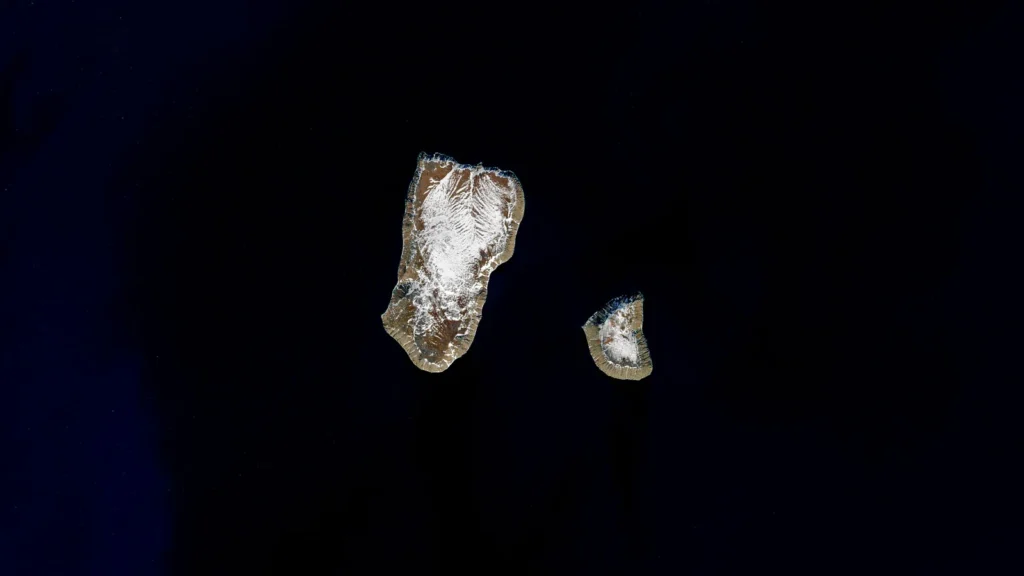
- Natural Earth, public-domain 1:10m geographic base. Featured image: NASA Earth Observatory/Joshua Stevens using USGS Landsat 8 OLI data, cropped from the source’s detailed island frame. NASA’s narrative dates the acquisition June 6, 2017. See the NASA media guidelines.