In Canada, a public insurance plan can pay for a visit at a privately owned clinic. The same distinction between who pays and who owns helps explain why public health insurance does not, by itself, make Canada a socialist economy.
No, not under an economy-wide ownership definition. Canada is a mixed market economy. If socialism means society or workers collectively control most businesses and other productive assets, publicly financing health care is not enough to meet that definition. Consider electricity: Québec owns Hydro-Québec, while Capital Power’s Genesee units in Alberta are owned and run by a shareholder-owned company.
How to use this article: see what Canada’s health plans insure, compare the two electricity producers, or see what federal and provincial governments do.
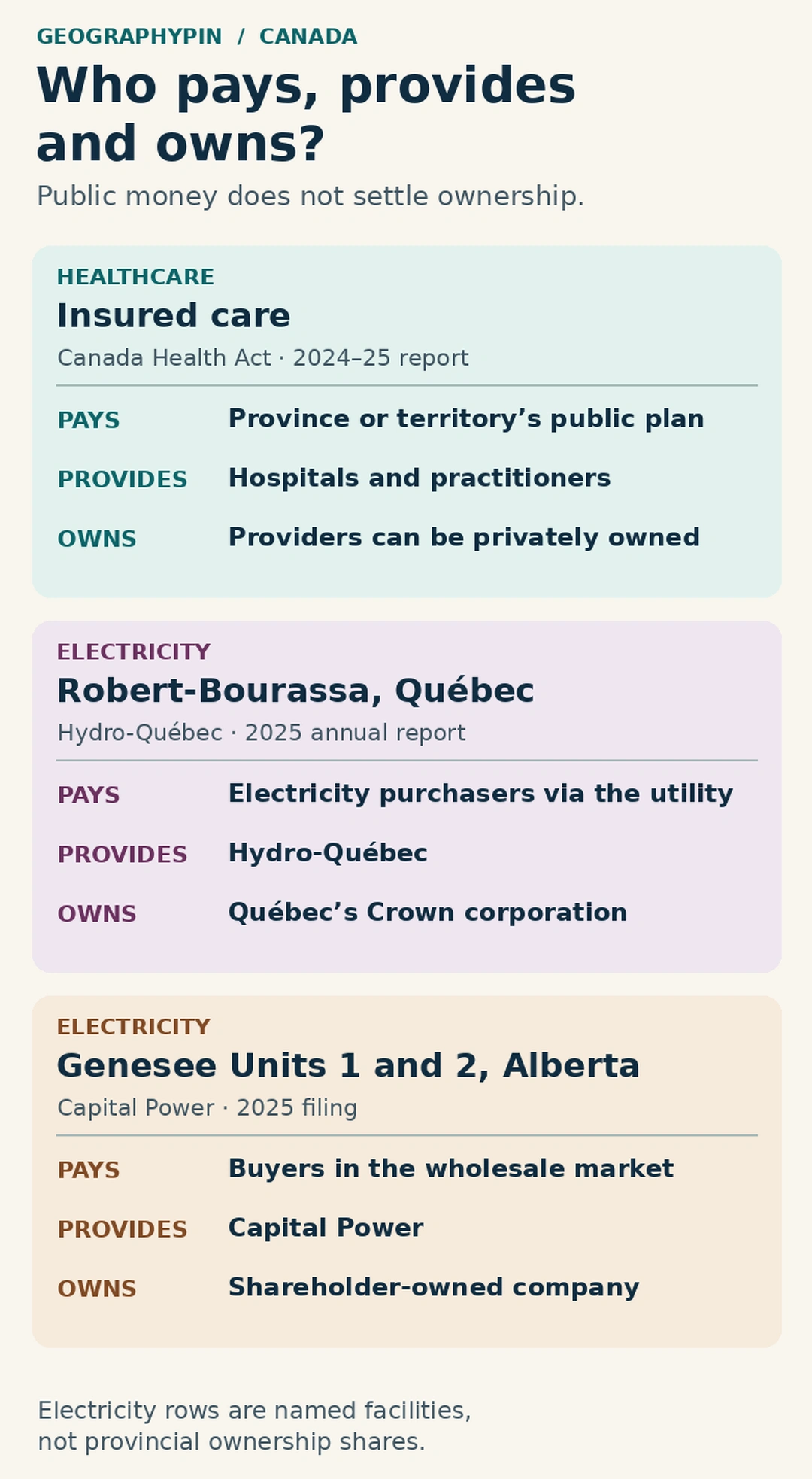
Who pays, who provides and who owns?
The ownership test asks who controls the assets used to produce goods or services. It is different from asking who pays the bill or who sets the rules. Some forms of socialism retain markets but change who controls firms; the existence of a market alone does not settle the question.
| Example | Who pays? | Who provides it? | What is owned by whom? | Evidence |
|---|---|---|---|---|
| Insured health services | Provincial or territorial public insurance, supported in part by a federal transfer. | Hospitals and professionals deliver the care. Many family physicians bill the public plan as independent contractors. | Public insurance is administered on a nonprofit basis. Some hospitals are private nonprofit corporations, and private providers can deliver publicly insured care. | Canada Health Act and Health Canada’s 2024–25 report. |
| Robert-Bourassa power station, Québec | Electricity purchasers pay for power through the utility system. | Hydro-Québec operates the station on La Grande Rivière. | Hydro-Québec is a Québec Crown corporation. This station’s installed capacity was 5,616 MW. | Hydro-Québec Act and 2025 report. |
| Genesee Units 1 and 2, Alberta | Electricity buyers in Alberta’s wholesale market. | Capital Power operates the two natural-gas units near Warburg. | Capital Power, a shareholder-owned company, owns both units. Reported net generating capacity was 1,332 MW. | Capital Power 2025 Annual Information Form. |
What public health insurance does and does not cover
A public plan can pay a private provider
The Canada Health Act ties the full federal cash contribution to how provincial and territorial plans operate. The core insurance covers medically necessary hospital and physician services and specified hospital-based surgical-dental services for eligible residents. Public administration applies to the plan, not the ownership of every place a patient visits. A publicly insured visit can take place in a privately run practice that bills the plan, not the patient. Under the Act, extra-billing or user charges for insured services can trigger deductions from federal funding.
Health Canada’s Services Policy took effect on April 1, 2026. It clarifies that a medically necessary service delivered by another regulated professional, such as a nurse practitioner, should be publicly insured if the service would be covered when delivered by a physician. That does not make every service delivered by such professionals free or create a single federal provider. Health Canada says provinces and territories first report any patient charges for these physician-equivalent services beginning in December 2028.
Where private insurance and out-of-pocket bills still matter
Coverage beyond insured core services can vary. Provinces and territories can fund some outpatient prescription drugs, routine dental services or ambulance care, sometimes for particular groups. Other services can be paid by private insurance or patients. Check the relevant plan rather than assuming a hospital service, a retail prescription and a dentist appointment are covered on the same terms.
In its November 2026 release, the Canadian Institute for Health Information estimated that public sources would fund 71.4% of total health expenditure in 2026 and private sources 28.6%. Those are shares of money, not shares of clinics owned by the government. The same report recorded C$1,374.10 per person in out-of-pocket health spending in 2024, a national average rather than a bill everyone paid.
One electricity industry with different owners
A Québec Crown corporation and an Alberta merchant plant
Shares in Hydro-Québec are Québec state property under the provincial Hydro-Québec Act. Its 2025 annual report lists the 5,616-megawatt Robert-Bourassa hydroelectric station in the James Bay region. The province owns this generating business, and the utility sells electricity. Ownership and the presence of a price are different questions.
Capital Power is a shareholder-owned company listed on the Toronto Stock Exchange, not a Crown corporation. Its 2025 filing says it owns and operates both repowered Genesee units in Alberta. It reports 1,332 megawatts of net generating capacity for those two units and describes the facility as selling into a wholesale market. The two capacity figures show the scale of named plants, not how much power they produced in a year. They do not estimate either province’s ownership share.
The Canada Energy Regulator identifies both privately owned producers and public utilities. It describes competitive generation markets in Alberta and Ontario and government-owned electricity providers across many other jurisdictions. Alberta also has municipally owned companies; the Capital Power example does not make all Alberta electricity private.
For a separate national check, Statistics Canada estimated 13.86 million private-sector employees and 4.50 million public-sector employees in October 2026, seasonally adjusted. Private-sector workers were about 76% of employees in that comparison, which leaves out the self-employed. Employment counts show where people work, not who owns 76% of the economy’s assets.
What Ottawa and the provinces are responsible for
Federal standards do not mean one national insurer
The Constitution Act, 1867 assigns provinces responsibility for establishing and managing most hospitals, and gives them powers over facilities that generate electricity in the province. In health care, provinces and territories administer their own insurance plans. Ottawa sets federal funding conditions through the Canada Health Act and helps finance the plans: Health Canada reports more than C$52.1 billion through the Canada Health Transfer in fiscal 2024–25. The transfer is not the cost of the whole Canadian health system.
The Canada Energy Regulator notes that provincial and territorial authorities generally govern local power generation and delivery, while federal authorities have roles in areas such as international power lines and electricity exports. The rules and public responsibilities differ by industry. A province can operate an electricity company without Ottawa owning that company, just as Ottawa can help fund health care without running a provincial insurance plan.
Frequently Asked Questions
Will my provincial plan pay for care while I visit another province?
The Canada Health Act includes portability for insured services during temporary absence. For planned elective treatment, your home plan may require prior consent. Check its terms before arranging treatment rather than assuming every bill is covered.
Is a publicly traded company the same as a government-owned company?
No. Publicly traded describes shares that can be traded on an exchange; it does not mean government ownership. A Crown corporation, by contrast, is owned by a government. Both can sell services and operate under public regulation.
What Did We Learn Today?
Canada’s public health insurance tells you who pays for insured care, not who owns every clinic or business. Québec’s Crown-owned hydro station and Alberta’s shareholder-owned generating units show why one policy or enterprise cannot define the whole economy.
Sources & Data Notes
Evidence checked November 2026. The ownership distinction follows the Stanford Encyclopedia of Philosophy’s discussion of socialism. The two electricity cases illustrate ownership models, not a nationwide estimate of asset ownership. The employment proportion divides private-sector employees by all public- and private-sector employees in the same survey table. The 2026 health-spending shares are preliminary estimates; 2024 out-of-pocket spending is an observed annual statistic reported by the same release.
- Justice Canada: Canada Health Act, sections 7–12 and 18–20; Constitution Act, 1867, section 92 and section 92A.
- Health Canada: how coverage works and Canada Health Act Annual Report 2024–25. Canadian Institute for Health Information: November 2026 national health expenditures, summary table.
- Canada Energy Regulator: national electricity profile and jurisdiction notes and Alberta profile. Québec: Hydro-Québec Act, section 3.3; Hydro-Québec: 2025 annual report and installed capacity list. Capital Power: 2025 Annual Information Form, Genesee Repower 1 & 2, p. 29.
- Statistics Canada: Labour Force Survey, table 14-10-0288-01, Canada, total gender, seasonally adjusted, October 2026.
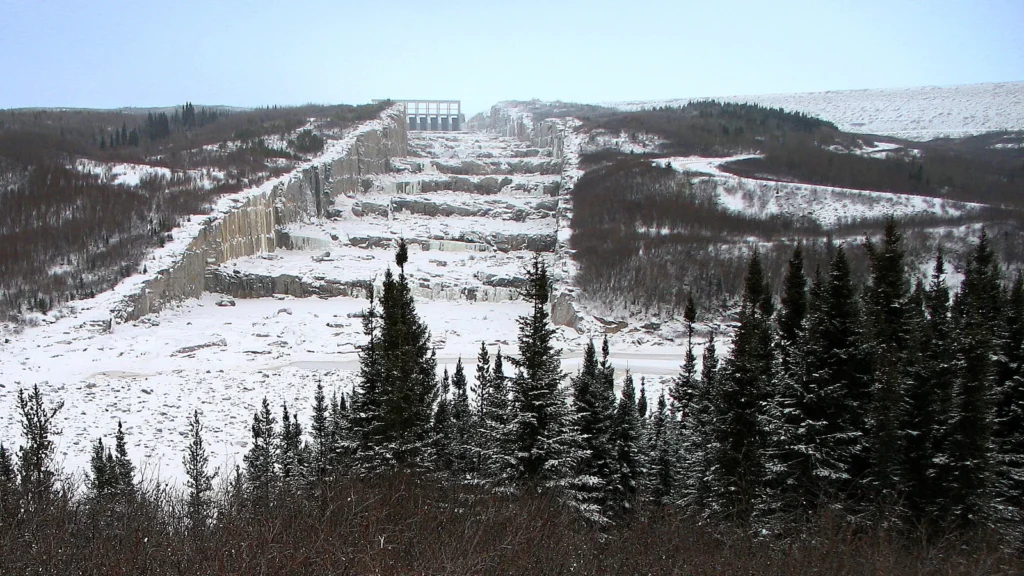
- Cover photograph: the Robert-Bourassa spillway and dam, Québec, December 2005. P199 / Wikimedia Commons, CC BY 2.5; cropped and resized.