India removed most industrial licensing requirements in 1991. The word “socialist” stayed in the Constitution. What changed was how businesses could operate, not the wording of the Preamble.
India’s Preamble calls it a socialist republic. The Forty-second Amendment Act of 1976 added the word, effective January 3, 1977. In its 2024 decision, the Supreme Court read it as a commitment to welfare and equality of opportunity, not a requirement to adopt one economic model. India has both private and public enterprise.
How to use this article: Compare the original and amended wording, read what the Court actually said, and see how private and public power capacity compare.
Constitutional wording
January 1977 • Constitution, Preamble note
Use this to check the official description of the Republic.
Ownership in one industry
March 2026 • Central Electricity Authority
Use this to check the mix of public and private generating capacity.
1. When “socialist” entered India’s Constitution
The original Preamble already promised social and economic justice. The 1976 Act changed how the Republic was described; it did not put those goals into the Preamble for the first time.
How the wording changed
| Date | What happened |
|---|---|
| The Constituent Assembly adopted the Constitution. The Preamble said “sovereign democratic republic” without the word “socialist.” | |
| 1976 Act | Section 2 added “socialist” and “secular” to the description of the Republic. The Preamble change took effect on that date. |
| The government’s industrial policy removed most industrial licensing and narrowed the list of industries reserved for the public sector. The Preamble wording did not change. | |
| The Supreme Court dismissed petitions challenging the additions and explained why “socialist” did not prescribe one economic model. |
The two years describe different events: 1976 is in the name of the amendment Act; 1977 is the year the new wording took effect. Both appear in the footnote to the Preamble in the Legislative Department’s consolidated Constitution.
2. What “socialist” means in the Constitution
What the Supreme Court decided in 2024
In Balram Singh v. Union of India, the Court rejected the claim that the word ties an elected government to a particular economic policy. It linked the term to social and economic justice and equality of opportunity. It also pointed to Article 19(1)(g), which protects citizens’ right to practise a profession or carry on a business. Article 19(6) allows reasonable restrictions in the general public interest and laws providing for state-run activity, even where that activity excludes private firms.
In economics, “socialist” usually describes who owns or controls productive assets such as factories or power plants. The Court was answering a different question: what India’s Preamble requires of the state.
Article 39 gives a separate look at the Constitution’s policy goals. It calls for distributing ownership and control of material resources to serve the common good and avoiding concentrations of wealth that harm it. Those are directions for policymaking, not a list of assets that must belong to the government. The Court’s order likewise did not approve every individual policy: it expressly referred to constitutional rights and the Constitution’s basic structure as limits.
3. What the 1991 reforms changed in practice
Under the July 1991 industrial policy, a licence stopped being the default for most industries, though specified exceptions remained. A separate 1991 change to electricity law allowed private participation in power generation. It did not open electricity distribution to private firms at the same time. The distinction matters: running a power plant and delivering power to customers are different activities.
Who accounted for India’s power capacity in March 2026?
On March 31, 2026, the private sector accounted for 52.3% of India’s 532.7 GW of installed power capacity. The Central Electricity Authority recorded 278.6 GW in the private sector, 130.0 GW in the state sector and 124.1 GW in the central sector.
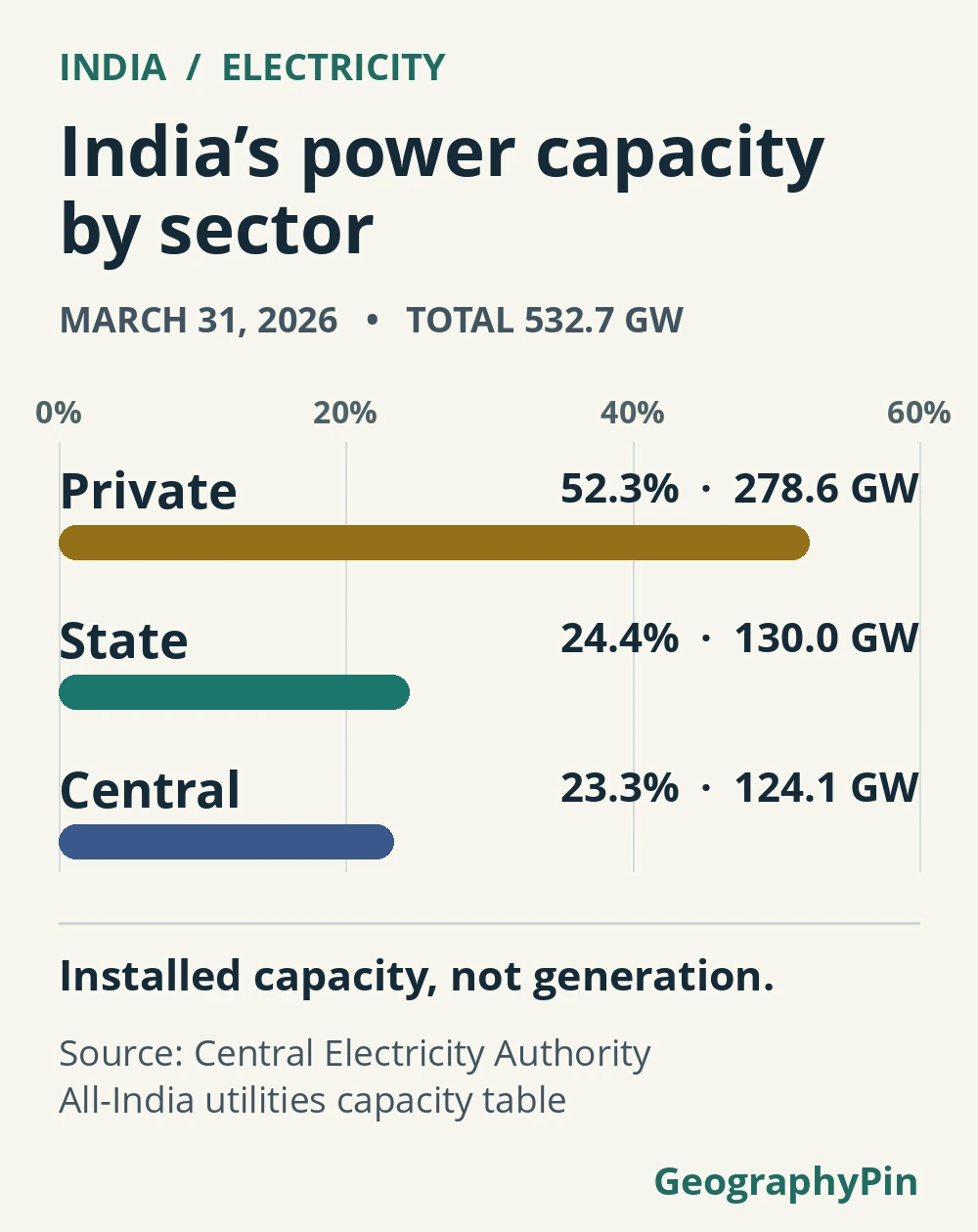
This is installed capacity, the power that equipment is rated to supply, not how much electricity it actually generated or delivered. The comparison shows public and private participation in the same industry. It does not measure the split across India’s whole economy or tell us how much of the 2026 mix was caused by the 1991 law.
For a comparison of how other countries use the socialist label, distinguish constitutional wording from the ownership of productive assets in each case.
Frequently Asked Questions
Can Parliament amend the Preamble again?
Yes. Paragraph 2 of the 2024 order says Parliament’s amending power under Article 368 extends to the Preamble. A constitutional amendment can still be challenged on grounds including a violation of the Constitution’s basic structure.
Can you take an Article 39 principle directly to court?
Not as an independently enforceable right. Article 37 says the Directive Principles, which include Article 39, cannot be enforced by a court. It also says these principles are fundamental to governance and that the state must apply them when making laws.
Does the private sector’s 52.3% tell us how much electricity it generated?
No. The denominator was India’s 532.7 GW of installed capacity on March 31, 2026. A gigawatt measures power; a gigawatt-hour measures energy. To find the private sector’s share of electricity produced, compare generation in gigawatt-hours over the same period.
What Did We Learn Today?
The word “socialist” tells us about a commitment in India’s Preamble, not who owns every business. The 1991 reforms and the mix of public and private power capacity show how economic policy can change without removing that commitment.
Sources & Data Notes
The March 31, 2026 capacity total includes off-grid solar. The chart rounds gigawatts and sector shares to one decimal; the Ministry of Power reports the underlying total as 532,740 MW.
View constitutional, electricity and image sources
- Government of India: Constitution as of September 10, 2026. Preamble footnotes and Articles 19, 37, 39 and 368. See also Section 2 of the Forty-second Amendment Act.
- Supreme Court of India: Dr Balram Singh and Others v. Union of India and Another, 2024 INSC 893, paras. 2, 5 and 7. See the Court’s 2024 judgment summaries for the same case.
- Ministry of Industry: Statement on Industrial Policy, July 24, 1991 (archived copy), decision 39, sections A and D; Reserve Bank of India: State Finances, 2019–20, annex “Power Distribution – the History of Reforms and Government Programmes.”
- Ministry of Power: All-India Power Sector at a Glance, March 31, 2026. Page 1 gives the Central Electricity Authority’s installed-capacity breakdown by sector.
- Stanford Encyclopedia of Philosophy: Socialism, section 1, for the separate economic meaning based on social ownership or control.
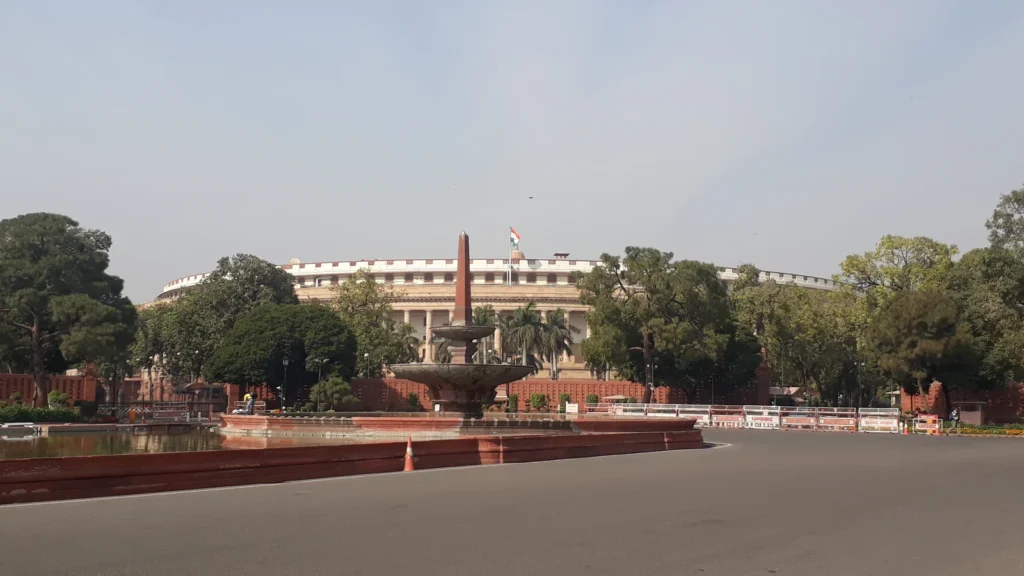
- Old Parliament of India photograph: Pinakpani, Wikimedia Commons, January 2019, CC BY-SA 4.0. The cropped cover is shared under the same license.